




Violent Riots Sweep Through Paris Over Weekend
Residents are reeling from the destruction and chaos caused by waves of violent riots that swept through the city over the weekend.
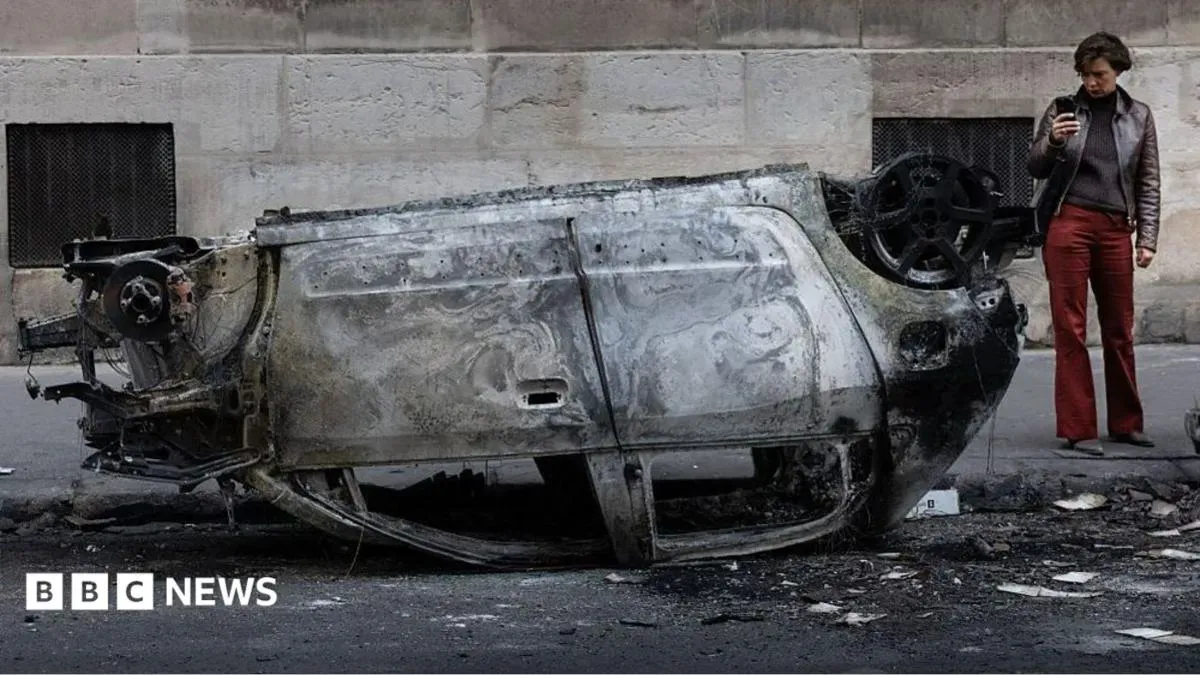
Tensions are running high in Paris after a wave of violent riots swept through the city over the weekend. The destruction and chaos have left residents like Elisabeth shaken, who pointedly rejected the notion that these actions represent the face of France.
Elisabeth's words were spoken in front of a row of shattered shop windows on a tree-lined street in central Paris. The walls surrounding her were daubed with graffiti insulting French police, bearing the date 17 October - the day the riots unfolded. This was not an isolated incident; similar vandalism was seen across the city.
When approached by passersby, Elisabeth and her friend struggled to articulate their thoughts on the matter. Her friend expressed concerns that the violence might signal a descent into civil war, but Elisabeth disagreed, describing Saturday's events as something different altogether.
As for what exactly happened over the weekend, theories are emerging - some more plausible than others. While many of the acts of vandalism appear opportunistic, there is evidence to suggest that some of the violence was pre-planned. The question remains: why now, after weeks of student protests?
Different groups and individuals have their own explanations for the riots, but it's clear that multiple factors are at play. To shed more light on the situation, the president of the National Assembly has proposed a parliamentary inquiry into the events surrounding the riots and how they were organized.
The weekend's violent riots in France have sparked intense debate over who is responsible for the chaos and what can be learned from it. A video shot on Saturday shows groups of young men dressed in black, with their faces hidden behind a kerchief, attacking police vans with large hammers or machetes.
A recent intelligence report suggests that student unions and radical left-wing political movements have been manipulating demonstrations to further their own agendas. The report, dated 29 September, reveals that the far-left movement La France Insoumise (LFI) has been relying on violence as an electoral strategy ahead of the 2027 presidential elections.
The scale of the looting is staggering, with reports suggesting over 3,000 shops and businesses were targeted. Many of those involved seemed to be motivated by opportunism rather than any deeper ideological commitment. Some even failed to cover their faces, suggesting a sense of impunity.
Online sales platforms have pledged to work with French authorities to track down the looters and recover stolen goods. Police are examining CCTV footage and social media posts in an effort to identify those responsible for the violence and theft.
Some politicians are calling for measures to prevent further violence, including social media blackouts. Former Prime Minister Gabriel Attal has suggested that selected blackouts could help quell the unrest and restore order.
Belgium is also experiencing violent protests, with its Interior minister warning of the "TikTokisation of violence. He blames the spread of riot footage on social media for inspiring impressionable young people to join in the chaos, as well as known far-left groups for fomenting the unrest in Brussels and Liege.
Prime Minister Sebastian Lecornu has joined Interior Minister Laurent Nunez in accusing far-left groups of fanning the flames of Saturday's unrest, describing their actions as pouring oil onto the fire.
Nunez's comments echo earlier statements from Lecornu, who on Tuesday described the disturbances as insurrections planned by small far-left and ultra-left groups. This is not the first time Lecornu has implicated the far left in such protests, having previously accused them of weaponizing student demonstrations for their own ends.
The leader of the anti-capitalist La France Insoumise (LFI) party, Jean-Luc Mélenchon, has strongly denied these allegations. Mélenchon himself participated in Saturday's planned protest and has been a vocal presence at student-led demonstrations in Paris' socially deprived outskirts since they began last month.
These protests have centered on demands for better state education for all, with students organizing themselves through social media messaging or student-led organizations. Lisa Cordat of the FSE student union, speaking to me in the Saint-Denis suburb on Monday, dismissed suggestions that students were being manipulated by politicians, calling it insulting to imply they were being told what to do.
Student anger, according to Cordat, arises from grassroots frustrations rather than external influences. This sentiment was echoed by Lisa's words: Student anger comes from the ground up.
Mélenchon, currently polling second place behind centrist candidates, has accused Prime Minister Lecornu of being responsible for the chaos that unfolded over the weekend. Mélenchon's statement implies a sense of deliberate inaction on the part of the government.
The accusation suggests that Lecornu allowed the violence to unfold as a way to rebrand itself as a party of order, thereby diverting attention from its own failures in managing public finances. France is currently grappling with spiraling public debt and increasing government borrowing costs.
President Macron has demanded explanations for the intelligence failures on Saturday, calling for a new policing strategy to be implemented. The Interior Minister acknowledged that there were insufficient police officers on duty, despite advance warnings of nationwide protests.
The heavy-handed tactics employed by police at earlier demonstrations have raised concerns about their preparedness and training. It appears that they were caught off guard by the scale and ferocity of the weekend's violence.
Marine Le Pen, leader of the National Rally Party, has capitalized on the chaos to further her own presidential ambitions. Her party's anti-immigration stance has resonated with some voters who feel disillusioned with mainstream politics.
Le Pen used social media to address the nation on Sunday, launching a video message that blamed Mélenchon and his associates for inciting violence. She accused the Macron government of being unable to cope with the situation, leaving France hostage to violence and powerlessness.
As protests continue to rock France, a growing number of citizens are questioning the role of migrants in the country's recent unrest. The far-right Le Pen party has been quick to capitalize on the situation, blaming migrants and others for the chaos that erupted over the weekend.
However, not everyone agrees with this assessment. A teacher, who wished to remain anonymous, expressed her frustration at the way politicians are using the violence to further their own agendas. It suits politicians' purpose," she said. "It distracts from weeks of legitimate protests for better public services."
The teacher's comments reflect a growing sentiment among young people in France and beyond. Many feel that traditional political parties are no longer listening to their concerns or addressing their needs. This disillusionment is not unique to France, with similar sentiments being echoed in other European countries.
Youth-led protests have erupted in several nations over the past weekend, including Italy, Portugal, Albania, France, and Belgium. These demonstrations are often sparked by issues such as rising living costs, deteriorating public services, and a sense of powerlessness among citizens.
As people struggle to make ends meet, they are increasingly asking what can be done about their rising energy costs, which are being driven up by conflicts in the Middle East and Ukraine. The young generation is particularly concerned about climate change, social inequality, and the impact of technological advancements on their job prospects.
Opinion polls conducted this year by Pew reveal a stark picture of disillusionment with democracy across several countries, including France, Spain, Italy, and the US. In France, 69% of people are dissatisfied with democracy, while in Spain it's 68%, and in Italy, 62%.
France is grappling with the aftermath of the recent riots, with many emphasizing the need to distinguish between peaceful protesters and those engaging in destructive behavior.
The widespread unrest has left a trail of damage across the country, with Marseille bracing for further turmoil as protests give way to chaotic disorder described by some as "apocalyptic".
Facts based on reporting originally published by BBC News World.
You may republish this story, in full or in part, if you credit Noti Group and link to it (licence CC BY 4.0). Photos are not included.