








Failed Execution in Tennessee Prompts Investigation
An investigation has been launched after Christa Pike survived an attempted execution by lethal injection.
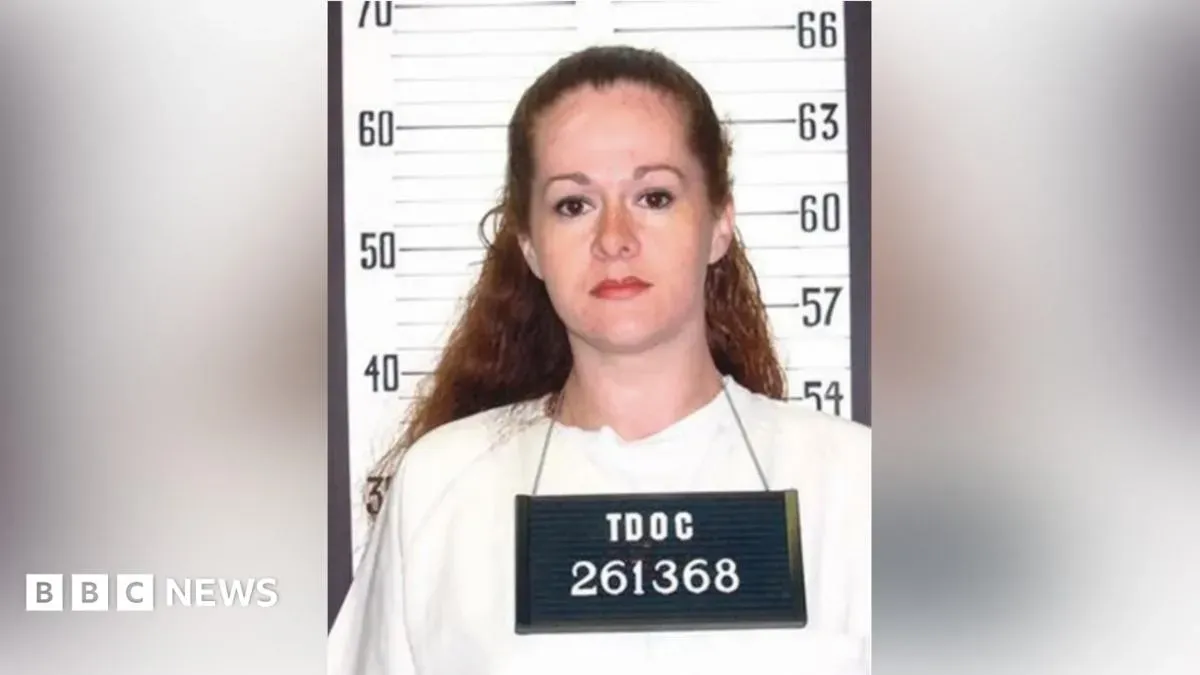
Executions in Tennessee are on hold until the end of the year after a botched attempt to put Christa Pike to death by lethal injection. The failed execution has prompted an investigation and raised questions about the state's capital punishment procedures.
Governor Bill Lee expressed disappointment over the incident, describing it as one of the state's most critical responsibilities. He announced that an independent review would be conducted to examine what went wrong during the attempted execution. This review is expected to be thorough and time-consuming.
Tennessee prison officials attempted to administer two lethal doses of pentobarbital to Christa Pike, but she survived and was taken to hospital for treatment. Her medical condition remains unclear at this point in time. The incident has sparked concerns about the state's ability to carry out executions safely and humanely.
Christa Pike, a 50-year-old woman, was sentenced to death in 1996 for her role in the murder of Colleen Slemmer when she was just 18 years old. This would have been Tennessee's first female execution in over two centuries if the lethal injection had succeeded.
The decision to halt all executions in Tennessee comes as a surprise, coinciding with plans to carry out the execution of Gary Sutton on 3 December. This development is likely to raise questions about the state's lethal injection protocol.
Pike's lawyers have expressed concern that their client needed immediate medical attention after the botched execution attempt, highlighting the need for life-saving measures. The Tennessee Department of Correction has defended its handling of the case, stating that it followed established protocols approved by the attorney general's office.
The department claims to have adhered strictly to the state's lawful and established execution protocol, which does not allow for additional procedures beyond what was carried out during Pike's attempted execution. However, court filings reveal that two doses of pentobarbital were administered, but still failed to result in a successful lethal injection.
As investigators look into the circumstances surrounding Pike's near-execution, her lawyers are calling for an end to her "unnecessary agony. The state's attorney general has agreed with the decision to launch an investigation, emphasizing the need to determine what went wrong during the execution attempt.
The botched execution of Christa Pike has left many questioning the state's handling of capital punishment. May Martinez, whose son was a victim of Pike, expressed her disappointment at the failed attempt, describing it as a mess. Her words reflect the sense of frustration and disillusionment that has been building among those who advocate for swift justice.
The incident has also sparked a heated debate among politicians in Tennessee. Republican Senator Marsha Blackburn called the situation tragic and suggested that the electric chair be reinstated as an alternative method of execution. However, her opponent, Democrat Jerri Green, took issue with this proposal, labeling it one of the most cruel forms of capital punishment".
Green's criticism highlights the deep divide in opinions on the matter, with some advocating for a more humane approach and others pushing for a return to traditional methods. The recent failure is not an isolated incident; it marks the second time in 2026 that Tennessee officials have struggled to carry out an execution.
The state will now conduct a thorough review of what went wrong during the execution attempt, with the aim of preventing similar incidents in the future.
Facts based on reporting originally published by BBC News World.
You may republish this story, in full or in part, if you credit Noti Group and link to it (licence CC BY 4.0). Photos are not included.