








Apple Releases New Apple Silicon iMac Model
This latest update marks the fourth refresh of the Apple Silicon iMac this month.
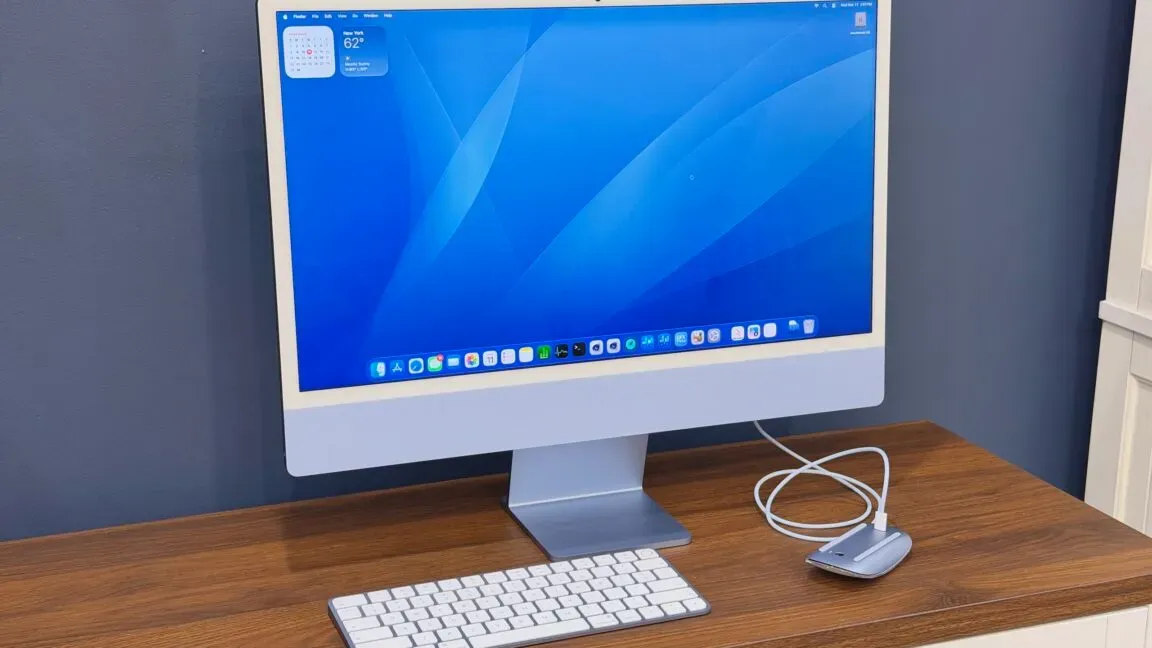
A new iteration of the Apple Silicon iMac has been released, marking its fourth refresh this month. This latest update is part of a broader trend in Apple's Mac lineup, where every other model has undergone significant design changes over the past five years.
The MacBook Pro, for instance, now boasts a more professional design, while the Mac mini has shrunk down to become even smaller. Meanwhile, the Mac Studio has effectively replaced the Mac Pro as the top-of-the-line workstation computer. However, the Apple Silicon iMac has continued to stick with its original design concept.
Its sleek and screen-on-a-stand design is reminiscent of the Bondi Blue G3 iMac from years ago. The new model still looks clean and pretty, often found in small offices or featured on TV shows that depict such settings. It's been some time since this design was Apple's primary workstation computer.
The entry-level buyer for an iMac typically chooses it because of its simplicity and ease of use. They might be considering a step up from the M1 model or comparing it against an older refurbished M4 model. What exactly does this new iteration offer that would make it worth upgrading?
To understand the new iMac's appeal, let's take a look at what sets it apart from earlier models. The Apple Silicon era has brought about significant changes to the iMac's design.
The latest iMac is noticeably thinner than its aluminum Intel predecessors, with a mostly seamless 24-inch screen as its main feature. This large display is framed by a thick white bezel on all sides, but it would be nice if black were an option, unfortunately, Apple seems to disagree.
The M6 iMac's design is where things get really interesting - it's by far Apple's most colorful computer to date. The entire system is shipped with color-matched components, including the front, back, stand, keyboard, mouse, trackpad, and even cables.
While the color palette has undergone some tweaks over the years, the M6 iMac sticks to a familiar six-color scheme - plus silver. This consistency makes for a cohesive look that's sure to catch the eye.
The base $1,499 model is essentially a stripped-down version of the iMac, with limited ports and capabilities. It features two Thunderbolt ports on the back and a headphone jack on the left side, similar to a MacBook Air.
This entry-level model also comes with a lesser version of the Apple M6 chip, boasting 10 CPU cores and 10 GPU cores instead of the full 12. The maximum RAM is capped at 24GB, while storage tops out at 1TB. The default keyboard lacks Touch ID support, but can be upgraded to include this feature for an additional $80.
Moving up to the $1,699 model offers a significant upgrade in terms of performance and features. This version includes the full-speed M6 chip with all its cores intact, as well as options for 32GB of RAM and up to 2TB of storage.
One notable addition on this higher-end model is four Thunderbolt ports on the back, allowing for easy connections to additional accessories. Both available keyboards on this version also feature Touch ID support.
For an extra $30, a 2.5 gigabit Ethernet port can be added to any iMac - and it's a clever solution that keeps even wired Internet connections hidden beneath the desk. Additionally, all iMacs offer a VESA mount adapter option in place of the default stand at no extra charge.
The design of Apple's M6 iMac is undoubtedly one of its most striking features. A color-matched keyboard, mouse/trackpad, and cables create a cohesive look that's hard to resist. The white bezel even complements the white keycaps and mouse perfectly.
However, it's essential to acknowledge that this sleek appearance comes with a hefty price tag. For those seeking a similar setup without breaking the bank, consider the $899 Mac mini as an alternative. This compact device offers comparable specs at a significantly lower cost.
The iMac's focus on style and convenience is its defining characteristic. It's not uncommon for manufacturers to upcharge for premium features, but Apple takes this approach to the next level. Whether or not this aligns with your budget and needs is a matter of personal preference.
A glance back at previous iMac models reveals a gradual evolution during the Apple Silicon era. Notably, the base storage capacity has remained unchanged, and even the M6 model still only supports a single external display in its base configuration.
If you're content with your current iMac's performance and don't feel the need for additional RAM or displays, there may not be sufficient justification to upgrade to the M6 model. The Apple M1, despite being six years old, remains more than capable of handling daily tasks when paired with 16GB of RAM.
In fact, if you're in the market for a new iMac now, it's worth considering the refurbished or sale-priced M4 model as an attractive option. This configuration still offers a minimum of 16GB of RAM and other desirable features like Thunderbolt ports and support for multiple external displays.
The decision to upgrade to the M6 model ultimately depends on your specific needs and priorities. If you value the latest and greatest technology, it may be worth the investment. However, if budget is a concern or your current setup meets your requirements, there are more affordable alternatives available.
The M6 iMac's performance benefits are undeniable, but they come at a cost that may be prohibitive for some users. A closer look at the specs reveals that the M6 is essentially a refinement of the previous model rather than a revolutionary upgrade.
One of the key differences between the M4 and M6 models lies in their silicon architecture, which has been tweaked to introduce neural accelerator hardware to the GPU cores. This addition boosts the speed of local AI workloads, including MetalFX upscaling and frame generation in games. As a result, users can expect improved performance in certain applications.
The M6's CPU and GPU configurations have also seen significant upgrades, with 12 CPU cores (two super cores, four performance cores, six efficiency cores) and either 10 or 12 GPU cores now available. The Neural Engine NPU has been doubled to 32 cores from 16, further enhancing the iMac's processing capabilities.
In terms of real-world performance, the M6 in the Mac mini and MacBook Pro perform similarly within a roughly 28 W sustained power envelope. However, there are some minor differences in memory bandwidth, with the 16GB version offering slightly lower performance in games and other workloads sensitive to memory speed.
The iMac's M6 consumes an average of 18 W of power under heavy load, which is significantly less than the Mac mini or MacBook Pro. This reduced power envelope results in slower performance compared to those two machines, particularly in multi-core CPU benchmarks and graphics tests.
HandBrake video encoding test results reveal the likely cause of this disparity: the iMac's M6 throttles its speeds more aggressively due to its lower power consumption. While this may be a deliberate design choice to prioritize efficiency over raw performance, it has consequences for users who require maximum processing power.
In summary, while the M6 iMac offers improved performance in certain areas, its reduced power envelope and lower memory bandwidth result in slower overall performance compared to other Macs with similar silicon configurations.
The M6 iMac's reduced power envelope comes with a significant benefit: it is even more power-efficient than its regular M6 and M4 counterparts, consuming much less energy to perform the same tasks.
This efficiency makes the iMac's M6 chip a solid upgrade over the M4, delivering improved performance across various benchmarks. In single-core CPU tests, the iMac's M6 outperforms by 15 to 20 percent, while multi-core CPU and graphics tests see improvements of 20 to 30 percent and 20 to 40 percent respectively.
When paired with sufficient RAM, such as 24GB or 32GB, the M6 iMac is more than capable of handling demanding tasks like running multiple monitors or light photo/video editing. Its performance in these areas makes it an attractive option for users who require a reliable workstation setup.
The introduction of the M6 chip does not fundamentally alter the iMac's purpose, position within Apple's lineup, or its technical capabilities. Instead, it serves as a minor upgrade that maintains the iMac's status quo.
For those seeking a hassle-free computing experience, the iMac remains an excellent choice, particularly for users who prefer a desktop over a laptop and don't require complex setup configurations. Its user-friendly interface and minimal maintenance requirements make it ideal for office environments or public kiosks.
The M6 iMac is well-suited for its traditional user base, individuals seeking a straightforward computing experience without the need for extensive customization or technical expertise. Its limitations, however, become apparent when compared to more flexible desktop options like the Mac Studio.
The iMac's appeal lies in its ability to simplify cluttered workspaces, offering a sleek and streamlined solution for those who prioritize aesthetics over complex functionality.
A clean desk is just what some users need, and Apple's M6 iMac delivers that promise with ease, but it falls short when compared to more versatile options.
Facts based on reporting originally published by Ars Technica.
You may republish this story, in full or in part, if you credit Noti Group and link to it (licence CC BY 4.0). Photos are not included.