








Amazon Expands Robotic Workforce Significantly
Amazon's robotic workforce is set to expand significantly as new factories are established to produce sophisticated robot workers.
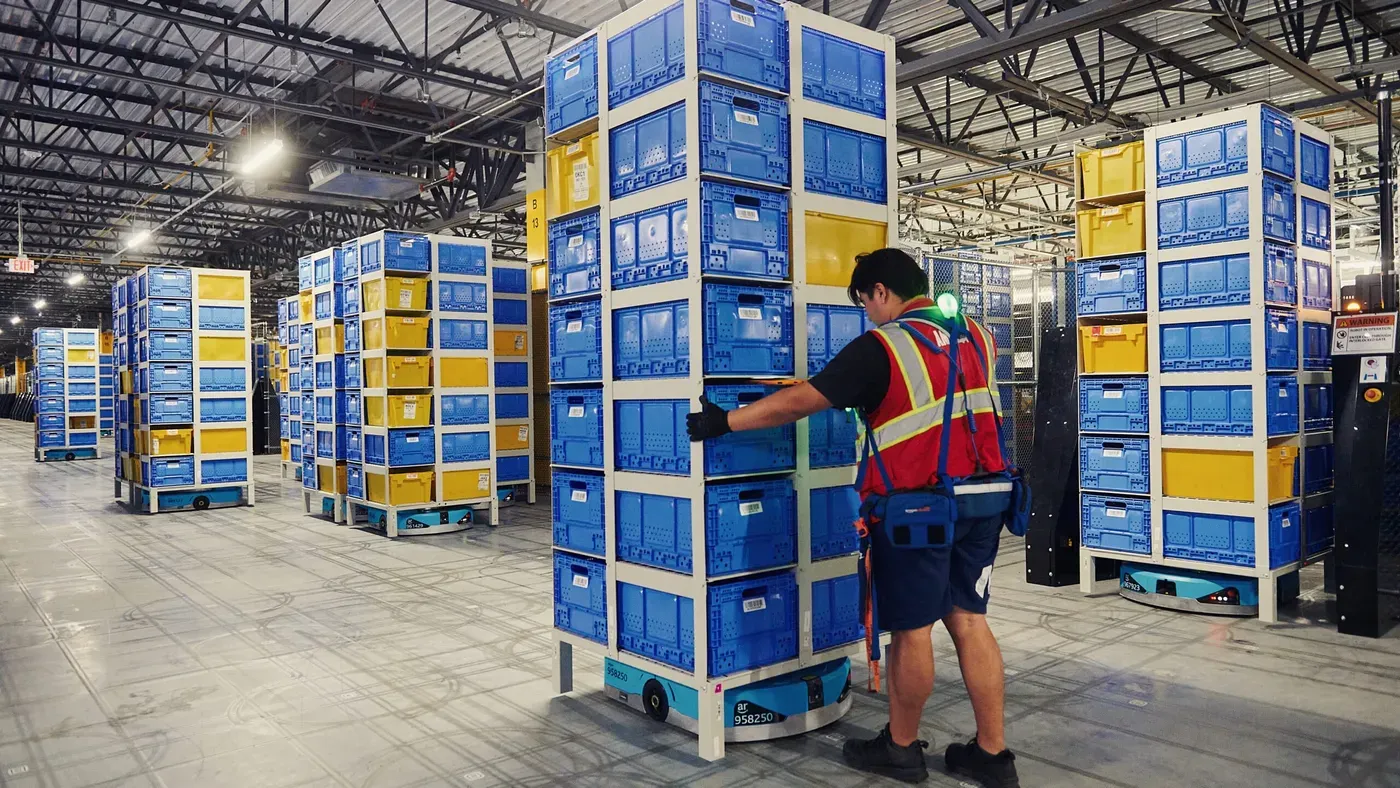
Amazon's vast robotic workforce is set to expand significantly in the coming years as the company establishes new factories to produce increasingly sophisticated robot workers. With over 1 million robots already operating in warehouses around the clock, Amazon's fleet is unmatched by any other organization worldwide.
The sheer scale of Amazon's robotic operations is staggering, with tens of millions of same-day and one-day package deliveries happening daily thanks to these machines. This massive workforce is a testament to the company's dedication to meeting the demands of its 200 million Prime subscribers who expect speedy delivery of their purchases.
Amazon's deployment of robots has also had a profound impact on its human workforce, with over 1.5 million full-time and part-time employees working for the company worldwide. According to Amazon executives, the growing robot fleet has eased the burden on its human workers by taking on the toughest tasks that carry the greatest risks of physical fatigue and injury.
However, labor advocacy groups and independent researchers have raised concerns about the impact of warehouse automation driven by AI on human workers. They point to evidence suggesting that while robots may be taking on some of the toughest tasks, they are also creating new challenges for employees who work alongside them.
The introduction of collaborative robots has changed the dynamic between humans and machines in the workplace, say experts. Collaborative robots really change that dynamic, notes Brian Greenwood, professor of business at George Mason University. It's physically proximate, and the robot dictates the pace of work.
Amazon's e-commerce fulfillment centers are among the most demanding workplaces in the retail industry, with hundreds of thousands of human employees working tirelessly to assemble and ship out customer orders. The relentless pace of work is perfectly suited to robotics and AI, which can process vast amounts of data and perform repetitive tasks with precision.
The growing reliance on robots and AI has significant implications for the future of work, particularly in industries where automation is already transforming job roles. As Amazon continues to invest heavily in its robotic workforce, it will be interesting to see how this trend affects employment patterns and worker safety in the years ahead.
The use of robots in warehouses is often justified by the need to alleviate workers from tasks that are considered "dull, dirty and dangerous". According to US Occupational Safety and Health Administration data, workplace injury rates in the warehouse sector have historically been more than double those found across all industries.
This trend is not surprising given the nature of work in warehouses. With millions of people employed in this sector, turnover and workplace injuries are common issues that companies like Amazon are working to address through automation.
Despite significant advancements in robotics, human workers still play a crucial role alongside their automated counterparts in Amazon's fulfillment centers. The company has developed a range of robotic systems designed to work in tandem with its human workforce, but these robots are not yet capable of handling all tasks on their own.
Amazon's acquisition of Kiva Systems in 2012 marked an important milestone in the development of its robotic fleet. Kiva was one of the first companies to pioneer wheeled mobile robots that bring items directly to workers, rather than requiring them to walk around and fetch goods from shelves.
Since acquiring Kiva, Amazon has rapidly expanded its robotics capabilities through a combination of internal manufacturing and strategic investments. The company now manufactures many of its robotic systems in-house at facilities in Massachusetts, with new production factories planned for Austin, Texas, and Greenwood, Indiana.
Amazon's focus on developing its own robotic technologies is driven by the need to improve efficiency and customer satisfaction. As Scott Dresser, vice president of Amazon Robotics, explained, the company aims to tackle complex technical challenges in order to make a meaningful impact on its customers' lives.
The majority of Amazon's million-robot fleet consists of wheeled mobile robots that can navigate warehouse aisles with ease. The company claims that its robotic Sequoia system can significantly accelerate item storage by coordinating swarms of these robots and streamlining the inventory process.
Amazon has also developed larger robotic systems, such as Hercules and Titan, which are capable of retrieving heavy loads from high shelves. These robots are designed to work alongside human employees at various workstations, freeing them up to focus on more complex tasks.
As Amazon continues to invest in its robotic workforce, it is likely that we will see further innovations in warehouse automation. The company's emphasis on developing its own technologies and manufacturing capabilities suggests a long-term commitment to leveraging robotics for business success.
Amazon's expansion into new production facilities underscores the scale of its investment in robotics. With more robots set to be manufactured in the coming years, it is clear that Amazon sees a significant future for automation in its operations.
Amazon's mobile robots are typically confined to grid-lined areas and fenced-in spaces, staying clear of human employees. However, the company's newest robot, Proteus, has advanced sensors that enable it to navigate freely around humans and objects.
The movement of multiple robots through narrow lanes can sometimes cause congestion. To mitigate this issue, Amazon developed its DeepFleet AI foundation models, which predict potential robotic traffic jams ahead of time.
Amazon is also increasing the number of robotic arms deployed in its facilities. These arms are capable of retrieving items from high storage pods, sorting packages, and placing them on carts or mobile robots for further processing.
The company's plans to expand its robotic arm fleet have been confirmed by Amazon CFO Brian Olsavsky during a recent earnings call. When questioned about the current number of deployed robotic arms, an Amazon spokesperson revealed that it is in the thousands.
Amazon initially acquired third-party robotic arms to handle heavy pallets and bins within its facilities. However, the company has since developed its own robotic arm technology, starting with Robin, which was first tested in 2021.
Robin represents a significant innovation in robotics, as it can sort individual packages from cluttered piles and identify items for picking and placement on mobile robots. According to Dresser, this milestone marked Amazon's attempt to tackle complex customer orders using advanced robotics.
The robotic arm's software analyzes the conveyor belt before taking action, quickly ranking possible picking actions based on a top-down view of the cluttered area. This enables the robot to efficiently select packages for processing and placement.
The Amazon Robotics team's early attempts at developing picking strategies for their robotic arms were hindered by limitations in each approach. One method prioritized larger packages but struggled when smaller items overlapped or lay on top of them. Another strategy focused on selecting packages near the top of piles, but this often failed to retrieve partially buried or "unreachable picks".
In response, the team shifted from hand-crafted algorithms to a machine learning-based approach. This involved training an AI model on over 394,000 picking actions from deployed robotic arms to estimate the probability of successful pick completion. The model then used an online pick ranker to prioritize optimal actions for the Robin robots.
The machine learning method outperformed traditional algorithms in a trial, achieving a success rate of 93.73 percent compared to 92.28 percent. This may seem like a small margin, but it translates to approximately 16,500 fewer failed picks during a period involving over 1 million total picks. For Amazon's operation, speed and efficiency at scale are paramount.
The Amazon Robotics team further demonstrated the effectiveness of machine learning in reducing failed pick rates by up to 20 percent during an experiment with 2 million picks by robotic workstations designed to mimic the operations of Amazon's Robin fleet. This research was presented at the International Symposium on Experimental Robotics in July 2025.
As the technology advances, it is being applied to new tasks within Amazon's warehouses. The Cardinal robot, capable of placing packages weighing up to 50 pounds into wheeled carts for transportation, began operating at a Nashville facility in November 2022.
The task of packing packages efficiently is akin to playing Tetris, with the goal of maximizing container density to reduce transportation costs and environmental impact. This focus on sustainability and cost-effectiveness is driving innovation in Amazon's robotic arms development.
Amazon's efforts to develop more efficient robotic arms have significant implications for the future of human work within its warehouses. As these machines become increasingly capable, they may assume a greater share of tasks currently performed by humans, potentially altering the nature of warehouse labor.
Amazon's robotic arms are becoming increasingly sophisticated, with Cardinal now being deployed in larger numbers to handle customer orders. This new system builds on lessons learned from Robin, which was capable of picking up and manipulating packages, but also adds the ability to densely pack items into carts.
Cardinal is not alone in its capabilities, however, as Amazon's Sparrow robotic arm has been developed to tackle an even more challenging task: handling the vast array of products that can go into customer orders. With hundreds of millions of different items to contend with, Sparrow focuses on consolidating partially filled containers to create densely packed totes.
When items are picked out for customer orders, Sparrow continually refills the totes, ensuring a smooth and efficient process. This level of complexity requires advanced AI capabilities, which Amazon's Robotics team has developed using foundation models.
These foundation models have enabled the team to efficiently identify and classify products, eliminating the need for manually coding every single item. As Dresser explained, this approach has greatly improved the development of new robotic strategies for grasping a wide range of products.
The success of Sparrow has also led to the creation of a foundation model for robotic perception that can handle new, never-before-seen products. This innovation will be crucial in future-proofing Amazon's fulfillment centers against the constant influx of new items.
Amazon Robotics team members have emphasized the importance of scalability and adaptability in their work. As Katyal noted during a presentation at the Intelligent Robots & Systems conference, building ad hoc perception models for every task and embodiment is not a viable solution due to its limitations.
Instead, the team has developed a generalized action model that can be used with different types of robotic arms, each with unique combinations of suction and finger grasping capabilities. This approach will enable Amazon's robots to adapt to new situations and tasks more easily.
The use of foundation models in robotics is a significant development, allowing for greater efficiency and flexibility in product handling and classification. As the demand for automation continues to grow, it remains to be seen how these advanced systems will impact human workers in warehouse settings.
Amazon's latest robotic arm, Vulcan, represents a significant advancement in warehouse automation technology. This innovative system combines vision capabilities with force feedback sensors that provide a sense of touch, enabling it to accurately pick out or stow away items within inventory pods.
The introduction of Vulcan is expected to address some of the limitations of previous robotic arms, which have primarily relied on vision alone. According to Amazon's experts, tasks such as inserting an item into a pod or creating space for new items are challenging with traditional non-touch-based systems, like suction-based systems used in Sparrow robots.
Vulcan has been deployed at select fulfillment centers in Spokane, Washington, and Hamburg, Germany, since 2025. While not yet widely adopted, the company plans to expand its use of this robotic arm by 2027, potentially leading to increased productivity and efficiency in warehouse operations.
Facts based on reporting originally published by Ars Technica.
You may republish this story, in full or in part, if you credit Noti Group and link to it (licence CC BY 4.0). Photos are not included.