







Venus' Lower Atmosphere Veiled by Accumulation of Meteorite Particles
Research has revealed that the yellowish haze surrounding Venus' lower atmosphere is composed of particles from meteorites that burn up in the planet's atmosphere.
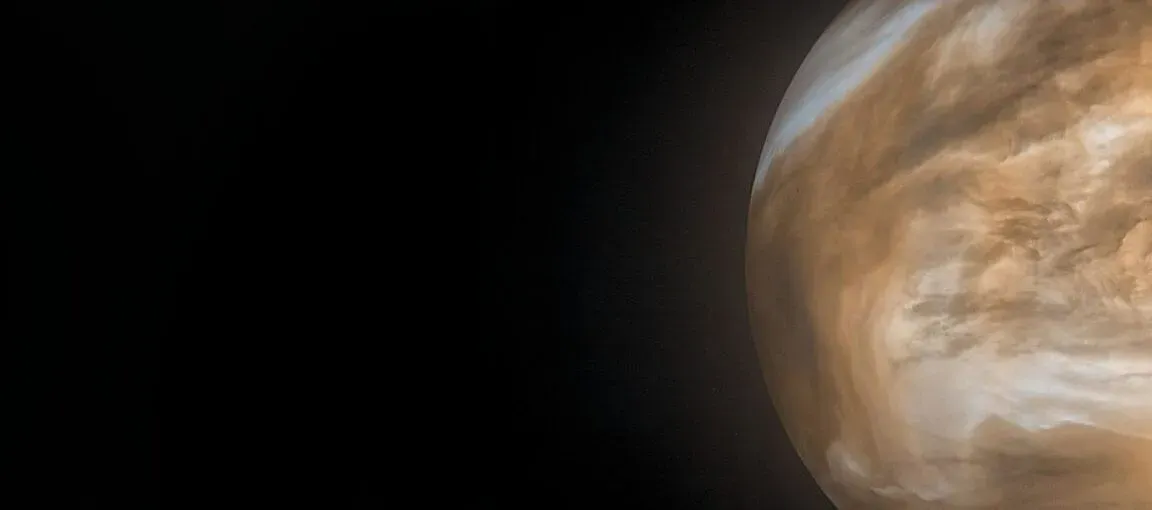
The planet Venus has long been shrouded in mystery, particularly when it comes to a veil of yellowish haze that surrounds its lower atmosphere.
This enigmatic haze was first detected by Venera and Pioneer Venus probes in the 1970s, which sent back images of the planet for the first time. However, the composition and origin of this haze remained unknown for decades, leaving scientists puzzled about its nature.
Research has now shed light on the mystery, revealing that the haze is actually an accumulation of particles from meteorites that burn up in Venus' atmosphere. These cosmic dust particles interact with sulfuric acid to form a haze that persists in the lower atmosphere.
Planetary scientist Hiroki Karyu and his team at Tohoku University in Sendai City, Japan, used a microphysical model to study the formation of this haze. This type of model examines the micro-scale processes that create clouds and precipitation on Earth and other bodies.
The team found that the continuous influx of cosmic dust is sufficient to sustain the lower haze layer, with particles from meteorites acting as efficient condensation nuclei that promote cloud formation even far from their initial source.
The notion that Venus' mysterious haze was formed from volcanic ash has been debunked by recent research. While it's true that Venus is incredibly volcanically active, with signs of its volcanic nature first detected by the Magellan spacecraft in the early 1990s, this activity does not seem to be responsible for the haze.
Surface dust was also found to be an unlikely culprit. Researchers discovered that even if there were significantly more dust particles on Venus' surface than previously thought, they would still be unable to interact with the planet's sulfur-rich atmosphere in a way that could form the haze layer.
The process of haze formation on Venus appears to be quite different from what was initially suspected. Instead of accumulating dust, the haze forms through a mechanism similar to how clouds are created on Earth. This involves tiny particles called condensation nuclei, which can range from volcanic ash and sea salt to dust and soot, floating around in the atmosphere.
These particles serve as a foundation for cloud droplets to form when water molecules bond to their surfaces, allowing liquid water to condense even if it's present in relatively low concentrations. This process eventually leads to the accumulation of clouds on Venus' surface.
As the meteorite particles plunge towards Venus' surface, they encounter gas particles that cause friction, leading to their rapid disintegration and scattering of smaller particles throughout the atmosphere.
These particles then provide a foundation for condensation to occur as sulfuric acid droplets form around them. The presence of these particles is crucial in increasing cloud production on Venus, but surprisingly, more particles don't necessarily translate to more cloud droplets.
Instead, several particles tend to stick together and merge into larger clusters before the sulfuric acid can condense around them. These clusters continue to grow heavier until they eventually sink into the lower atmosphere, where the scorching temperatures cause the sulfuric acid to evaporate.
The remaining naked particles then contribute to the formation of the dense haze that envelops Venus' surface, providing a key insight into the mysterious fog that has long been a subject of study for scientists.
The investigation into Venus' mysterious haze has taken a significant turn with the discovery that iron compounds are responsible for absorbing UV radiation in the atmosphere. Researchers had previously suspected that iron compounds might be the culprit, but this theory was not conclusively proven until now.
Iron sulfate, a compound found in meteorites, matches the properties of the haze, lending credence to the idea that it is a major contributor to the absorption of UV radiation. This finding is significant because it sheds light on the long-standing mystery of what causes the haze's unique behavior.
At certain heights above Venus' surface, around 40 to 50 kilometers or about 25 to 31 miles, the high energy of particles creates a barrier that prevents droplets of sulfuric acid from sticking to their surface. This phenomenon is known as a nucleation barrier and has important implications for our understanding of haze formation.
The discovery that iron sulfate particles are taken to the upper cloud layer by rising air currents, where they cool and become incorporated into sulfuric acid particles, provides strong evidence for this process. Previous observations had suggested this might be happening, but Karyu's team now has more concrete evidence.
This breakthrough has far-reaching implications for our understanding of haze formation on other planets. Upper hazes on gas giants like Jupiter have been extensively studied, but the microphysical processes that occur beneath their main cloud layers remain poorly understood.
Further research into how cosmic dust affects cloud and haze formation on planets like Jupiter, Saturn, and Neptune could provide valuable insights into these complex phenomena. The study of Venus' mysterious haze has already begun to shed light on some of the secrets surrounding other gas giants in our solar system.
The study's findings have significant implications for our understanding of planetary climates beyond Earth. Observing the metal layers in the atmospheres of gas giants like Jupiter and Saturn could provide valuable insights into how cosmic dust affects their climates.
This knowledge is also crucial for understanding exoplanets, which are distant planets that orbit other stars. By studying the role of cosmic dust in these celestial bodies, scientists can gain a deeper understanding of how planetary climates form and evolve over time.
Facts based on reporting originally published by Ars Technica.
You may republish this story, in full or in part, if you credit Noti Group and link to it (licence CC BY 4.0). Photos are not included.