







US Steps Up Efforts to Limit Beijing's Access to Advanced Semiconductors
The US government is increasing scrutiny of data centre operators in several countries, including Singapore, Malaysia, and Thailand, as part of efforts to limit China's access to advanced semiconductors.
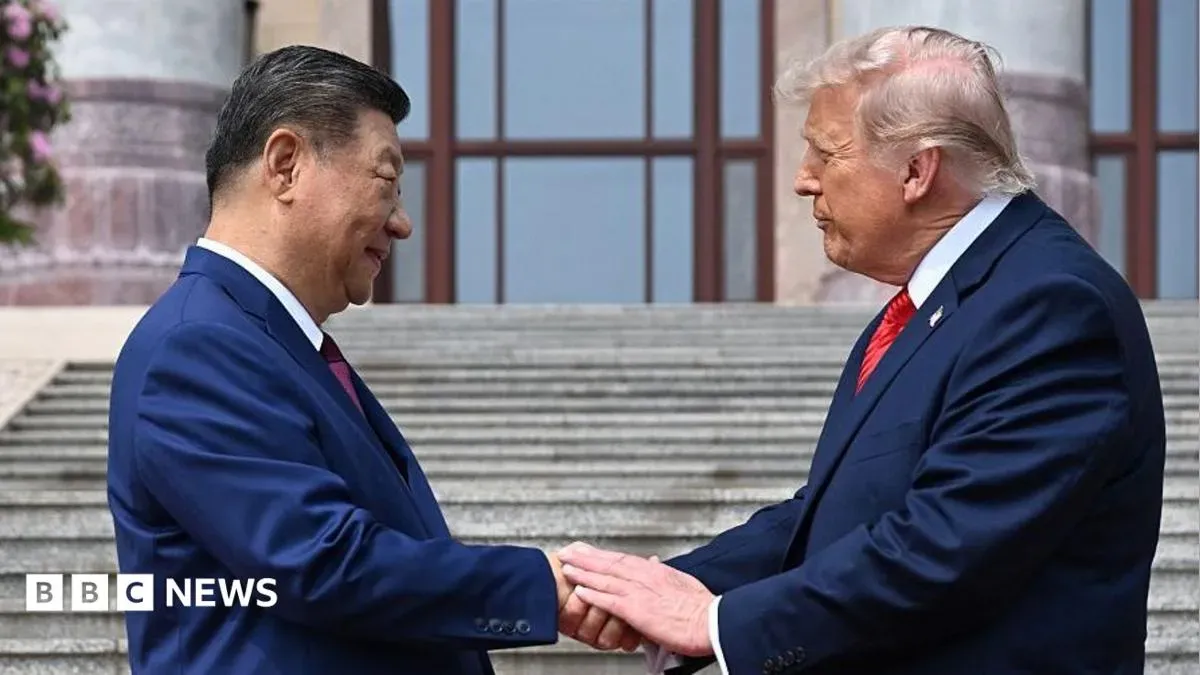
US President Donald Trump's administration has stepped up efforts to limit Beijing's access to advanced semiconductors as he prepares to visit China.
New interim rules announced on Monday will subject data centre operators in Singapore, Malaysia, Thailand, Indonesia, and Brazil to increased scrutiny by the US government. Data centres are crucial for training artificial intelligence (AI) models, and these countries have invested heavily in them to power their own AI ambitions.
Chinese firms have been renting computing power abroad to train their AI models, with many of these rentals coming from South East Asian countries. However, under the new rules, Chinese companies will need a US government licence to buy advanced chips from American manufacturers such as Nvidia.
At least 30% of China's advanced AI computing power is projected to come from renting overseas or smuggling in by 2027, according to research by the Institute for Progress, a US-based think-tank. This reliance on foreign compute poses a significant challenge for Beijing, which has become increasingly dependent on external sources due to US export restrictions.
China's foreign ministry has denounced new US export restrictions on South East Asia as "economic coercion", vowing to take measures to protect its interests.
This criticism comes at a time when several economies in the region are grappling with the implications of their reliance on advanced computing technology from external sources, including the US. The emergence of numerous data centres in countries like Malaysia, Indonesia, and Thailand has raised concerns about the potential for illicit activities.
Megaspeed, a Singaporean firm accused of helping China evade US export controls, is one such example. The company has been implicated in allegations that it smuggled Nvidia chips to Chinese companies after purchasing them for use in data centres across Southeast Asia.
The US Commerce Department's Bureau of Industry and Security has identified Brazil and four South East Asian nations as high-risk countries for diverting sensitive chips away from China.
These countries present a higher-than-normal risk due to the likelihood that Washington's desired restrictions on chip exports may be circumvented through data centres in third-party nations. The bureau aims to ensure that US technology cannot be exploited via remote computing arrangements involving such facilities, it has stated.
Malaysia and Thailand are likely to bear the brunt of these new measures, as their data centre expansions have been largely driven by Chinese buyers. According to international trade expert Naoise McDonagh from Australia's Edith Cowan University, this trend is expected to continue despite the restrictions.
Singapore, an early adopter in the region, has already begun limiting new data centre construction, but its neighbours Malaysia and Thailand are poised to capture the spillover demand with billions of dollars' worth of approved investments in Johor and Batam.
The region's efforts to attract foreign investment in data centres may be hindered by new restrictions on chip exports from the US. Countries such as Singapore, Malaysia, and Thailand have been offering incentives like cheaper land to woo companies, including Chinese tech giants Alibaba and Tencent.
In response to the new rules, Singapore has reached out to relevant US authorities for clarification and is exploring ways to facilitate trusted access to advanced chips for local firms. Meanwhile, Malaysia has stated its willingness to welcome data centre investment but will not compromise on export controls.
The timing of these restrictions comes as a significant challenge for Beijing's ambitions in AI development. The Chinese government has prioritized self-sufficiency in technology and relies heavily on accessing the best chipsets to build powerful AI models.
China is working to bridge the gap with its US rivals, who have reportedly maintained a six-and-a-half-month lead in AI model performance despite having better access to compute resources and financing.
Despite having a significant lead in AI model performance, China's reliance on advanced US chips remains a pressing issue for the country's top researchers. Experts warn that without access to these high-performance chips, China's best AI models will struggle to keep pace with international standards.
The new restrictions on South East Asia and Brazil have effectively eliminated one of the most viable routes for Chinese AI developers to access cutting-edge computing power, according to Bhattacharya. This development may prompt Chinese firms to focus on developing domestic semiconductors, which could accelerate innovation in the country.
This dilemma has been a longstanding concern for Washington policymakers, who must weigh the benefits of maintaining US dominance over the global chip market against the potential risks of restricting access to China.
Facts based on reporting originally published by BBC News Technology.
You may republish this story, in full or in part, if you credit Noti Group and link to it (licence CC BY 4.0). Photos are not included.