




Israeli Military Occupation Expands in Gaza Strip
The Israeli military occupation in the Gaza Strip has continued to expand, violating a US-brokered 'ceasefire' and forcing Palestinians into an increasingly smaller area of land.
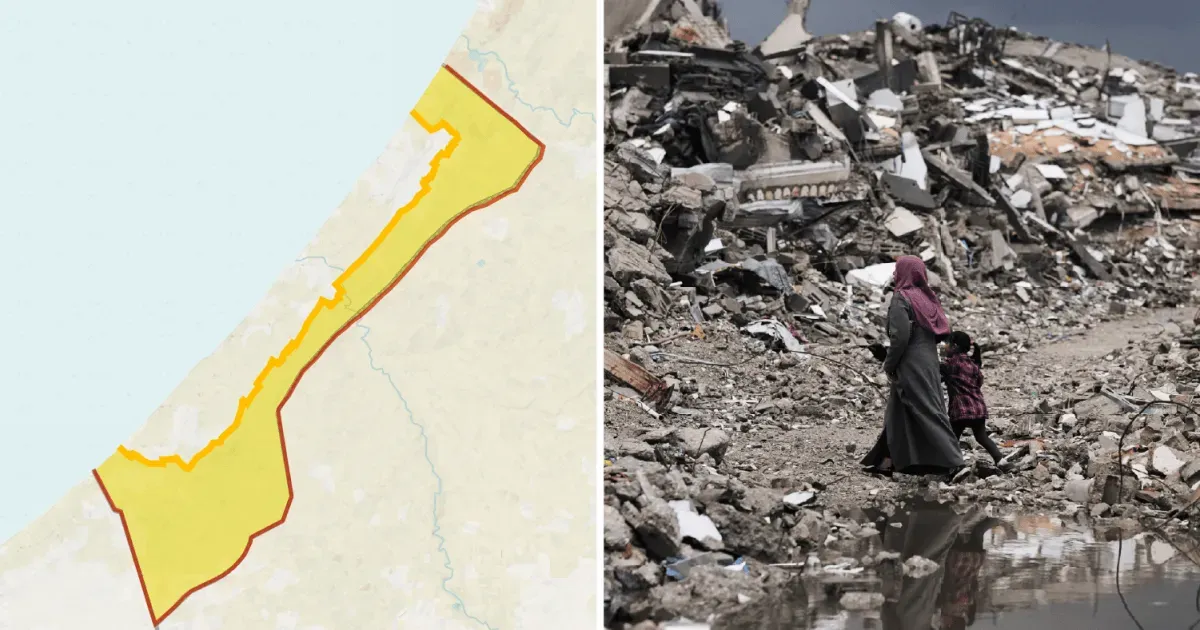
The Israeli military occupation in the Gaza Strip has continued to expand, violating a US-brokered 'ceasefire' and forcing Palestinians into an increasingly smaller area of land.
According to maps, nearly two-thirds of the territory is now under Israeli control or subject to access restrictions. The situation is particularly dire for families who have been repeatedly displaced by Israel's ongoing military operations in Gaza.
The original 'Yellow Line', established as part of a plan to end the war, was meant to mark the area from which Israeli forces would gradually withdraw. However, instead of pulling back, they have seized more territory and pushed the line further into Palestinian neighbourhoods.
In recent days, Israeli forces have moved concrete blocks dozens of metres west in Shujayea, a neighbourhood in southeastern Gaza City, forcing families to flee their homes. The move has brought more of the area under Israeli military control.
For families who have been displaced multiple times in recent years, the situation remains desperate. They are forced to make impossible decisions about where they can go and find safety.
The Gaza Strip's geography has long made it one of the most densely populated regions on Earth, with approximately 6,000 people per square kilometer. This density is comparable to that of cities like Nairobi and London, where each person averages around 160 square meters of land.
However, not all of Gaza's land was accessible even before the recent conflict. Israel enforced a buffer zone along its border with Gaza, which restricted Palestinians' movement and access to certain areas. According to a 2010 estimate by the United Nations Office for the Coordination of Humanitarian Affairs (OCHA), this restricted area covered nearly one-fifth of Gaza's land and over one-third of its farmland.
This limited accessibility was made worse by Israel's blockade, which has been in place since 2007. The blockade restricts the movement of people and goods in and out of Gaza, exacerbating the territory's already dire economic situation.
The "Yellow Line established under the first phase of the ceasefire marked a significant shift in Israel's control over Gaza. According to maps published on social media platforms, this line left Israel in control of roughly 53 percent of the Strip, mostly consisting of farmland and border areas in the east.
This division leaves Palestinians confined to around 47 percent of the territory, approximately 172 square kilometers in size. The impact of this division is evident in the limited access to resources and services that Palestinians have, further exacerbating their already dire living conditions.
The devastating effects of the ongoing conflict in Gaza are starkly evident in the territory's shrinking space and soaring population density. By October 2025, the war had claimed over 67,000 Palestinian lives, while tens of thousands more had fled the area, reducing Gaza's population to approximately 2.1 million.
As a result of this displacement, the remaining Palestinians were squeezed into less than half of Gaza's original territory under the terms of the ceasefire. This has led to an unprecedented density of around 12,000 people per square kilometre, comparable to the bustling metropolis of New York City.
The Israeli military has continued to extend its control over Gaza by incrementally moving the yellow concrete blocks marking the Yellow Line further west. These adjustments often occur under the cover of darkness, with satellite imagery revealing a pattern of ongoing demolitions in areas held by Israeli forces.
Research estimates suggest that Israel now controls around 58 percent of Gaza's territory as of December, while aid agencies have been provided with maps outlining a new orange line", a restricted zone beyond the "Yellow Line" where humanitarian movements must be coordinated with the army.
The cumulative effect of these measures is evident in the stark statistics: approximately 65 percent of Gaza is now subject to restrictions, according to the Office for the Coordination of Humanitarian Affairs (OCHA). The Israeli military claims control over around 70 percent of the territory, a claim corroborated by a UN official's testimony before the Security Council in June.
The living space for each person in Gaza has shrunk to approximately 61 square meters, a staggering reduction that encompasses not just residential areas but also essential infrastructure like roads, schools, hospitals, and farmland.
A significant portion of the territory is already uninhabitable due to extensive damage or destruction. According to UNOSAT, a staggering 82 percent of structures in Gaza are compromised, leaving little room for expansion or relief efforts.
The remaining land that could potentially be utilized is severely limited by access restrictions imposed by Israel. The UN Food and Agriculture Organization reports that only 3 percent of Gaza's agricultural land remains undamaged and accessible, exacerbating the crisis faced by aid groups attempting to relocate families before the onset of the rainy season.
The 'Yellow Line' has become a deadly boundary, with nearly 1,500 people killed across Gaza since the ceasefire was announced. Approaching this line can be perilous, as Israel treats areas beyond it as a free-fire zone, putting lives at risk for those who venture too close.
Facts based on reporting originally published by Al Jazeera.
You may republish this story, in full or in part, if you credit Noti Group and link to it (licence CC BY 4.0). Photos are not included.