






Genesis AI Secures $500 Million Investment for Artificial Intelligence Development
The investment will enable Genesis AI to further develop its artificial intelligence technology, which enables robots to perform complex tasks with precision.
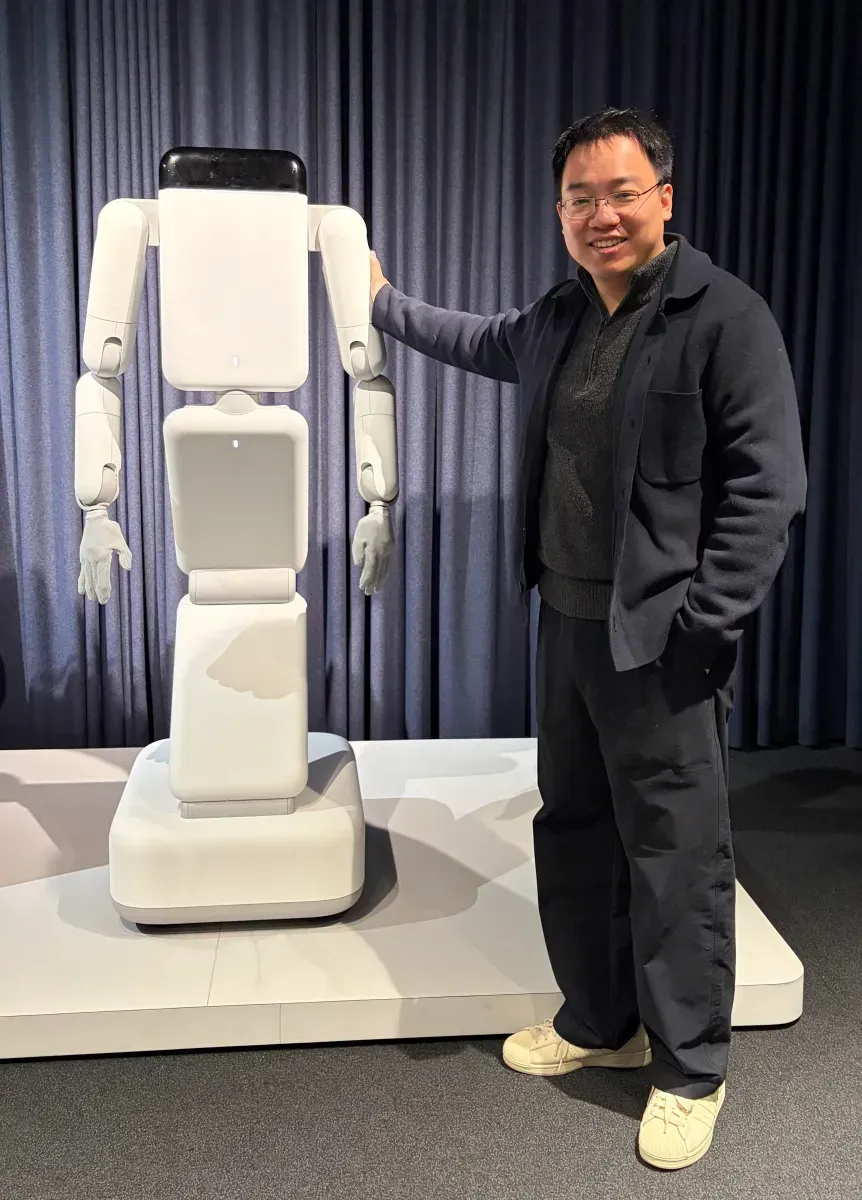
Genesis AI has secured a significant investment to further develop its artificial intelligence technology, which enables robots to perform complex tasks with precision. The company's CEO and co-founder Zhou Xian claims that his team has made a major breakthrough in "dexterous manipulation, allowing robots to interact with their environment in a more human-like way.
At Genesis AI's Silicon Valley facility, our team witnessed a demonstration of the technology's capabilities. Two robotic arms, purchased off-the-shelf, were programmed to perform a series of tasks, including picking up small cardboard boxes and placing them inside a larger box. The robot then folded the box closed, applied tape to seal it, and even attached a label from a strip of printer tape.
The demo was impressive, showcasing the kind of complex workflows that current robots struggle to accomplish. While Genesis AI wouldn't allow our reporter to experiment with the setup, the company did agree to re-run the presentation. During the second iteration, the robot encountered some difficulties, fumbling a box and struggling to remove a tiny adhesive label from the printer tape.
This mistake, however, can be valuable for improving the model. A Genesis executive described it as hiccup data, which can help refine the AI's performance in edge cases. This is exactly where the industry needs to focus its efforts, bridging the gap between lab demos and reliable automation.
Genesis AI has announced a $500 million Series A funding round, led by Khosla Ventures, Premji Invest, and Eclipse. This significant investment will enable the company to further develop its technology and bring it closer to practical applications in real-world settings.
Genesis AI's vertical integration strategy involves generating its own training data and developing its generative AI model in tandem with designing and constructing humanoid robots.
The company's focus on dexterity sets it apart from competitors, particularly when it comes to gathering the right data to achieve it. This is where Genesis' sensor-enabled gloves come in - worn by over 100 workers worldwide, they collect force data that feeds into the company's model.
These gloves are also used on the robots themselves, whose hands" are designed to mimic human proportions. According to Xian, this fidelity enables the robots' capabilities in tasks like sorting and wire manipulation.
The company has also invested heavily in simulation, leveraging a physics algorithm developed by one of its advisers, Minchen Li, to create millions of high-fidelity models of the robot's experience. This allows for more realistic training scenarios.
This significant investment in simulation technology will likely play a key role in further developing Genesis AI's robots and bringing them closer to practical applications in real-world settings.
Genesis AI's robots are designed to be more than just functional machines - they're meant to evoke a sense of style and sophistication. The company's flagship humanoid robot, Eno, is a prime example of this approach, boasting a design that pays homage to the late Steve Jobs' influence on tech aesthetics.
Eno's sleek appearance is not just for show; it reflects the company's goal of creating robots that are both capable and desirable. By emphasizing form as well as function, Genesis AI aims to make its robots appealing to a wide range of customers - from industrial users to consumers.
Despite having built 30 to 40 Enos, Genesis AI is being cautious about scaling up production. The company has chosen a mass-manufacturing contractor in the US and finalized the design for the mass-produced version, but it's not yet ready to share details on how many units will be produced next year.
Genesis AI is currently piloting Eno with a handful of undisclosed customers as part of its testing process. This real-world feedback is crucial for refining the robot's capabilities and identifying areas where improvements are needed.
The company recognizes that hardware capability remains a significant bottleneck in developing more advanced robots. The mechanical design and supply chains required to produce industrial-grade machines need to be refined, particularly when it comes to the dexterous hands that allow Eno to perform tasks.
To achieve truly generalized robotic intelligence, Genesis AI needs access to more data. Xian downplays the importance of specific model architectures, instead emphasizing the need for a robust training infrastructure and high-quality data to support the development of its robots.
The development of Genesis AI's glove-wearing robots is not about making significant scientific breakthroughs, but rather about putting existing knowledge into practice.
A robust training infrastructure and high-quality data are crucial for supporting the creation of these robots, according to Xian.
Xian emphasizes that the focus should be on execution, rather than seeking another major scientific leap forward.
This approach underscores a pragmatic view of technological progress, where the key challenge is not inventing new concepts but refining existing ones.
Facts based on reporting originally published by TechCrunch.
You may republish this story, in full or in part, if you credit Noti Group and link to it (licence CC BY 4.0). Photos are not included.