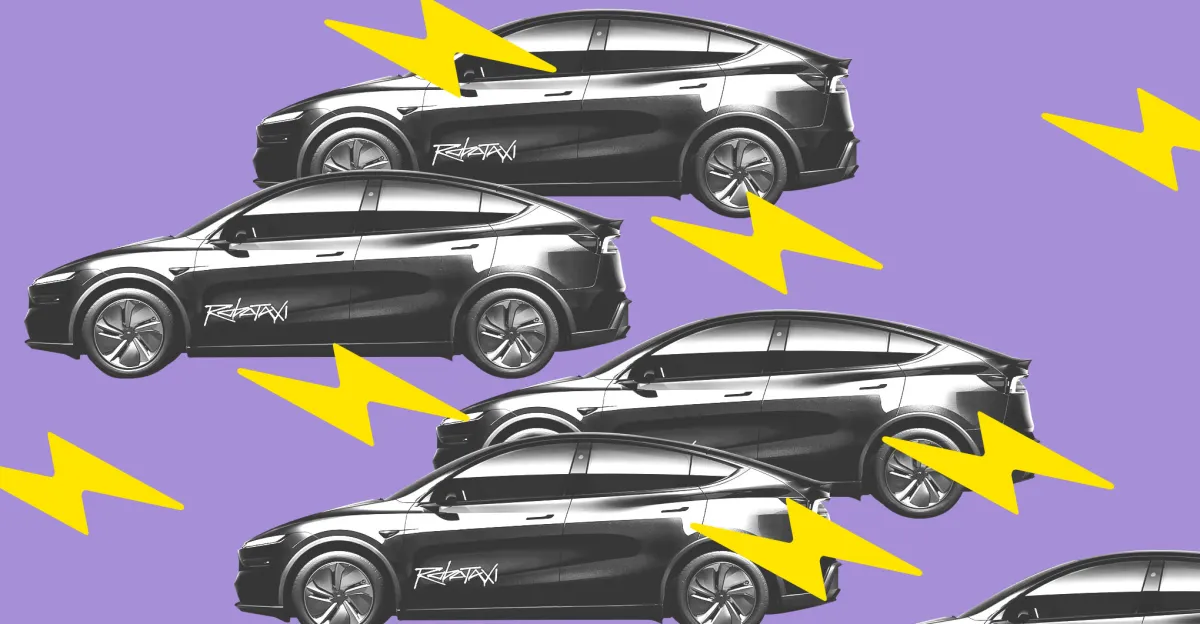
In an earnings call yesterday, Tesla CEO Elon Musk did his best to paint a positive portrait of the company’s robotaxi program. New cities are being added, more miles are being driven, and more people are experiencing Tesla’s unsupervised vehicles.
But Musk’s typical bullishness seemed to be absent from the call, as the occasional trillionaire sought to temper expectations about the program’s future.
“We’re going as fast as humanly possible in scaling Robotaxi,” Musk said, “while trying to ensure that we do not harm anyone at all and ideally do not even run over a pet.”
Musk’s insistence that Tesla’s robotaxi service was growing is clashing with the reality of the situation: Mileage is basically flat, the number of vehicles appears to be shrinking, and despite the Tesla executive team’s claims of “zero notable incidents,” the safety of the company’s technology appears to be an open question.
Tesla did it’s best to frame the situation as headed in the right direction. Ashok Elluswamy, the company’s head of AI, said that Tesla’s unsupervised robotaxis have driven 380,000 miles across six cities in two different states. And according to Musk, that was increasing at a rate of 10 percent a week in terms of miles driven.
Tesla did it’s best to frame the situation as headed in the right direction
Elluswamy couldn’t help but take a swipe at Tesla’s competitors who use lidar sensors, as opposed to Tesla’s camera-0nly approach. “Historically, the so-called experts have always claimed that you need lidars, radars, HD maps, and the entire kitchen sink to drive safely,” he said. “Here we show that such is not true. You can have safe, comfortable, and affordable autonomy with just cameras. This record should be a huge validation of Tesla’s entire AI approach.”
But even the numbers that Tesla reported seem to betray that message. Waymo, which uses lidar sensors and radar as redundant sensors in addition to cameras, typically drives around four million miles a week. Tesla’s total mileage, a year into its robotaxi program, is less than 10 percent of that figure. This reality is starting to spook investors, with BNP Paribas Equity Research senior analyst James Picariello calling it “an alarming decline” in a research note to clients.
Tesla uses a mix of unsupervised and supervised vehicles as part of its fleet, but that ratio appears to be in a constant state of flux. According to the crowdsourced Robotaxi Tracker, the company currently only has 16 unsupervised vehicles in Austin, four in Dallas, and one in Houston. During the earnings call, Elluswamy was asked what was preventing Tesla from flooding the zone in Austin, where it first launched its robotaxis a year ago, as opposed to dropping a small number of vehicles in new cities.
“The reason we have been expanding across different cities, instead of just doubling down on a single city, is that we want to make sure that our stack is a very general one,” Elluswamy said. “It is a general one. We just want to like, you know, both prove to ourselves and to other folks that it is working across a lot of different cities without too much effort per city.”
Another limiting factor is state regulations. New Jersey is considering a bill that would essentially ban robotaxis without multiple sensors, like radar and lidar. Morgan Stanley analyst Andrew Percoco flagged this on the call, noting “there seems to be some evolving regulations at the state level, potentially around sensor requirements.” To which Tesla’s vice president of vehicle engineering Lars Morvay acknowledged “obviously the stuff in New Jersey, you know, is a little bit disheartening.”
A more restrictive regulatory environment could limit the total addressable market for Tesla robotaxis, which would clash with the company’s message about a more generalized service that can drive anywhere, under any conditions.
Safety is another obstacle. Musk’s comment about wanting to avoid running over anyone’s pet appeared to be a subtle swipe at Waymo, which has hit and killed a number of animals over the past several years. But Tesla’s safety record is a mixed bag. We don’t have a lot of great insight into Tesla’s robotaxi crashes because the company tends to redact a lot of the important details.
According to the Robotaxi Tracker, the company’s fleet has been involved in approximately 18 incidents, 56 percent of which were the fault of another driver. And Tesla’s Full Self-Driving is under investigation by the National Highway Traffic Safety Administration, with the potential for a future recall. Tesla’s robotaxis are currently running version 15 of FSD, as compared to version 14.3.6 on its customer vehicles.
Tesla is asking investors, supporters, and customers to look past these shortcomings as it continues to push the message that it’s robotaxi program is growing. But the company continues to run into a reality that contradicts that message.
[Notigroup Newsroom in collaboration with other media outlets, with information from the following sources]