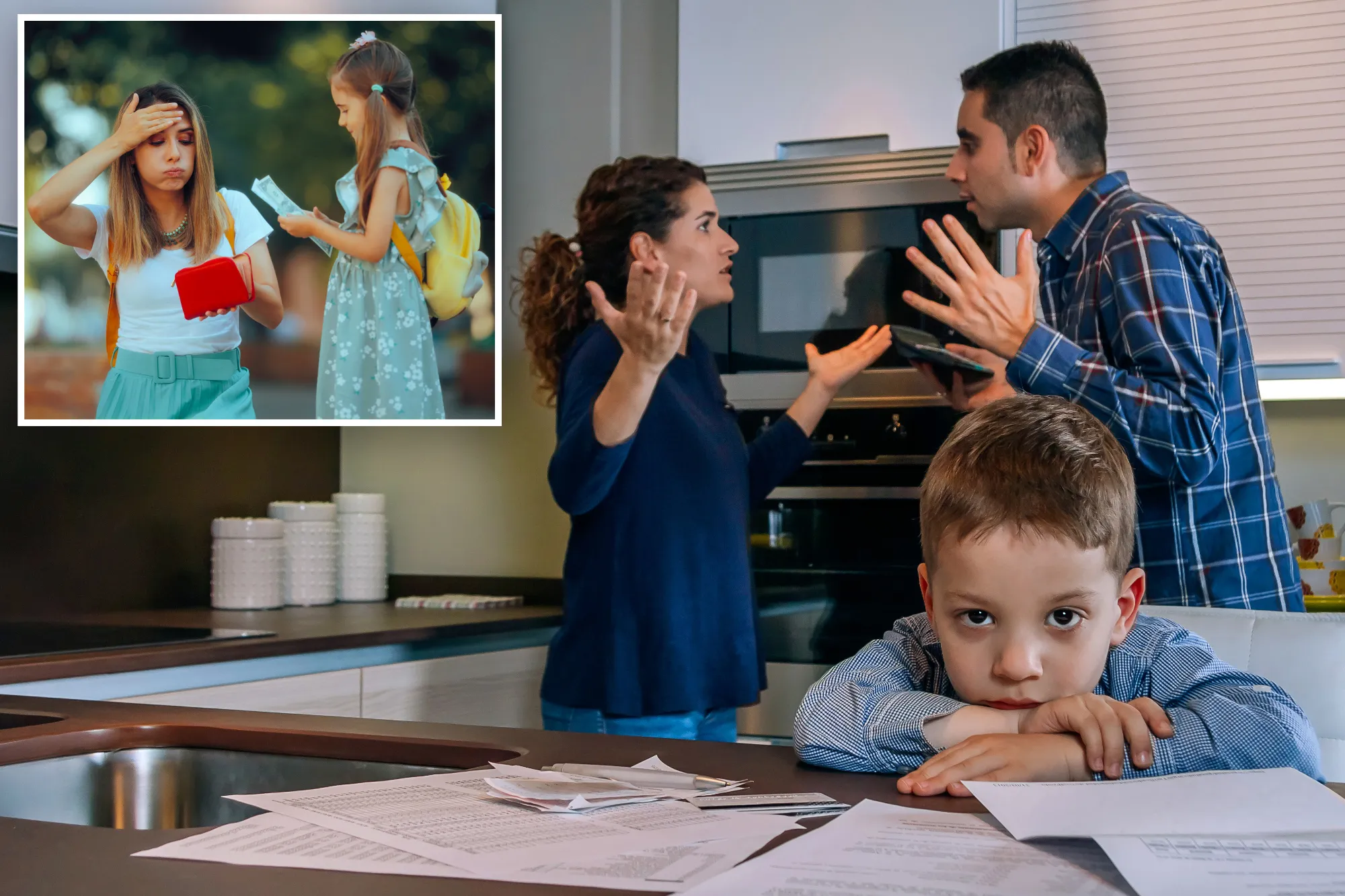
It now costs more than $300,000 to raise a child in the US over 18 years – a nearly 30% rise over the past three years, according to a new analysis.
The average cost of raising a kid hit $303,418 after tax exemptions and credits, up 1.9% from a year ago, according to a LendingTree study.
American parents are shelling out an average of $16,857 annually on little Johnny or Suzy — and $29,325 during each of the child’s first five years, a more expensive time of life due to infant and toddler day care.
The average cost of the first five years actually decreased slightly, owing to “a dip in day care costs,” according to LendingTree.
Matt Schulz, chief of consumer finance analyst at LendingTree and the author of the study, said some parents are already making sacrifices, like dining out less – or in more drastic cases, deciding whether it’s worth it for one parent to remain in the workforce or stay at home.
“We all wish that we didn’t have to crunch numbers and take finances into account when thinking about having a first kid or expanding your family, but the way costs are today, you’re doing yourself a bit of a disservice if you don’t,” he told The Post.
The nation’s fertility rates hit record lows in 2025, extending roughly two decades of declines. A large driver was a sharp downturn in birthrates for teens and women in their 20s.
Among the costs measured by the LendingTree analysis, including rent, food, apparel, transportation and insurance, infant day care tops the list – averaging $17,264 a year.
Day care costs climb even higher in some states, hitting $22,628 in California and $20,439 for New Yorkers.
“When you factor in costs like infant day care that has seen practically hockey-stick growth in previous years … it all adds up to a really, really daunting situation for parents,” Schulz said.
Erica Sandberg, consumer finance expert at CardRates.com, said some families “are starting to get creative” – shopping at thrift stores for children’s clothing to avoid expensive retail prices or bartering for free goods in Facebook groups.
There are several states where parents will be forced to pay even more than $300,000 to raise a child over 18 years, including Hawaii – the priciest place to raise a child at a staggering $412,661.
Alaska and Maryland are the second- and third-most expensive states at $365,047 and $326,360, respectively. California is the fourth-most expensive state at $312,300.
New Jersey ranks in fifth place at $312,295, while New York State is at No. 14 at $278,051.
New Hampshire, Washington, DC – which offers free preschool for 3- and 4-year-olds – and South Carolina are some of the most affordable states at $201,963, $202,115 and $204,213, respectively.
Families with young children are having an especially difficult time, typically spending 21.9% of their income on basic annual expenses, according to the analysis, which was based on a married, dual-income couple with one child earning a median family income of $99,999.
Child care is considered affordable if it costs no more than 7% of a household’s income, according to federal guidelines.
In New York City, the average cost of child care for infants and toddlers was $26,000 in 2024 – meaning a family would need to earn $334,000 to afford care for a 2-year-old, according to figures from New York City Comptroller Mark Levine’s office.
That’s four times the median family income and the equivalent of 10 minimum wage jobs, Levine’s office.
Day care centers have repeatedly hiked their prices, especially since the pandemic, so the cost of child care now significantly outpaces overall inflation – rising 8% on average from June 2024 through last month, while inflation jumped 4% over the same period.
In rural parts of the country, there is a lack of supply of quality child care centers, so “the really good places can more or less charge what they want,” Schulz told The Post.
New York City is a different beast, with high labor and real estate costs making child care an even pricier business, he added.
Another major factor in child care costs is the need to raise wages for workers to keep up with higher everyday costs, Sandberg said.
When parents are forced to spend more on child care, there’s a broader ripple effect across the economy, as it leaves them with less money for a car payment, mortgage or small business fund, along with retirement savings and emergency funds, Schulz said.
Affordability issues have been a driving force at voting booths, with many Democratic candidates – including NYC’s socialist Mayor Zohran Mamdani – pledging to make child care free.
In March, Mamdani and Gov. Kathy Hochul, a fellow Dem, announced $73 million in funding to provide 2,000 free 2-K seats this fall in the city.
Experts told The Post that people should start saving for child care as soon as possible to avoid getting overwhelmed by rising costs.
“I don’t think that it’s cause for alarm,” Sandberg told The Post. “I think it should be more of a call to action.”
Schulz suggested that individuals start putting a small amount of money from their paycheck each week into a high-yield savings account set aside as a “family fund.”
[Notigroup Newsroom in collaboration with other media outlets, with information from the following sources]