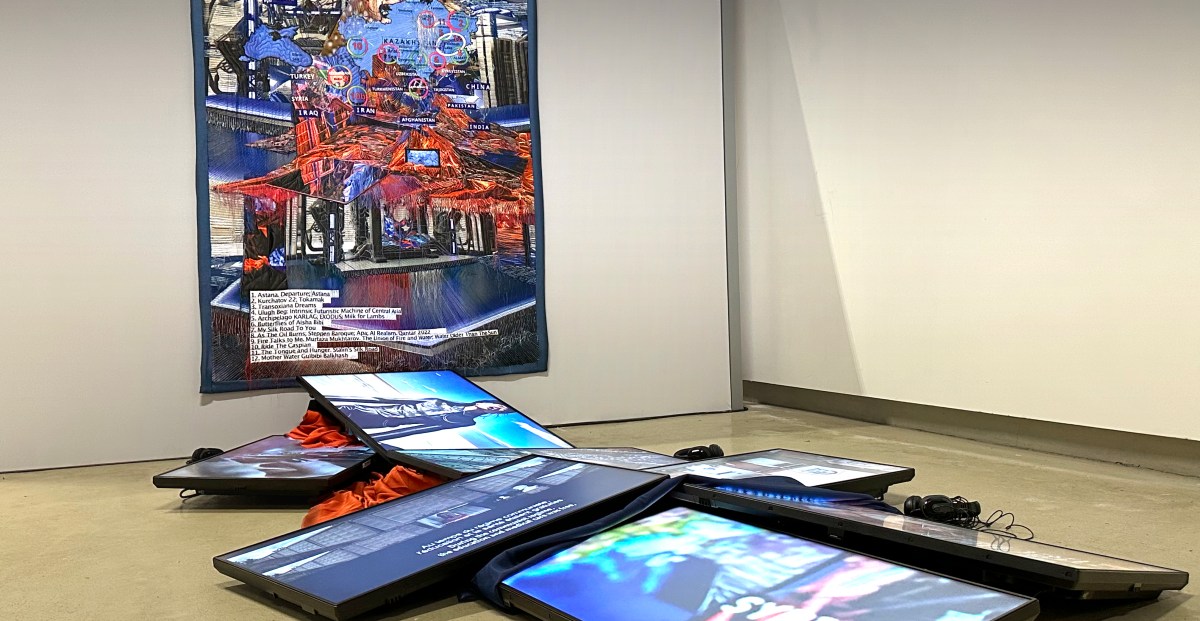
Video screens glow softly from the floor, looping footage of salt lakes, steppe villages, and decaying nuclear test sites. Suspended above them is a large handwoven textile map, crafted by artisans in Kazakhstan. The tapestry maps 12 significant sites across Kazakhstan and the surrounding region, each corresponding to one of the flickering videos below. This is Posthuman Matter: The Map of Nomadizing Reimaginings #3, the latest large-scale installation by photographer and multimedia artist Almagul Menlibayeva.
Recently unveiled at the VRHAM! Digital & Immersive Art Biennale in Hamburg, Germany, the work is part of Menlibayeva’s ongoing series of “cyber textiles,” which offer a striking blend of craft and code. It imagines an alternative cartography of Central Asia, with each video in the installation infusing the locations with erased histories and traditions, putting forth an alternative future for them. While the tapestries are created by hand, the videos are a mixture of real and replicated, built from documentary footage captured by Menlibayeva and then augmented with AI to infuse feminist rituals, nomadic storytelling traditions, and whispers of endangered languages.
Menlibayeva’s approach to artificial intelligence isn’t rooted in fascination with high-tech innovation for its own sake. Rather, it’s part of a deeper reckoning — with history, with loss, and with the systems that shape how stories are remembered or erased. She engages with AI not as a neutral tool, but as a terrain of power, ideology, and potential transformation. “Perhaps my interest in artificial intelligence is rooted in the traumatic history of Kazakh nomads,” she says, recalling how Soviet-era collectivization dismantled her ancestors’ way of life under the guise of technological progress.
Born in Kazakhstan and educated in the Soviet art system, Menlibayeva’s early training in folk textiles and Russian futurism is evident in her layered, hybrid works, which centered on photography and multichannel video installations for many years. Since 2022, she has expanded her practice to include AI, marking a pivotal evolution in her decades-long engagement with themes of historical erasure, cultural survival, and ecological trauma. Across these mediums, Menlibayeva critiques the lingering impacts of Soviet rule in Central Asia — from ecological degradation to cultural erasure — while reviving Indigenous and nomadic histories long overwritten by empire. With AI, she’s found a way to confront and reanimate these stories.
AI Realism: Qantar 2022 was Menlibayeva’s first project to incorporate AI. It’s a visceral example of how she uses AI to build counternarratives. Created in response to the Bloody January protests in Kazakhstan — mass demonstrations that were violently suppressed by the state and subsequently censored in national media — the project constructs a synthetic memoryscape from collective trauma. During the protests, the Kazakh government imposed a near-total internet blackout, plunging the nation into an information vacuum.
Faced with this blockade, Menlibayeva began collecting protest-2related stories from friends and social media, extracting key phrases in Kazakh and Russian, as well as voice messages sent via landlines and mobile networks. These fragments of real speech became the raw material for AI Realism: Qantar 2022. “The situation itself pushed me, because when these political events happened, the internet was shut down in the whole country,” she recalls. “I used audio recordings of voice messages, words these people used, to generate images of this work.”
Working with text-to-image and voice-to-image models via Google Colab, Menlibayeva assembled a series of AI-generated images from those crowdsourced stories. The resulting artwork, a 24-minute video and a series of haunting stills, is nonlinear and emotionally charged, confronting the erasure — both state-sanctioned and otherwise — of the events from memory. “I knew that the conditions, the events, would be forgotten or deliberately erased,” she says. “In this work, the people’s words are the main material. That is why the project is called AI Realism.”
The image Search and Seizure. History of Kairat Sultanbek. Kazakh January (2022), which is part of this series, reveals a chaos of bloodied surfaces and fragmented bodies. But it resists straightforward interpretation: there is no clear sequence of events and no clear heroes. “AI machines have a large limit, but sometimes system errors give rise to interesting results,” Menlibayeva says. In AI Realism: Qantar 2022, those glitches evoke the ruptures in history itself: the erasures, silences, and distortions enforced by both state violence and data-driven platforms.
Menlibayeva’s process often starts analog, with her own photographs or video stills — or even embroidered motifs passed down from older generations. These materials are transformed using Stable Diffusion, Midjourney, and Perplexity. For video-related work, tools including Deforum, Runway, and Kaiber AI are used, but not without friction. “My first stage is to find the right prompt. Then I choose the most suitable platform based on how well it performs for that specific idea. Each platform has its own strengths, limitations, and biases, so I adapt my approach accordingly,” she says.
While some celebrate AI’s democratizing potential, Menlibayeva remains wary. “AI is a complex tool with both democratizing potential and the risk of reinforcing new hierarchies,” she warns, noting that “AI systems are often controlled by large corporations, which influences access and power.”
So, why use them at all? Menlibayeva doesn’t believe AI creates anything truly new, only what data makes possible. But by inserting her own images, myths, and archives, she sees it as opening a dialogue between algorithmic systems and human history. “AI acts both as a tool and a distorted mirror, reflecting the hidden codes, preferences, and limitations of its creators: data, culture, and power,” she says. “I consciously engage with these biases, embedding my personal mythologies into the process.”
To Menlibayeva, “humanizing AI” doesn’t mean teaching machines to mimic empathy. Instead, it means embedding human stories, memories, and resistance into their logic. In her art, AI becomes a way to recover what state archives, history books, and dominant media refuse to hold. “That is why, as an artist, I try not to obey this logic, but to transform it. Humanizing AI is not the task of programmers, it is the task of artists,” she says.
[Notigroup Newsroom in collaboration with other media outlets, with information from the following sources]