This is Optimizer, a weekly newsletter sent every Friday from Verge senior reviewer Victoria Song that dissects and discusses the latest gizmos and potions that swear they’re going to change your life. Opt in for Optimizer here.
I take my beauty rest seriously. So seriously that, after months of testing, I bought my ludicrously expensive Eight Sleep Pod 4 Ultra review unit. It had a lot of things going for it. It kept my spouse’s side of the bed cool and mine toasty. That, in turn, convinced my aloof cats to curl on my side at night. It improved my marriage by dramatically reducing my spouse’s sonorous snoring. What more could I possibly want?
Earlier this week, I received a most unwelcome answer.
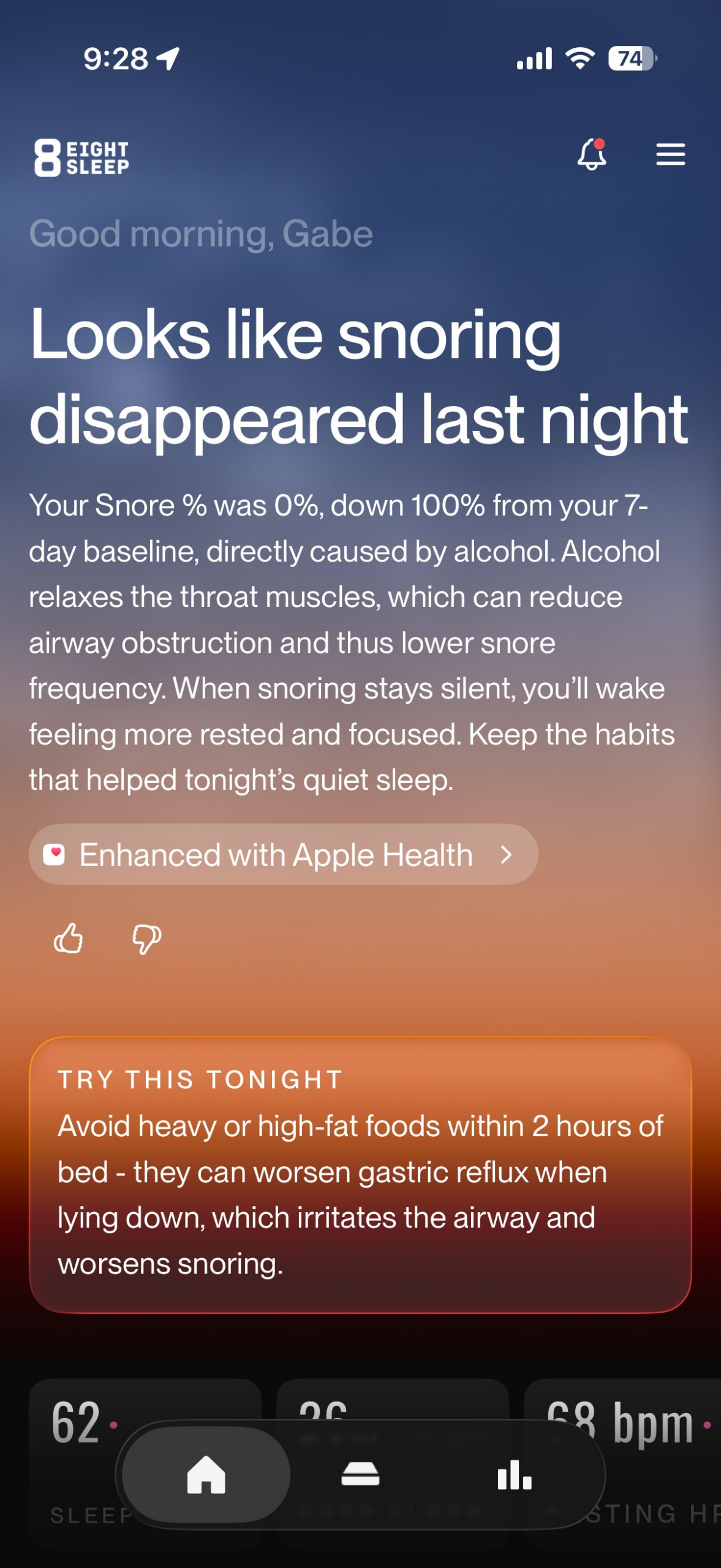
There I was, groggily drinking coffee, when my breakfast was interrupted by my spouse thundering down the stairs. “I HATE THIS!” they shouted, shoving their smartphone in my face. “The stupid AI bed is telling me to drink alcohol!”
I’ve tested a lot of sleep and health tech. Never have I ever heard of a wearable, smart bed, or other health gadget promoting alcohol consumption. I’ve read enough over the years to know that while alcohol can help you fall asleep faster, it significantly reduces sleep quality. Surely, my sleepy spouse had misread.
And yet, reading their Eight Sleep morning summary, I nearly choked on the protein bagel I’d been shoveling into my gob.
“Looks like snoring disappeared last night,” read the headline. “Your Snore % was 0%, down 100% from your 7-day baseline, directly caused by alcohol.” (Emphasis mine.) The summary went on to explain that alcohol relaxes throat muscles, which reduces snoring by lessening airway obstructions. “Keep the habits that helped tonight’s quiet sleep.”
I furrowed my brow. I’m no stranger to unhelpful AI health summaries. This, however, was the first factually false health advice I’ve received. Every bit of research I’ve done says that because alcohol relaxes throat muscles, it worsens snoring and increases snore frequency. This is precisely why it’s a common tip to avoid alcohol for four to five hours before bed.
“This update gets worse,” my spouse said. “There’s a leaderboard.”
Sure enough, there was a widget comparing our sleep stats across three categories: sleep fitness score, time slept, and snoring. The “winner” of each category was highlighted in green, with the overall winner (me) awarded a teeny green crown. And while I’d love to add Nap Queen to my illustrious list of titles, I’ve never viewed sleep as a competition to be won.
Marriages have been destroyed over less.
Sleep tracking can be an odd duck. After all, don’t you already know whether you’ve gotten a good night’s sleep based on how you feel the next morning?
Yes and no. For regular sleepers, sleep tracking is a lot like stating the obvious with a bunch of numbers. Of course you sleep worse when beset by jet lag, after a night of heavy drinking, or in the middle of a heat wave with a broken air conditioner. Those are all instances with a clear cause and effect. But what if there isn’t one obvious culprit? In those cases, sleep tracking can help troubleshoot what’s wrong, whether it’s environmental or health-related.
For years, my spouse and I have had alternating issues with sleep. I used to sleepwalk, and we both get insomnia during periods of high stress. For a few years, our rotund cat Pablo insisted on having a witness while he ate his 3AM snacks. (He has been documented on noti.group as a sleep optimization saboteur.) Lately, my spouse’s snoring has been the most pressing problem. It’s why we reluctantly bit the $5,000 bullet on the Eight Sleep. The base elevates the head when it detects snoring. I’ve drowsily witnessed how that actually works to lessen my spouse’s raucous snuffles and snorts. That, combined with temperature control, gave us over a year of some of the best sleep of our lives.

Notice how none of our reasons for loving this bed involve AI summaries or marital sleep tournaments. I never thought I’d have to tell my bed to shut the hell up and stick to what it does best. But here I am, in 2026, doing just that.
The alcohol suggestion was egregious. But the other insights have been regurgitated data reports. Last night, I was told my deep sleep increased by 57 percent because I spent extra time in bed. Who would’ve thought that spending more time in bed means you get more sleep cycles? I was then advised to keep the same dinner time, even though I ate uncharacteristically late. None of the information here is bad, but it’s simply not useful or lacks real-life context. (For the record, I did log that I’d eaten a late dinner.)
I know exactly where this is coming from. Health trackers of any kind generate an immense amount of data. That data is incredibly valuable, but it’s difficult to convince consumers of that when they’re overwhelmed by an increasing number of charts, graphs, and metrics. Even I struggle to see the point of it. So, over the past year, companies have increasingly turned to AI as a contextual shortcut. The AI (supposedly) gives consumers actionable, personalized insights that make them feel like they’re getting something out of all this data collection. The company, in turn, gets to keep customers engaged and maintain an ongoing trove of monetizable health data.
I didn’t mind Eight Sleep’s Autopilot AI, which automatically makes microadjustments to bed temperature and position to help you stay asleep. It’s the sort of thing that’s appropriate for AI to do. In the same way, algorithms and machine learning are integral AI applications for any health tech product. But this quest for increased personalization, and therefore optimized optimization, hits on a crucial error in logic.
As far as I can tell, health tech companies have decided that more data metrics means more engagement. Engagement is key to customer retention. That’s needed when you introduce more data, because you now need servers running 24/7 to process all this, and that requires subscriptions that every customer hates. To compete with your rivals, you need new features, and that means digging into the data you already have to find new potential insights. This is the first feedback loop.
The problem is then data overload, and so to keep customers engaged and not overwhelmed, you introduce even more numbers: scores, graphs, and now generative AI insights/coaching, none of which reduces data overload. It’s just creating a different kind, one not limited to numbers, but extending to chunky AI text blocks. Having a long-term, big-picture set of baseline data can be useful — but only for identifying when things aren’t as they should be. Arguably, the best thing for people is for all this self-quantification to fade into the background of your life and only flag your attention when it’s warranted.

Much like how my smart bed used to be silent, programmable, and incapable of interjecting bad or regurgitated advice into my life. For crying out loud — sleep is a time for peace. It’s a respite from the dystopian news cycle and the dramas of daily life. The last thing anyone needs is to fixate on waking up to an excellent sleep score or beating your sleep partner in a snoozing competition. Gamifying sleep might work for a certain type of hyper-competitive, sleep-deprived couple. But leave the rest of our relationships out of it.
Alas, this kind of common sense isn’t always compatible with the engagement economy. People developing unhealthy data obsession and app-checking habits is actually good for a company’s bottom line. I’m also not knocking the concept of personalized health tech. It’s true; everyone’s individual health needs are different. Lumping people under a broad healthcare umbrella hasn’t worked. I’m merely suggesting that this current approach isn’t working. Specifically, it’s lacking discernment as to when personalized insights are warranted and how they should be communicated. That’s not something that gets better when the AI gets better. If it gets better.
I don’t know how to solve the conflict between what’s best for the user versus health companies. But I think we can all agree that an AI smart bed telling someone to drink every night is not the insight you pay $5,000 for.
[Notigroup Newsroom in collaboration with other media outlets, with information from the following sources]