This is Optimizer, a weekly newsletter sent every Friday from Verge senior reviewer Victoria Song that dissects and discusses the latest gizmos and potions that swear they’re going to change your life. Opt in for Optimizer here.
These days, it seems I cannot escape peptides. Online, I’ve been assaulted by videos of shirtless Chads injecting dubiously sourced bottles of the so-called “Wolverine stack.” On the New York City subway, I’m haunted by Serena Williams’ Ro ads for easy GLP-1 access. Silicon Valley seems to be a parade of peptide parties. In Washington, RFK Jr. has said he’s pro-peptide and wants to expand access. In July, the FDA will meet to possibly reclassify 14 peptides so they can be eligible for compounding.
And in Hollywood, Gwyneth Paltrow — mother Goop, one of the original wellness influencers — is selling a series of peptide skincare products. Except, after some research, I’m not sure Paltrow actually understands what peptides are.
You might be wondering why I’m fixating on a Goop product in Optimizer. The short answer: While researching peptides for a forthcoming feature, I’ve descended into madness.
The longer answer is that peptide mania is central to Silicon Valley’s current fixation with longevity and metabolic optimization. As I’ve recently written, wellness trends increasingly inform new health tech features and gadgets that make up the wearable surveillance state. Peptides are also being framed on social media as an innovation that democratizes healthcare. (A similar rhetoric used to describe wearables!) It’s part of the wellness Wild West feedback loop that’s fueling Silicon Valley’s obsession with self-optimization. With that in mind, it’s worth examining how “peptide washing” has crept into various corners of the internet — and the resulting ripple effects.
While peptide shots are a relatively new trend, we’ve known about peptides and how they work for decades. They’re short chains of amino acids, which, in turn, make up proteins. In other words, building blocks for the building blocks. Because a peptide can be a chain ranging from two to roughly 100 amino acids, there are potentially trillions of peptides. Their main function is to act as messengers for various bodily functions. Some are naturally occurring and often come from the foods you eat. Others are made synthetically in a lab. The most famous ones include insulin and GLP-1 medications like semaglutide (Ozempic and Wegovy) and tirzepatide (Zepbound and Mounjaro).
What’s taking social media by storm are peptides that exist in legal gray areas. They’re not widely tested or FDA-approved drugs, and are sometimes sourced from dubious suppliers. I’ve previously written about retatrutide — another popular weight loss peptide — in Optimizer, but there’s a whole slew of others with names that sound vaguely like Star Wars droids. The most popular ones include BPC-157, TB-500, GHK-Cu, and CJC1295. These peptides are touted as biohacks for ailments ranging from fat loss and muscle growth, to faster wound healing, anti-aging, and increased energy. Essentially, everything associated with living a longer, healthier life. Lumped alongside these is NAD+, which is not a peptide but is often marketed as one. That’s partly because it’s frequently consumed as an IV drip and is thus an injectable substance.
But just because you can inject something, that doesn’t make it a peptide.
Do you have experience using peptides?
Or extremely strong feelings about this trend? I’m researching this phenomenon and I’d love to chat with you. Hit me up at [email protected] or on Signal at @ vicmsong.14.
NAD stands for nicotinamide adenine dinucleotide. It’s a coenzyme — basically an enzyme booster — that’s found in every cell. Its primary job is to help convert food into energy. It does this by shuttling electrons from one chemical reaction to another. As you age, your NAD levels naturally decline. This can lead to an array of conditions associated with aging, like Type 2 diabetes, lower energy levels, and saggy skin. Not to get too weedsy, but the + in NAD+ simply denotes one of two versions of the NAD molecule. (The other is NADH.)
Which, finally, brings me to the Goop Youth Boost NAD+ Peptide Rich Cream and whether Gwyneth Paltrow actually knows what a peptide is.
In my research, I was looking into influential people who have spoken out about peptide injections. There’s a long list, but in Hollywood, Paltrow’s name kept popping up. Cue this recent Elle interview, in which Paltrow plays a “fuck, marry, kill” game with wellness trends.
From the get-go, the Elle article incorrectly identifies NAD+ as a peptide. Paltrow is then quoted as saying she uses NAD+ IV drips and an injectable NAD+ pen for impromptu energy boosts. She goes on to say that injectable peptides dealing with inflammation and brain health that are “being formulated for longevity” will be the next NAD+. In the fuck, marry, kill game, Paltrow is asked to choose between NAD+, B12, and peptide shots. She refuses, saying she’d marry them all.
What’s worrisome is the conflation of these treatments, even though they’re three separate things. It’s easy for the average person to read this article and think, “NAD+ is a type of peptide shot and a rich, glamorous celebrity like Gwyneth Paltrow does it, so this must be their secret to looking good.”
(For the curious: B12 is a vitamin. Supplementation can boost energy if you have a B12 deficiency, which is relatively common in the elderly, vegetarian, and vegan populations. As for NAD+, there’s considerable research interest, but limited clinical evidence for drips or supplements at the moment. I wrote a whole Optimizer newsletter about dubious peptide shots.)
From this interview, I get the sense that Paltrow knows that peptides are trendy, but she doesn’t actually admit to using any specific one. After some more digging, I found she has stated that she loves glutathione IV drips. Now, that is a peptide. However, she characterized her usage as “I love IV drips!” so, again, I’m not sure if Paltrow is aware that IV drips and peptides are not the same thing. Upon looking into her “peptide-rich” moisturizer, I’m even less certain.
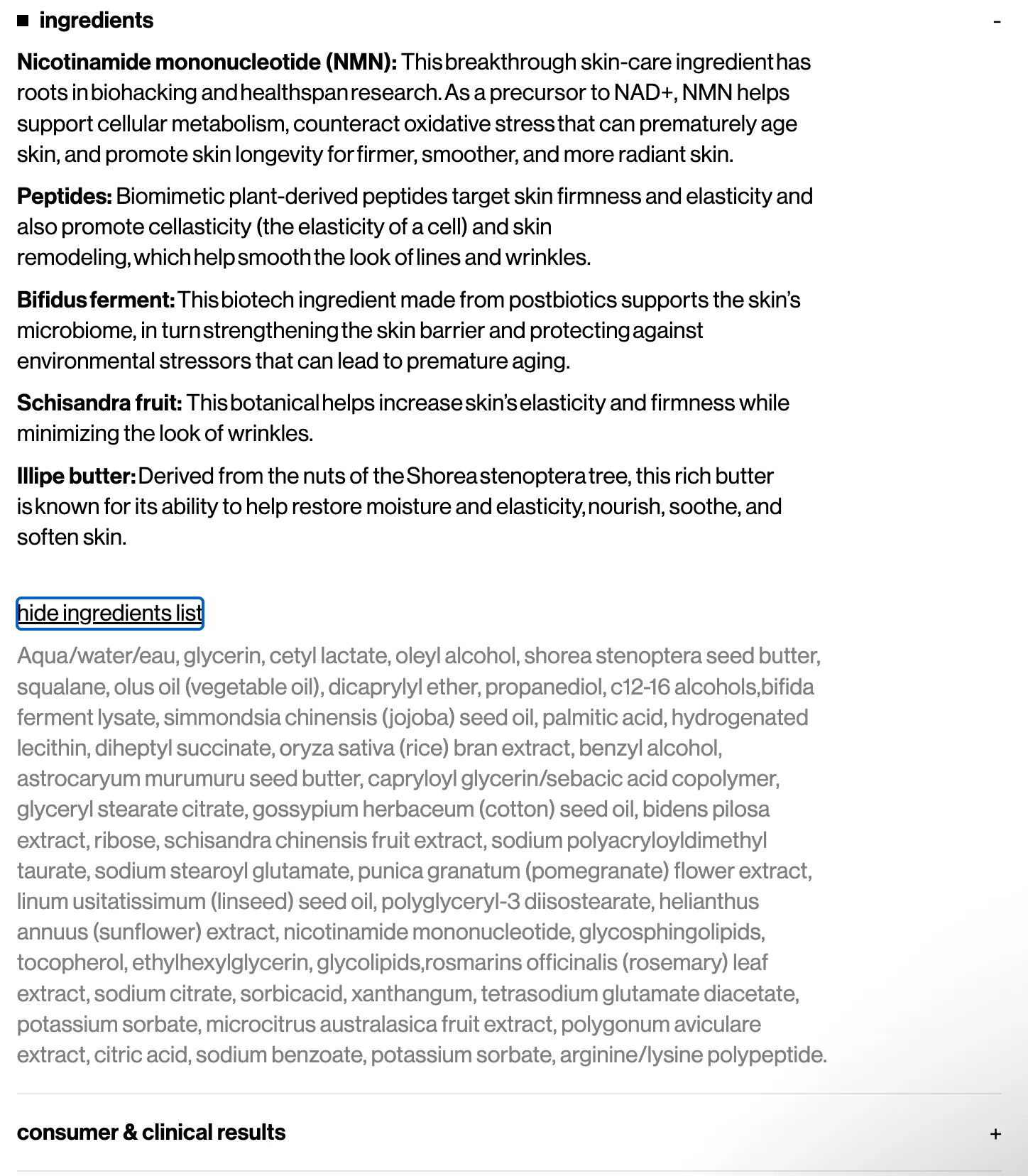
Calling it a “Youth Boost NAD+ Peptide Rich Cream” would suggest this $105 moisturizer has both NAD+ and a bunch of peptides. Peruse the ingredient list, and you’ll find it doesn’t even have NAD+. It has NMN, or nicotinamide mononucleotide, a precursor (another kind of building block) for NAD+. As for its peptide content, the marketing claims the cream features “biomimetic plant-derived peptides.” Again, the list only refers to one true peptide molecule: arginine/lysine polypeptide. (A polypeptide is a longer peptide; this one supposedly helps with wrinkles.) It also appears last. In skincare, the ingredient list is generally ordered in terms of concentration. The top three to five ingredients make up the bulk of the formula. One hack is to find the so-called “one percent line”, which you can estimate from when the first preservative or fragrance appears. Given how this list is written, this is a standard moisturizer with a teeny sprinkle of a single peptide thrown in for marketing flavor. Even if there was a more potent amount, peptides are delicate molecules. Effectiveness for any topical skincare active — be it peptides or salmon sperm DNA — depends on stable formulation, concentration, whether the molecule can penetrate the skin barrier, and packaging that prevents degradation.
In any case, I reached out to Goop to clarify the peptide content in this cream. I have not heard back.
The only thing I can conclude is Paltrow isn’t afraid to try fringe wellness trends. (That and she loves an IV drip.) If someone handed her a peptide shot with the promise of energy and youth, I’d bet she’d do it. But do I think a peptide-curious person could ask her to explain the pros and cons of this trend based on her public statements? Now that’s a bet I would not take.
I could be wrong. In which case, I find her statements and her moisturizer to be disappointing given her status and influence. Case in point, the average person likely isn’t going to go through the trouble of accessing gray market peptide vials. They probably won’t be able to afford the same quality treatments as Paltrow, either. But a so-called peptide cream from a celebrity? That’s easily accessible. And in this particular case, that consumer wouldn’t be getting much of the thing they purportedly want to try.
More concerning is the flattening of any injectable as a peptide. Paltrow showing up to a podcast with an IV drip, speaking of peptides, phospholipids, and regular vitamins in a single breath? That’s confusing. It conflates relatively harmless therapies — like vitamin supplementation — with those that aren’t as well-studied. And the more influential people do this, the more regular people will too.
Peptides aren’t inherently dangerous. Injections aren’t evil. But the way peptide mania has made a more extreme, experimental trend as casual as taking a multivitamin? That feels like the slipperiest of slopes.
[Notigroup Newsroom in collaboration with other media outlets, with information from the following sources]