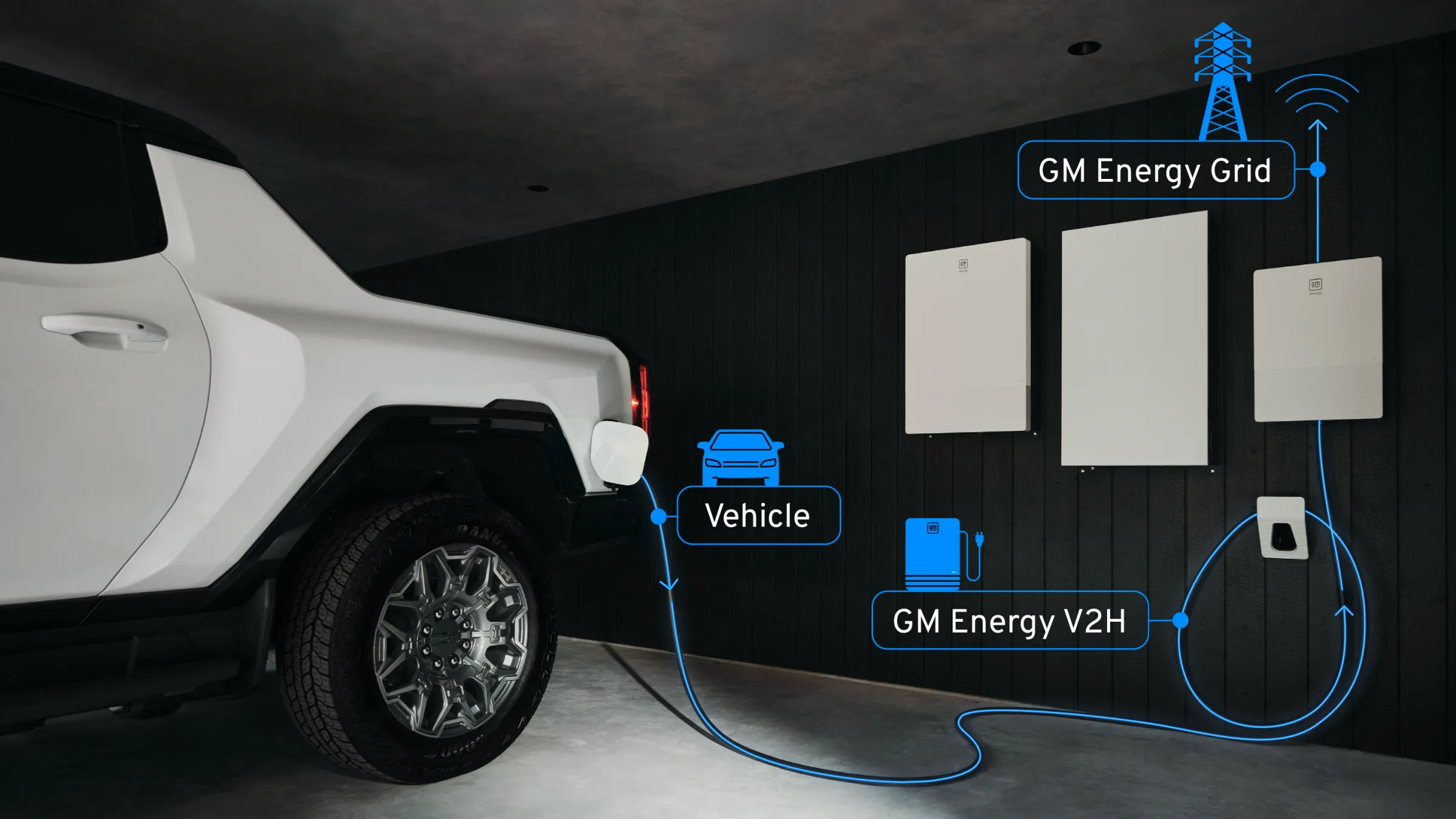
At an event in San Francisco today, General Motors made a series of announcements around EV batteries, energy storage, and grid resiliency in the face of growing electricity demand from AI data centers. The automaker announced that it would be activating new vehicle-to-grid capabilities for its current EV and home energy customers. It’s releasing a new commercial energy storage system strategy, anchored by newly developed sodium-ion batteries for industrial-scale grid applications. And it’s launching a new feature for EV owners that it says will help simplify public charging.
Right now, millions of EVs are sitting idly in driveways across the country with a wealth of electrons stored in their batteries. GM is betting that even as EV sales cool down, public utilities will want to work with automakers to utilize those EV batteries as a potential solution to the energy demand crisis they face. It was also the latest effort by the largest automaker in North America to grab a piece of the multibillion-dollar energy generation and storage market, which it has been trying to do for nearly four years now.
“We see a future where electric vehicles, batteries that power them, and the country’s power grids work together,” GM’s chief product officer Sterling Anderson said in prepared remarks for today’s event.
EVs are unique in their ability to send energy back to the grid, just as they pull it while charging. Many EVs are built with this bidirectional charging capability, enabling the two-way flow of energy. In essence, it treats high-capacity lithium-ion batteries not only as tools to power EVs but also as backup storage cells to charge other electric devices, an entire home, or even to send power to the electrical grid for possible energy savings.
As AI data centers put more stress on the grid, GM thinks its hundreds of electric vehicles can help lighten the load. The automaker says that with bidirectional charging capabilities, EVs can send energy back into the grid during times of peak demand. As such, the automaker says it will release a firmware update to give its current vehicle-to-home system customers the ability to send energy back to the grid (vehicle-to-grid, or V2G). GM customers who already own the equipment will receive the update automatically.
GM says there are currently over 250,000 bidirectional-capable Chevy, Cadillac, and GMC EVs on American roads today. Theoretically, their combined battery capacity is enough to power 120,000 homes for up to an entire week.
GM is already testing this theory in two states. In Northern California, the company is partnering with PG&E to develop a localized fleet of 52,000 EVs for “grid balancing protocols,” which it says will be operational by 2030. And in Michigan, GM is working with DTE Energy to “stress-test” bidirectional charging using 30 of its own employees’ homes as real-world test cases. In addition to providing a benefit to public utilities, the automaker says EV owners could see a financial windfall too.
“By injecting flexibility into a historically rigid system, V2G technology simultaneously can lower aggregate energy costs, create a potential financial return for the consumer, and enhance the systemic reliability of the broader grid,” Anderson said.

But enabling V2G technology isn’t as easy as flipping a switch. In an open letter, GM Energy VP Wade Sheffer urged regulators to formalize V2G infrastructure, citing International Energy Agency (IEA) reports identifying V2G as the technology with the largest hourly flexibility to limit future grid investment costs. Sheffer said that the auto industry needs to work with government to educate the public to the benefits of V2G tech. And utilities must simplify the administrative process to allow their customers to seamlessly enroll in future projects.
GM says it’s also working on new industrial-scale solutions, partnering with New York-based Peak Energy to develop and deploy sodium ion chemistry for energy storage systems. Sodium is seen by some as an improvement over lithium, both in terms of availability and stability. The material is more cost-effective to obtain and isn’t subject to the same safety hazards as lithium, which can catch fire under certain circumstances. They also perform better in cold weather than Li-ion batteries. Some major battery makers, like China’s CATL, believe that sodium-ion batteries could potentially replace up to half the market for lithium iron phosphate (LFP) batteries that now dominates the field.
GM says sodium ion chemistry is a good fit for commercial energy storage, but not necessarily EVs, because it prioritizes “longevity, high cycle and calendar life, and intense cost-efficiency.” The automaker is also working with Redwood Materials to build energy storage out of US-manufactured batteries, as well as “second-life” EV packs from GM’s vehicles. For its EV batteries, GM is betting on lithium manganese-rich batteries, or LMR, to close the gap between the US and China.
Lastly, GM announced Energy Pass, a new feature that will appear across its suite of mobile apps. Energy Pass allows Chevy, Cadillac, and GMC EV owners to find, start, and pay for charging across multiple third-party charging operators, including Tesla, Electrify America, and IONNA. (The company says it also plans to add EVgo and ChargePoint.) Owners can use now use their mobile app to find a charger, initiate a charging session, and pay for the charging without having to sign up for a separate account for each provider.
The lack of convenient and reliable charging is frequently cited in customer surveys as a major obstacle to purchasing an EV. GM is using Tesla’s NACS charging standard for its future vehicles, as the company’s Superchargers are widely seen as among the best EV charging network in the world.
GM has recently been trying to expand its EV business to include a variety of energy storage and charging projects. The company launched GM Energy, its energy spinoff, in 2022 as a way to compete in the rapidly expanding home energy market. In an effort to compete with Tesla for the $150 billion home energy market, GM sells a number of products, including home EV chargers, stationary home batteries, and vehicle-to-home (V2H) kits that enable a home to pull energy from an EV battery in the event of a blackout.
[Notigroup Newsroom in collaboration with other media outlets, with information from the following sources]