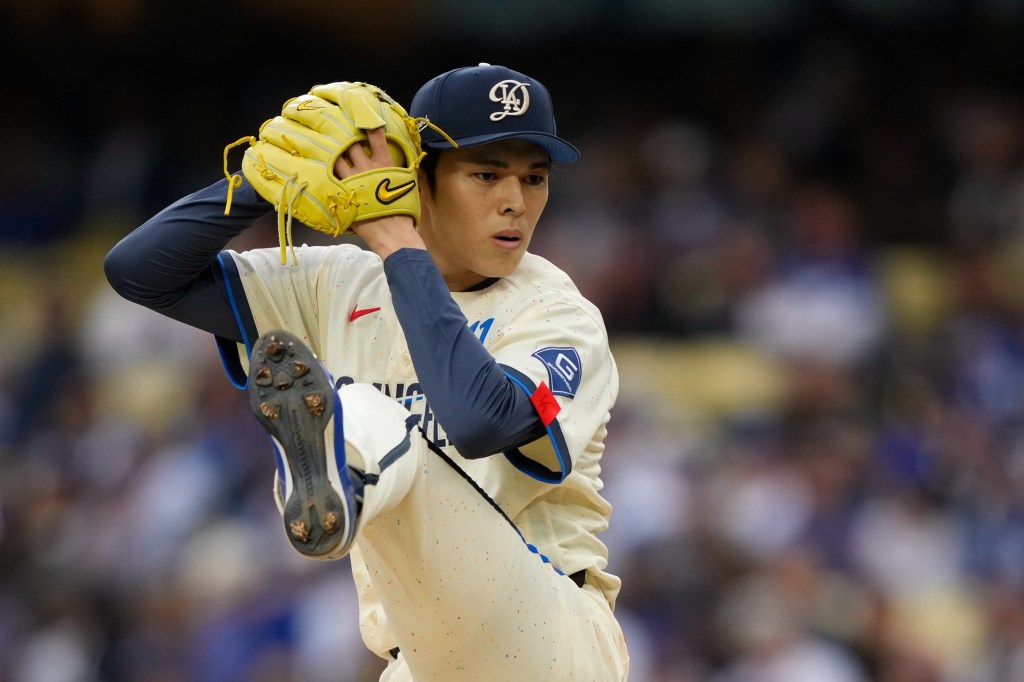
ST. LOUIS — Ahead of the most pivotal stretch of his career as an MLB starter, Roki Sasaki had the idea to completely alter his signature pitch.
During the Dodgers’ last road trip in late April, Sasaki navigated a 4 ⅔-inning, three-run outing against the Rockies at Coors Field. Like most of his starts this year, the results were underwhelming. Under the hood, however, he felt like he was finally making progress.
Thus, when he sat down with Dodgers pitching coaches later during that trip in San Francisco, the right-handed phenom expressed confidence with the state of his mechanics –– then suggested an idea about how to improve his inconsistent arsenal.
“One of the things that came up,” pitching coach Mark Prior recalled, “was he said, ‘Hey, I do feel like I’m in a spot with my delivery where I can throw my forkball harder, like it used to be.’”
Turned out, by the next time he took the mound, both he and his trademark pitch looked completely different.
When Sasaki came over from Japan last year, his big, knuckling, low-spin forkball was his most unique weapon. But during his first year and a half with the Dodgers, it became a confounding problem.
Sasaki struggled to throw it with the same upper-80s mph velocity he used to have in Japan. He also couldn’t command nearly as well as before.
Some with the Dodgers have theorized it could be because of the differences between the American and Japanese ball (the latter of which is slightly smaller and made with a tackier substance), or simply a byproduct of Sasaki’s inconsistent mechanics in general.
Download The California Post App, follow us on social, and subscribe to our newsletters
California Post News: Facebook, Instagram, TikTok, X, YouTube, WhatsApp, LinkedIn
California Post Sports Facebook, Instagram, TikTok, YouTube, X
California Post Opinion
California Post Newsletters: Sign up here!
California Post App: Download here!
Home delivery: Sign up here!
Page Six Hollywood: Sign up here!
Either way, the pitch didn’t play as well off his fastball and was too easy to differentiate out of his hand.
It was still largely unhittable, just not something he managed to get many batters to chase.
“I think that my No. 1 problem hasn’t been my fastball,” Sasaki said in Japanese, “but rather the percentage of forkballs I’ve been able to throw over the plate.”
This year, of course, Sasaki had other pressing problems that needed to be addressed, from his poor fastball command to the introduction of a cutter/slider as a necessary third option.
In recent weeks, though, he expressed to team officials that he was finally feeling like he had turned a corner with his delivery, following a five-walk fiasco against the Rangers on April 12.
Now, he wanted to iron out his forkball.
“The game is telling him that there needs to be an adjustment,” manager Dave Roberts said.
Making one, it turned out, meant reimagining the fork grip entirely.
Following his meeting in San Francisco, Sasaki threw a bullpen session in which assistant pitching coach Connor McGuiness suggested a more traditional splitter grip (where the ball comes more off the end of his fingertips, rather than being lodged firmly between his middle and index fingers).

The change meant less overall break but more velocity and deceptively late bite.
“He threw one of them, and we were like, ‘That’s pretty gross,’” Prior said. “And then he threw a few more, and they were pretty good. So we had a conversation where we were like, ‘It’s good. It’s your call.’”
Recognizing it was time to do something different with his ERA over 6.00, Sasaki promptly leaned on the new pitch heavily during his subsequent five-inning, four-run start against the Cubs last weekend.
Though three home runs put a dent in his final line, he filled up the strike zone, limited himself to one walk and got consistent swing-and-miss for one of the first times all season.
It all represented a significant forward step in the Dodgers’ view of his development.
“He feels confident about where he’s at physically but also understands that he needs to get better as a pitcher,” Prior said, adding: “The results haven’t necessarily been overwhelming, like, ‘Oh, my gosh, look what he’s doing.’ But I do think we see some more consistency.”
Time is still ticking on the 24-year-old pitcher.
With Blake Snell nearing a return from the injured list, one of Sasaki, Emmet Sheehan or Justin Wrobleski will soon either be bumped to the bullpen or (more likely, in Sasaki’s case) demoted to the minor leagues.
It’s against that backdrop that the Dodgers will look for more signs of growth when he takes the mound Saturday against the Cardinals.
“We do expect him to continue to get better in his process and execution,” Roberts said.
Prior noted that Sasaki still has his traditional forkball in his arsenal. Long term, he doesn’t want to abandon the pitch that made him such a singular talent.
Meantime, dependable production is the more important objective.
Sasaki recognized that, made a drastic adjustment and is hoping it will keep him in the rotation moving forward.
[Notigroup Newsroom in collaboration with other media outlets, with information from the following sources]