
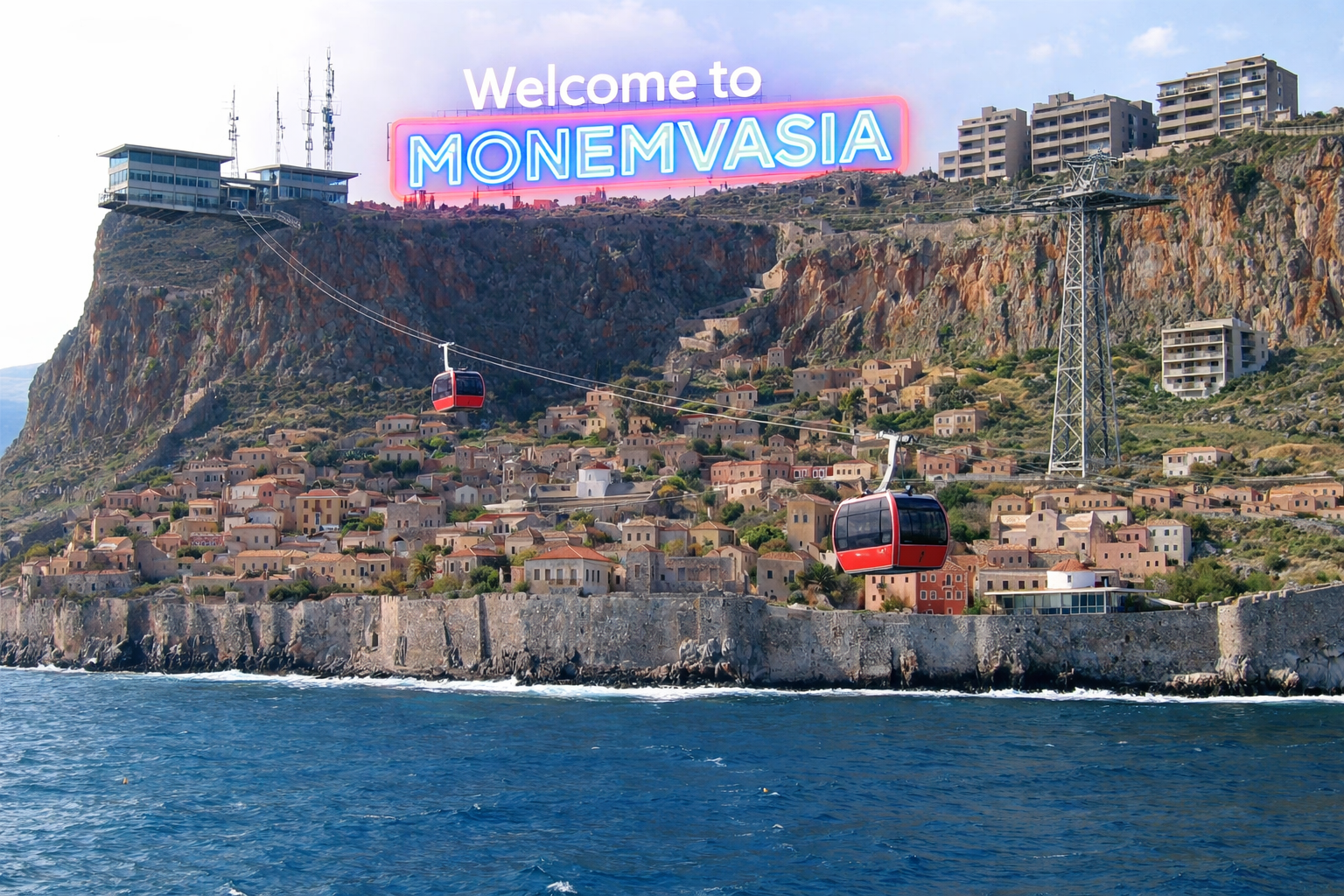
Perched on a colossal rock off the southeastern coast of Greece, the medieval town of Monemvasia doesn’t just look like the past, it is the past. Carved directly into a cliff and hidden from the mainland, this fortress has stood untouched for over a thousand years.
A World Apart, Now Under Threat
While most historic castle and towns in Europe have long since surrendered to modern development, Monemvasia remains an extraordinary exception, a place where time has quite literally stood still. Shielded for centuries by its dramatic geography, this fortified medieval settlement was carved into a massive rock off Greece’s southeastern coast, invisible from the mainland and virtually unreachable to invaders. It was built for secrecy and for survival.
Today, that same geography continues to protect Monemvasia. From within its stone walls, the modern world vanishes. But this final sanctuary will now disappear, the very isolation that safeguarded Monemvasia for more than a millennium is beginning to unravel. Not because of war or weather, but because of neglect, poor planning, and the unchecked prioritization of tourism over preservation. Ill-conceived developments, cultural disregard, and a growing appetite for “accessibility upgrades” are placing the town’s unique authenticity in real danger.
Crucially, Monemvasia’s value lies not just in its architecture, but in its undisturbed context. It is not a museum piece frozen behind velvet ropes; it is a living community, a breathing relic of the Byzantine Middle Ages. To alter its geography, to impose modern infrastructure for convenience or spectacle, is to break the very spell that makes Monemvasia unlike any other place on Earth.
If its isolation is breached, Monemvasia loses far more than its quiet, it loses its soul. And with it, the world loses the last remaining chance to walk through history untouched, a crisis of global heritage, one that raises urgent questions about how we value the past, and whether we are willing to let it vanish in the name of progress.
A Dying Cat Population Left to Rot
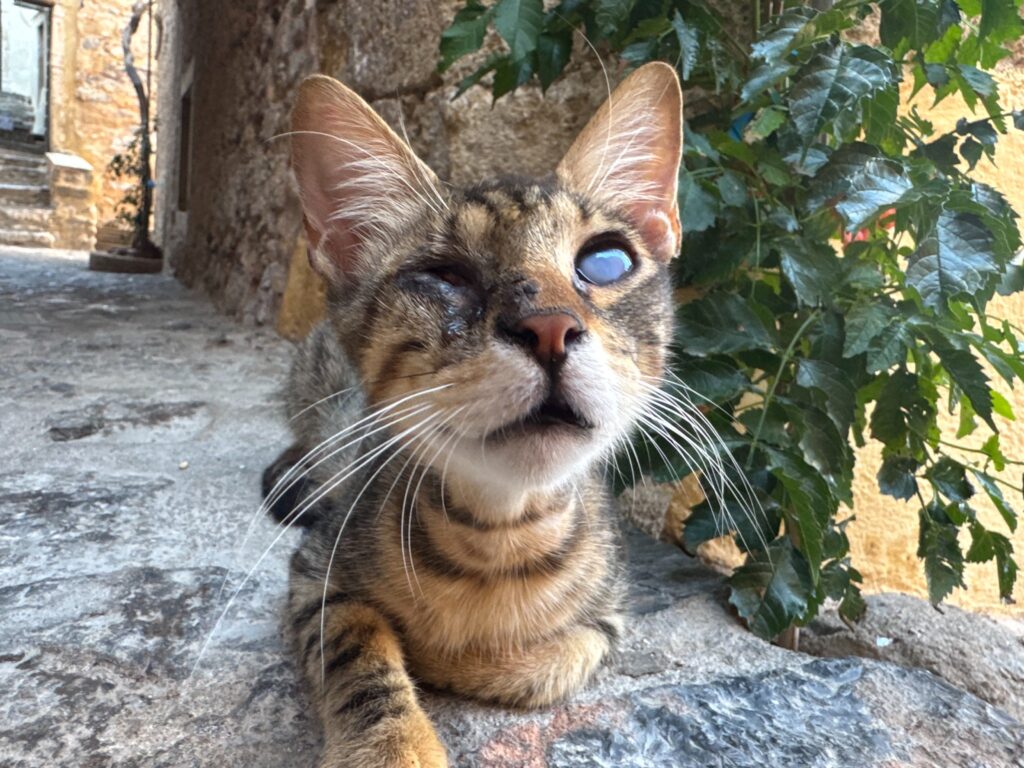
Among the most heartbreaking and visible signs of Monemvasia’s neglect is its growing population of sick, injured, and dying cats. Once symbols of charm in this byzantine city, these very necessary residents now roam the alleys of Monemvasia in a state of profound suffering, many blind, others missing ears, tails, or limping from untreated injuries. With no vaccination programs, no access to veterinary care, and no municipal neutering initiative, the cat population has grown unchecked, spiraling into a tragic cycle of disease, injury, starvation, and death.
Local residents and business owners, moved by compassion, attempt to feed and care for these animals. But without professional intervention, their efforts are overwhelmed by the scale of the problem. What they witness daily is not just suffering — it is slow-motion mass neglect, playing out in full view of tourists and children.
The consequences go beyond animal welfare. When requested for comment, the Resident and Owners Association reported that it spent just in 2025 a staggering 6,800 EUR of their own resources attempting to control an increased infestation of cockroaches and other vermin within the Kastro further underscoring the severity of the town’s collapsing environmental health infrastructure. Still, authorities remain absent, and no organized municipal or veterinary support has been implemented, despite the visibility and urgency of the problem.
The “Funicular” That Will Ruin the last remaining treasure in Greece.
But the spark that ignited outrage by both residents and business operators in the kastro is the construction of the cable car, a contemporary mechanical lift that would shuttle tourists from the lower town to the Acropolis above within the same protected island. Proponents argue it’s for inclusivity — yet the narrow, carless streets of Monemvasia are already inaccessible by design. The proposed funicular, far from democratizing access, would shatter the only thing that has preserved the town for centuries: its topographical isolation.
Residents argue that hidden behind the curtain of accessibility is a shadowy economic motive. The lift would be operated privately, monetizing the only surviving aspect of Monemvasia that remains untouched — its inaccessibility. Residents warn that once that barrier is broken, Monemvasia will become just another “medieval theme park” no longer a miracle of time, but a simulation of one.
They destroyed Santorini, then they destroyed Mykonos, now Monemvasia is next. : Monemvasia Resident
Noti.Group found that 86% of those interviewed are against this project. In their view, the funds for this initiative should be used to restore the seawall, provide safe drinking water, maintain the historic trails, implement humane animal control programs, and protect the night sky from light pollution by updating lighting to international sky-preservation standards. Instead, the money is being spent on what residents consider a vanity project that caters to destructive tourism, benefiting only a handful of contractors and operators.
A Crisis of Heritage, and of Priorities
Monemvasia is a global heritage site in every way but official designation. There’s no comparable living medieval town isolated in both time and space. Its preservation should be a European and international concern.
In an era where historic towns are swallowed by modern development, Monemvasia stands as the last of its kind. But if its defining isolation., its silence, purity and authenticity, will be breached, and it will never be restored. Once that boundary is crossed, the magic vanishes forever.
As of early 2025, the proposed €6.8 million aerial funicular (cable car/lift) was fully approved by Greece’s Central Archaeological Council and funded via the EU Recovery & Resilience Facility https://www.monemvasiasociety.com/press-release-on-the-controversial-cable-car-project-for-the-archaeological-site-of-monemvasia-greece
The Greek section of ICOMOS, the Association of Greek Archaeologists (SEA), the Society for the Environment and Cultural Heritage (ELLET), Monumenta, the Hellenic Society for the Protection of Nature (EEPF), Callisto, MEDASSET, the Ecological Recycling Society, Organisation Earth, and the Society of Cultural Heritage Management Consultants (ESDIAPOK) have all expressed opposition or concern regarding the project.
In addition, numerous academics, particularly archaeologists and architects, have publicly voiced strong objections, a significant portion of the local community, regardless of political affiliation, is also deeply concerned.
However, the Greek Council of State rejected two appeals filed by the Hellenic Society for Environment and Culture (ELLET), the Friends of Monemvasia Association, and local residents, approving the construction of the cable car, citing the need to improve access to the monument’s Upper Town.
This decision raises serious concerns about the balance between accessibility and the preservation of cultural heritage. The court justified its ruling by stating that monuments fulfill their cultural role through collective memory and should be accessible to all, including people with disabilities. Yet, this argument fails to address the irreversible damage that modern constructions such as the proposed cable car stations and related infrastructure is visibly inflicting on the archaeological integrity of Monemvasia, a site that has stood untouched for centuries.
Heritage sites, especially those with substantial archaeological value, should remain free from contemporary developments that threaten to destroy or alter their historical features. The construction of the cable car, while framed as an effort to improve access, represents a violation of the core principle of safeguarding such sites for future generations. This is not merely about improving accessibility; it is about protecting the very essence of the heritage that defines these places.
Monemvasia’s inclusion as one of Europe’s 7 Most Endangered Heritage Sites for 2025 underscores the serious threats posed by the ongoing changes to the island. The cable car construction risks damaging the delicate historical fabric, irreparably altering its visual and physical character in favor of a modern tourism infrastructure that prioritizes short-term financial gains over the long-term preservation of the town. The goal appears to be to attract mass tourism, particularly from the cruise industry, without regard for the lasting damage that such a flood of visitors could bring.
A comparable situation occurred with the 182-meter glass elevator on the cliffside of Kelingking Beach in Bali, Indonesia. The project, which sought to improve access to the beach under the same pretence, was eventually canceled after significant public outcry over its environmental and aesthetic impact. The “glass lift” was part of a broader effort to capitalize on tourism by creating a new visitor attraction, but it faced criticism for its intrusive design and its negative environmental consequences. While that project was halted, Monemvasia’s cable car proposal has not stirred such widespread international concern, largely because the plan is proceeding with minimal public awareness. Despite the potential consequences for the site, there has been little global outcry or formal campaigns from heritage advocates.
Destined to Fade in Silence
Social media occasionally buzzes with hashtags like #SaveMonemvasia and #NoFunicular, but no major digital movement has gained significant traction. Legally, the funicular project has not attracted any formal interventions from UNESCO, nor have expert legal briefs been made public. Ironically, Monemvasia’s absence from the UNESCO World Heritage List may have contributed to this lack of attention. Once wary of the potential impacts that such a designation might bring, locals now find themselves in a situation where that very fear may be contributing to the destruction of the town’s future.
At the European and national policy levels, no substantial efforts have been made to protect Monemvasia, nor has there been any clear lobbying for preservation initiatives. Without strong advocacy or a redirection of resources toward conservation, this once-pristine archaeological site faces the very real danger of losing its charm and its history, forever.
A Medieval Masterpiece Survived 1,000 Years, Until Now
Monemvasia isn’t just a medieval town, it’s the last of its kind in the entire world. A time capsule frozen in the heart of the Aegean, where every cobblestone and shadow carries centuries of untarnished history. Here, visitors wander streets untouched by modern life, beneath a sky so dark and clear the stars blaze like a celestial spotlight, illuminating a world that has all but vanished elsewhere. This fortress, carved from rugged rock and layered with history, stands alone as one of the last pure medieval towns, a living sanctuary where the past still breathes freely, unbroken by contemporary intrusion.
The stakes could not be higher. Monemvasia is not merely a European treasure; it is a beacon for all humanity, a rare, irreplaceable link to our collective heritage. It represents a chapter of human history that, if lost, cannot be rewritten or recovered. Yet today, this extraordinary relic teeters on the brink, threatened by choices that prioritize short-term profit over preservation, and by developments that risk erasing the very soul that makes it unique.
The coming months will decide whether Monemvasia continues to offer the world a glimpse into an ancient past, or if it becomes yet another silent victim of modern neglect. This is a moment for all of us citizen of humanity to reflect: preserving Monemvasia is preserving a part of ourselves, a shared legacy that transcends borders and generations. Because when the last town like Monemvasia disappears, a piece of humanity’s story disappears with it.. forever.
You may be interested in:
The Last Byzantine Medieval Town on Earth Is Being Destroyed, and It’s Too Late


