When Amrita Bhasin, 24, learned that products from South Korea might be subject to a new tax when they entered the United States, she decided to stock up on the sheet masks from Korean brands like U-Need and MediHeal she uses a few times a week.
“I did a recent haul to stockpile,” she said. “I bought 50 in bulk, which should last me a few months.”
South Korea is one of the countries that hopes to secure a trade deal before the Aug. 1 date President Donald Trump set for enforcing nation-specific tariffs. A not-insignificant slice of the U.S. population has skin in the game when it comes to Seoul avoiding a 25% duty on its exports.
Asian skin care has been a booming global business for more than a decade, with consumers in Europe, North and South America, and increasingly the Middle East, snapping up creams, serums, and balms from South Korea, Japan, and China.
In the United States and elsewhere, Korean cosmetics, or K-beauty for short, have dominated the trend. A craze for all-in-one “BB creams” — a combination of moisturizer, foundation, and sunscreen — morphed into a fascination with 10-step rituals and ingredients like snail mucin, heartleaf, and rice water.
Vehicles and electronics may be South Korea’s top exports to the U.S. by value, but the country shipped more skin care and cosmetics to the U.S. than any other last year, according to data from market research company Euromonitor. France, with storied beauty brands like L’Oreal and Chanel, was second, Euromonitor said.
Statistics compiled by the U.S. International Trade Commission, an independent federal agency, show the U.S. imported $1.7 billion worth of South Korean cosmetics in 2024, a 54% increase from a year earlier.
“Korean beauty products not only add a lot of variety and choice for Americans, they really embraced them because they were offering something different for American consumers,” Mary Lovely, a senior fellow at the Peterson Institute for International Economics, said.
Along with media offerings such as “Parasite” and “Squid Game,” and the popularity of K-pop bands like BTS, K-beauty has helped boost South Korea’s profile globally, she said.
“It’s all part and parcel really of the same thing,” Lovely said. “And it can’t be completely stopped by a 25% tariff, but it’s hard to see how it won’t influence how much is sold in the U.S. And I think what we’re hearing from producers is that it also really decreases the number of products they want to offer in this market.”
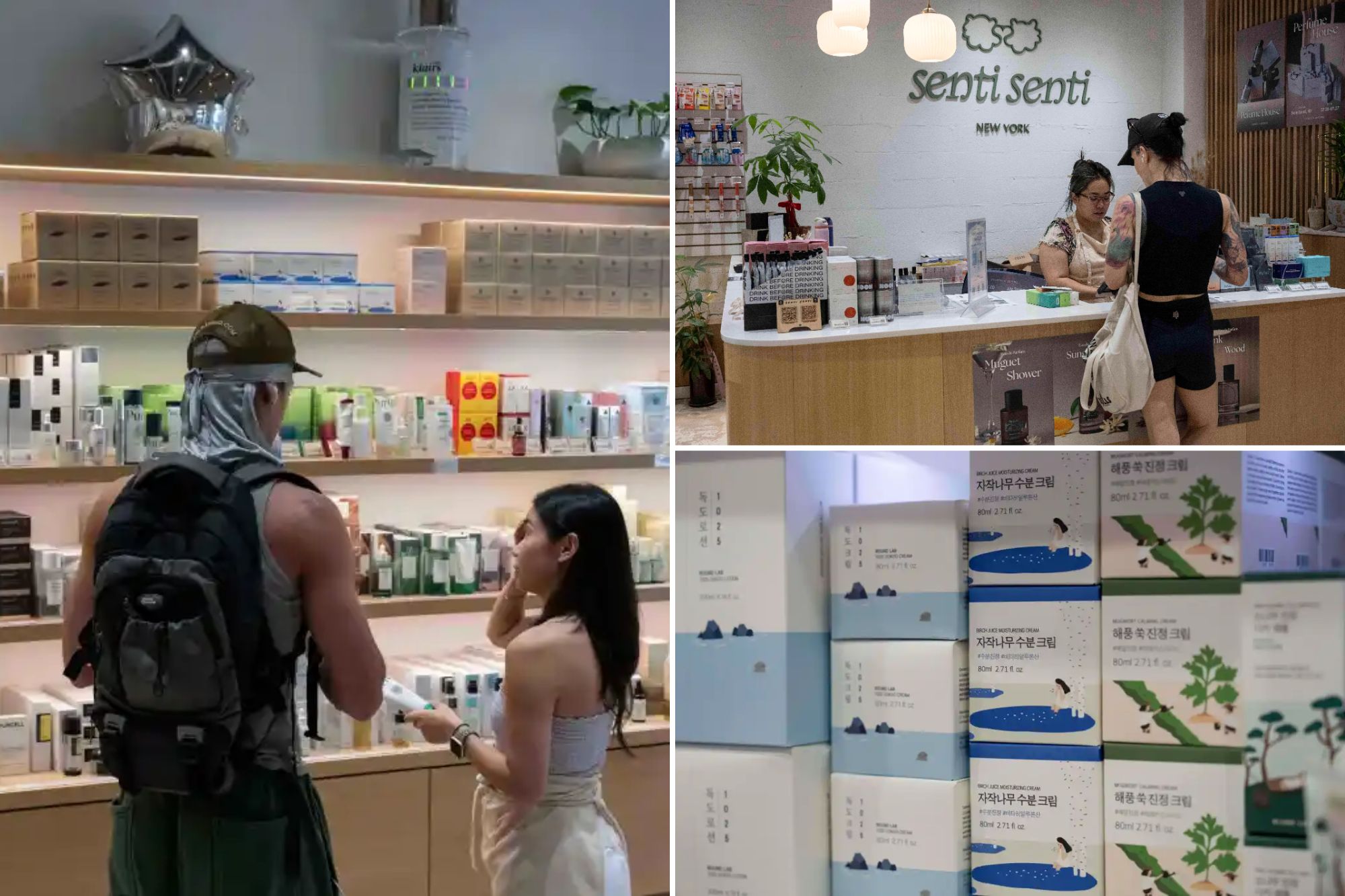
Senti Senti, a retailer that sells international beauty products at two New York boutiques and through an e-commerce site, saw a bit of “panic buying” by customers when Trump first imposed punitive tariffs on goods from specific countries, manager Winnie Zhong said.
The rush slowed down after the president paused the new duties for 90 days and hasn’t picked up again, Zhong said, even with Trump saying on July 7 that a 25% tax on imports from Japan and South Korea would go into effect on Aug. 1.
Japan, the Philippines, and Indonesia subsequently reached agreements with the Trump administration that lowered the tariff rates their exported goods faced — in Japan’s case, from 25% to 15%, still higher than the current baseline of 10% tariff.
But South Korea has yet to clinch an agreement, despite having a free trade agreement since 2012 that allowed cosmetics and most other consumer goods to enter the U.S. tax-free.
Since the first store owned by Senti Senti opened 16 years ago, beauty products from Japan and South Korea have become more of a focus and now account for 90% of the stock. The business hasn’t had to pass on any tariff-related costs to customers yet, but that won’t be possible if the products are subject to a 25% import tax, Zhong said.
“I’m not really sure where the direction of K-beauty will go with the tariffs in place, because one of the things with K-beauty or Asian beauty is that it’s supposed to be accessible pricing,” she said.
Devoted fans of Asian cosmetics will often buy direct from Asia and wait weeks for their packages to arrive because the products typically cost less than they do in American stores. Rather than stocking up on their favorite sunscreens, lip tints, and toners, some shoppers are taking a pause due to the tariff uncertainty.
Los Angeles resident Jen Chae, a content creator with over 1.2 million YouTube subscribers, has explored Korean and Japanese beauty products and became personally intrigued by Chinese beauty brands over the last year.
When the tariffs were first announced, Chae temporarily paused ordering from sites such as YesStyle.com, a shopping platform owned by an e-commerce company based in Hong Kong.
She did not know if she would have to pay customs duties on the products she bought or the ones brands sent to her as a creator.
“I wasn’t sure if those would automatically charge the entire package with a blanket tariff cost, or if it was just on certain items,” Chae said. On its website, YesStyle says it will give customers store credit to reimburse them for import charges.
Every morning, the NY POSTcast offers a deep dive into the headlines with the Post’s signature mix of politics, business, pop culture, true crime and everything in between. Subscribe here!
At Ohlolly, an online store focused on Korean products, owners Sue Greene and Herra Namhie are taking a similar pause.
They purchase direct from South Korea and from licensed wholesalers in the U.S., and store their inventory in a warehouse in Ontario, California. After years of no duties, a 25% import tax would create a “huge increase in costs to us,” Namhie said.
She and Greene made two recent orders to replenish their stock when the tariffs were at 10%. But they have put further restocks on hold “because I don’t think we can handle 25%,” Namhie said. They’d have to raise prices, and then shoppers might go elsewhere.
The business owners and sisters are holding out on hope that the U.S. and Korea settle on a lower tariff or carve out exceptions for smaller ticket items like beauty products. But they only have two to four months of inventory in their warehouse.
They say that in a month, they’ll have to make a decision on what products to order, what to discontinue, and what prices will have to increase.
Rachel Weingarten, a former makeup artist who writes a daily beauty newsletter called “Hello Gorgeous!,” said that while she’s devoted to K-beauty products like lip masks and toner pads, she doesn’t think stockpiling is a sound practice.
“Maybe one or two products, but natural oils, vulnerable packaging, and expiration dates mean that your products could go rancid before you can get to them,” she said.
Weingarten said she’ll still buy Korean products if prices go up, but that the beauty world is bigger than one country. “I’d still indulge in my favorites, but am always looking for great products in general,” she said.
Bhasin, in Menlo Park, California, plans to keep buying her face masks too, even if the price goes up, because she likes the quality of Korean masks.
“If prices will go up, I will not shift to U.S. products,” she said. “For face masks, I feel there are not a ton of solid and reliable substitutes in the U.S.”
[Notigroup Newsroom in collaboration with other media outlets, with information from the following sources]