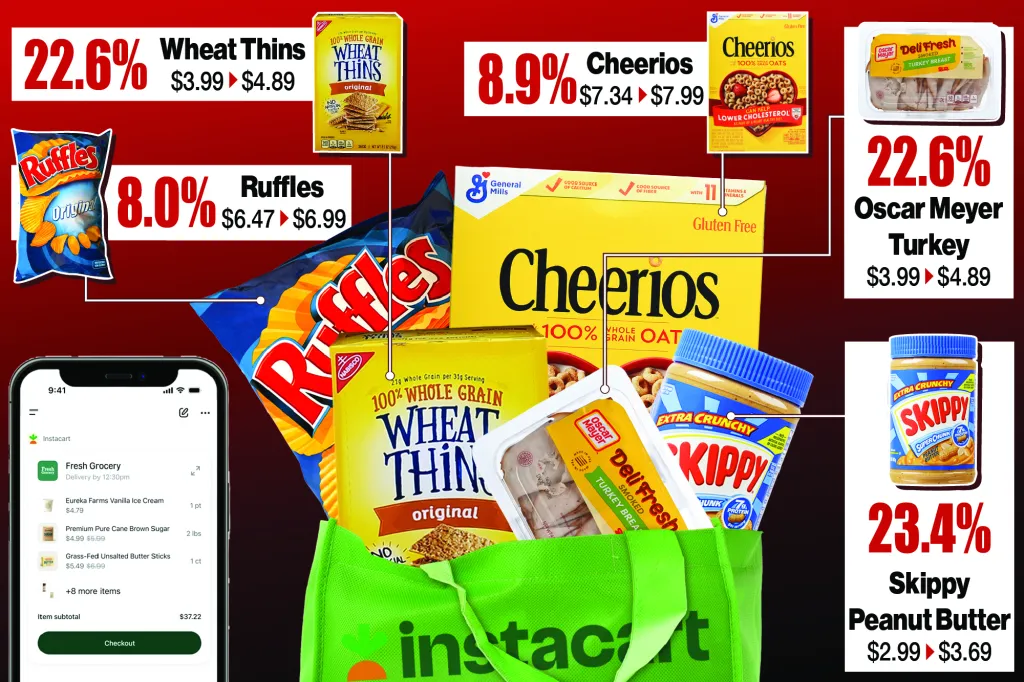
Instacart has been using a shady algorithm that charges different prices to different customers on the same grocery items in the same supermarkets – and the undisclosed price swings can be huge, according to an explosive study.
At a Target store in North Canton, Ohio, the wildly popular grocery app charged a customer $2.99 for Skippy Creamy Peanut Butter one day in September – while other Instacart users that day paid as much as $3.59 for the same jar picked up from the same location, according to the study.
At a Safeway supermarket in Seattle, shoppers using Instacart paid five different prices for the same Oscar Mayer Deli Turkey: $3.99, $4.31, $4.59, $4.69 and $4.89 — a range that spanned a whopping 23% between the lowest and highest markup.
The same pattern emerged at Target and Safeway stores across four cities, according to Groundwork Collaborative and Consumer Reports, which used 437 shoppers in its survey, ordering groceries off the Instacart app for in-store pickup.
It’s the latest example of so-called “dynamic pricing” — the hated practice introduced more than a decade ago by Uber and Lyft, hiking prices for rides during rainstorms — that is nickel-and-diming consumers, even as relentless inflation has sparked an affordability crisis.
Airlines are known to hike prices when more customers visit their sites at the same time — a tactic known as “surveillance pricing.” Even fast-food junkies claim to have spotted fluctuating prices on burger menus that are increasingly displayed on video screens.
Groundwork, a consumer advocacy group, said Instacart’s pricing algorithm could lead to shoppers forking over an extra $1,200 on groceries each year — even as food inflation has outpaced price increases for other goods since the pandemic.
Nearly three-quarters of grocery items surveyed were sold at different price points on Instacart, one of the largest grocery-shopping apps in the US, according to the study published Tuesday.
In response to a query by The Post, Instacart said its price “tests” are never based on the personal or behavioral characteristics of shoppers. It said its prices were never “dynamic,” meaning they never change in real time, although the study found that they changed wildly depending on who was shopping.
The study found no evidence that Instacart was using personal information, but said it’s almost certain that Instacart and other retailers have the ability to base prices on demographics like age and household income, as well as whether they’re new or returning customers.
Instacart claimed its “tests” help retailers “learn what matters most to consumers.” While the algorithm might charge higher prices on craft beverages or specialty snacks, it often lowers prices on essentials like milk and bread, Instacart claimed.
“Just as retailers have long tested prices in their physical stores to better understand consumer preferences, a subset of only 10 retail partners – ones that already apply markups – do the same online via Instacart,” an Instacart spokesperson told The Post in a statement.
A Target spokeswoman, however, told The Post in a written statement that “Target is not affiliated with Instacart and is not responsible for prices on the Instacart platform.” The Target spokesperson declined to comment on whether the retailer was reviewing Instacart’s practices at its stores.
Albertsons, which owns Safeway, did not immediately respond to noti.group’s request for comment.
With grocery prices up 25% since the pandemic, President Trump over the weekend ordered a sweeping investigation into food price-fixing allegations. Several Dem lawmakers have accused food conglomerates of price gouging.

Instacart powers e-commerce for Stew Leonard’s, which operates more than a half dozen supermarkets across the New York metro area. But Instacart has never approached Stew Leonard’s to do variable pricing within the same store — and the grocer says it never would.
“We would never price customer A differently from customer B,” the grocer’s chief marketing officer, Tammy Berentson told The Post. “We would have nothing to gain. It’s unfair. We are transparent about our pricing and we want to be fair to our customers and for our customers to trust us.”
At a Safeway in Washington, DC, a couple of shoppers paid as little as $3.99 for a dozen Lucerne eggs, while others coughed up $4.79 for the same carton. At that same store, some shoppers paid $2.99 for a box of Signature SELECT Corn Flakes, while others were charged as much as $3.69.
A box of Premium Original Saltine Crackers at a Target in North Canton, Ohio, cost $3.99 for some Instacart customers, and $4.59 and $4.69 for some others. Some shoppers paid $1.19 for store-brand farfalle pasta at the same Target, while others were charged $1.43.
Instacart charged shoppers at least four different prices on Wheat Thins at a Safeway in Seattle, at $3.99, $4.31, $4.69 and $4.89.
“Instacart is a black hole for the retailer,” an industry executive told The Post. “The classic rub in the scenario is ‘Whose customer is it’ – Instacart’s or the grocer’s?’”
“The problem is the retailers got into Instacart because it gives them an online presence, but then the pandemic occurred and they realized that they don’t have any visibility into the customer transactions,” the executive added.
The price changes are powered by Eversight, a software firm that Instacart acquired in 2022.
In a call with investors last year, Instacart CEO Fidji Simo said the new AI technology “helps retailers dynamically optimize their pricing both online and in-store to really figure out which categories of products a customer is more price sensitive on versus less price sensitive on and really adjust their prices based on that information.”
[Notigroup Newsroom in collaboration with other media outlets, with information from the following sources]