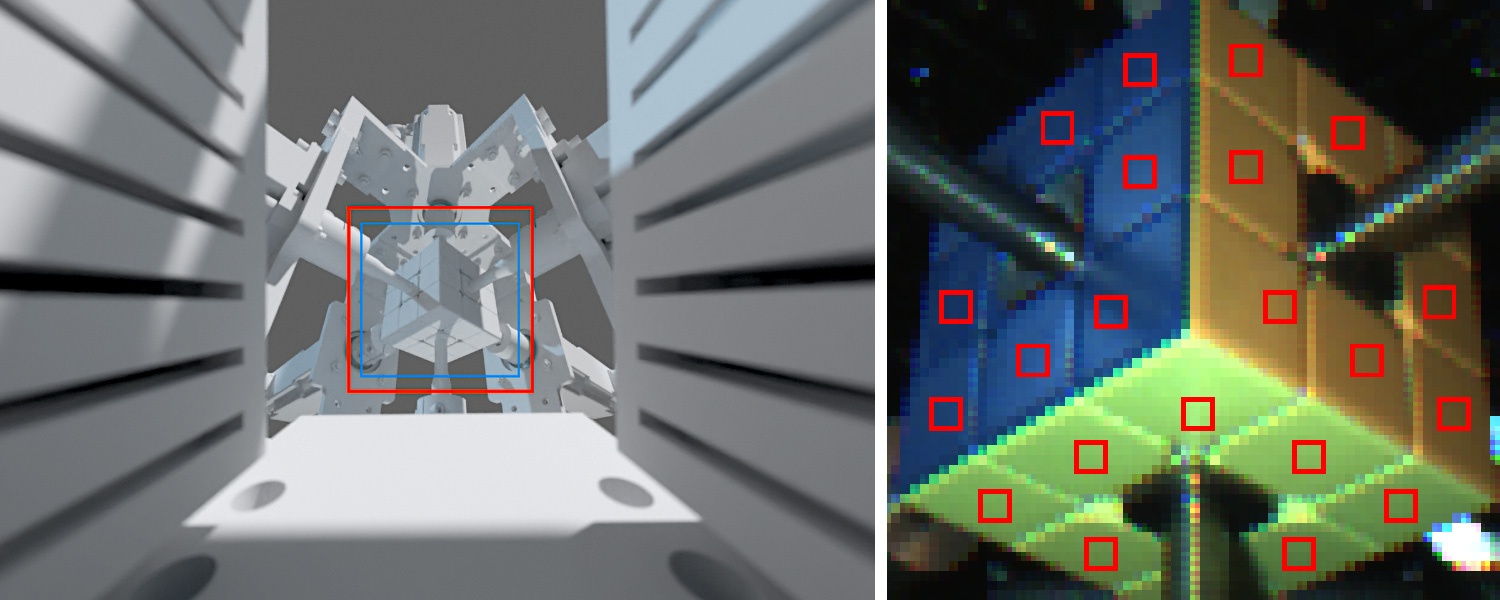
A team of Purdue University students recently set a new Guinness World Record with their custom robot that solved a Rubik’s Cube in just 0.103 seconds. That was about a third of the time it took the previous record-setting bot. But the new record wasn’t achieved by simply building a robot that moves faster. The students used a combination of high-speed but low-res camera systems, a cube customized for improved strength, and a special solving technique popular among human speed cubers.
The Rubik’s Cube-solving robot arms race kicked off in 2014, when a robot called Cubestormer 3 built with Lego Mindstorms parts and a Samsung Galaxy S4 solved the iconic puzzle in 3.253 seconds — faster than any human or robot could at the time. (The current world record for a human solving a Rubik’s Cube belongs to Xuanyi Geng, who did it in just 3.05 seconds.) Over the course of a decade, engineers managed to reduce that record to just hundreds of milliseconds.
Last May, engineers at Mitsubishi Electric in Japan claimed the world record with a robot that solved a cube in 0.305 seconds. The record stood for almost a year before the team from Purdue’s Elmore Family School of Electrical and Computer Engineering — Junpei Ota, Aden Hurd, Matthew Patrohay, and Alex Berta — shattered it. Their robot has come to be known as Purdubik’s Cube. Bringing the robot record down to less than half a second required moving away from Lego and, instead, using optimized components like industrial motors. Getting it down to just 0.103 seconds, however, required the team from Purdue to find multiple new ways to shave off milliseconds.
“Each robot that previous world record-holders has done has kind of focused on one new thing,” Patrohay tells noti.group. When MIT grad students broke the record in 2018, they opted for industrial hardware that outperformed what previous record-holders had used. Mitsubishi Electric chose electric motors that were better suited for the specific task of spinning each side of the cube, instead of just hardware that moved faster.
However, the first thing the Purdue students improved was actually the speed that their robot could visualize the scrambled cube. Human speed cubing competitors are allowed to study a Rubik’s Cube before their timer starts, but the robot record includes the time it takes it to determine the location of all the colored squares. The students used a pair of high-speed machine vision cameras from Flir, with a resolution of just 720×540 pixels, pointed at opposing corners of the cube. Each camera can see three sides simultaneously during exposures that lasted as little as 10 microseconds.
Although it may seem instantaneous, it takes time for a camera to process the data coming from a sensor and turn it into a digital picture. The Purdubik’s Cube uses a custom image detection system that skips image processing altogether. It also only focuses on a very small area of what each camera’s sensor sees — a cropped region that’s just 128×124 pixels in size — to reduce the amount of data being moved around.
Raw data from the sensors is sent straight to a high-speed color detection system that uses the RGB measurements from even smaller sample areas on each square to determine their color faster than other approaches — even AI.
“It’s sometimes slightly less reliable,” Patrohay admits, “but even if it’s 90 percent consistent, that’s good enough as long as it’s fast. We really want that speed.”
Despite a lot of the hardware on Purdue’s robot being custom-made, the team chose to go with existing software when it came to figuring out the fastest way to solve a scrambled cube. They used Elias Frantar’s Rob-Twophase, which is a cube-solving algorithm that takes into account the unique capabilities of robots, like being able to spin two sides of a cube simultaneously.
The team also took advantage of a Rubik’s Cube-solving technique called corner cutting where you can start to turn one side of the cube before you’ve finished turning another side that’s perpendicular to it. The advantage to this technique is that you’re not waiting for one side to completely finish its rotation before starting another. For a brief moment, there’s overlap between the movements of the two sides that can result in a significant amount of time saved when you’re chasing a world record.

The challenge with corner cutting is that if you use too much force (like a robot is capable of) and don’t time things perfectly, you can physically break or even completely destroy a Rubik’s Cube. In addition to perfecting the timing of the robot’s movements and the acceleration of its motors, the students had to customize the cube itself.
Guinness World Records follows the guidelines of the World Cube Association, which has a long list of regulations that need to be followed before a record will be recognized. It allows competitors to modify their cube, so long as it twists and turns like a standard Rubik’s Cube and has nine colored squares on each of its six sides, with each side a different color. Materials other than plastic can be used, but the color parts all need to have the same texture.
To improve its durability, the Purdue team upgraded the internal structure of their cubes with a custom 3D-printed version made from stronger SLS nylon plastic. The WCA also allows the use of lubricants to help make cubes spin more freely, but here it’s used for a different reason.
“The cube we use for the record is tensioned incredibly tight, like almost hilariously tight,” says Patrohay. “The one that we modified is very difficult to turn. Not impossible, but you can’t turn it with your fingers. You have to really get your wrist into it.” When solving the cube at high speeds, the lubricant helps to smooth out its movements while the increased tension reduces overturns and improves control so time-saving tricks like corner cutting can be used.

Faster servo motors do help to reduce solving times, but it’s not as simple as maxing out their speed and hoping for the best. The Purdubik’s Cube uses six motors attached to metal shafts that slot into the center of each side of the cube. After testing several different approaches the team settled on a trapezoidal motion profile where the servos accelerate at speeds of up to 12,000,000 degrees/s2, but decelerate much slower, closer to 3,000,000 degrees/s2, so the robot can more accurately position each side as it comes to a stop.
Could the Purdubik’s Cube break the record again? Patrohay believes it’s possible, but it would need a stronger cube made out of something other than plastic. “If you were to make a completely application-specific Rubik’s Cube out of some sort of carbon fiber composite, then I could imagine you being able to survive at higher speeds, and just being able to survive at higher speeds would then allow you to bring the time down.”
[Notigroup Newsroom in collaboration with other media outlets, with information from the following sources]