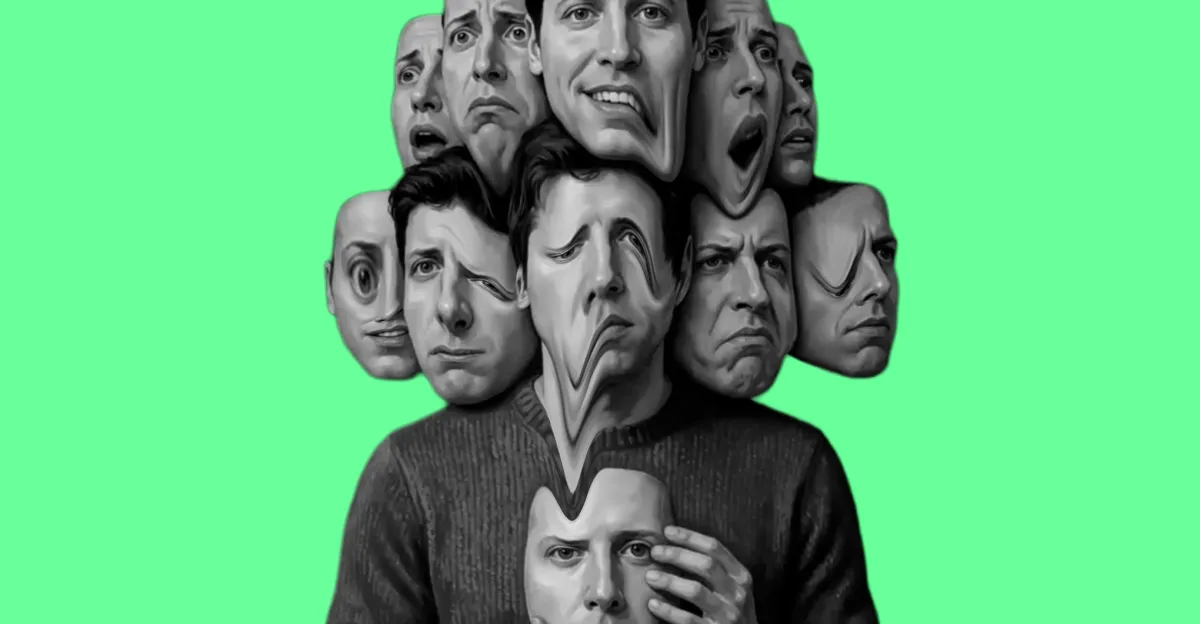
The illustration for The New Yorker’s profile of OpenAI CEO Sam Altman is a jump scare. Altman stands in a blue sweater with a blank expression. Around his head hovers a cluster of disembodied faces — creepy alt-Altmans, their expressions ranging from anger to open-mouthed woe. Some barely look like Altman. One final face rests in his hands. And at the bottom, there’s a disclosure that might spook many illustrators far more: “Visual by David Szauder; Generated using A.I.”
Szauder is a mixed-media artist who has been working with collage, video, and generative art processes that predate commercial AI tools for over a decade, and was recently teaching art and technology at Moholy-Nagy University of Art and Design in Budapest. Here, his work leans into the shifty uncanniness of Altman’s two (or more)-facedness. The pained-looking expressions on the faces and a gloss of eerie motion smoothing communicate the central thesis that Altman can’t be trusted. There’s a painterly look to the image, rather than the typical slop-style sickly sheen, but the AI origins are still unmistakable.
What does it say for The New Yorker, one of America’s most prestigious magazines, to adopt generative AI? At its worst, the technology eliminates any discernable art process, flattening the creator’s intention. It’s a system for making pregnant videos of LeBron James and Italian Brainrot, not creations that rival the work of New Yorker illustrators like Kadir Nelson, Christoph Niemann, or Victo Ngai. In Szauder’s hands, it’s far more complicated: one piece of a longer creative process, which apparently includes programming his own AI tools and feeding them archival imagery, like newspaper clippings and family photos.
Yet it’s still, in my opinion, a waste of an opportunity. Human artists have designed creative parodies of AI slop, but AI lacks the necessary self-awareness to parody itself, even with a human behind the wheel. The image relies on the unsettling nature of AI animation to tell its story without really saying anything new about AI imagery or the industry behind it all.
When we reached out to Szauder, while he wasn’t specific about which AI tools he used, he did explain the process of the piece in some detail. There is usually a sketch stage prior to delivering any final imagery. The New Yorker’s digital design director, Aviva Michaelov, says that Szauder sent around 15 different sketches to senior art director Supriya Kalidas, including the one that eventually led to the final Hydra-esque eldritch monstrosity that can be seen above the article. In an email to us, Szauder writes:
“For the base structure of the final image, I had a clear idea of how I wanted to position the character and its heads. So AI functioned even more as a tool than usual, especially since much of the work focused on shaping the faces, the heads, the portraits, through a combination of classical editing methods (Photoshop, if we want to name it) and AI-based editing. The results were often imperfect or flawed, which required manual correction and refinement. We spent considerable time refining facial expressions, while also developing multiple variations in clothing and repeatedly adjusting the lighting to arrive at the final image.”
According to a 2025 article on Szauder from Whitehot Magazine, he “managed to devise his own coding system and programming software to generate images based on a particular prompt or archival image materials he feeds into its design.” He also seems concerned with the moral quandary of traditional AI image generation, using “ethically clarified source materials.”
As Szauder explained to us, “I strongly believe that even in the age of AI, an image must first be formed in the human mind, not in the machine.”
This is a far deeper human touch than goes into much AI-generated work. The ensloppification of newsrooms has been well documented by other Verge writers. Great journalists everywhere have been completely replaced by AI or told that, to keep their jobs, they have no choice but to find ways to use it. Our parent company, Vox Media, even has an agreement with OpenAI.
The topic (and controversies) of AI use in illustration is reliably a cortisol spike for most illustrators. It’s not the first time a renowned publication has dabbled in AI. It’s also not the first time The New Yorker has commissioned David Szauder to create an AI animated illustration.
Here at noti.group, we hold a strict policy on the use of AI-generated imagery. We slap a yellow label on any image we publish that’s been generated with AI, and any time we use AI image generation to assist with the creation of an image it is disclosed, loudly, and with clear justification.
In many cases, generated images — particularly those created purely through text prompts, likely the most common method — strip out the creation process that makes art human. The input from a text field only has so much effect on the output, to the point that AI-generated images created this way can’t be copyrighted. According to a guidance from the US Copyright Office on the legal authorship of AI-generated images, “No matter how many times a prompt is revised and resubmitted, the final output reflects the user’s acceptance of the AI system’s interpretation, rather than authorship of the expression it contains.”
The eye of an artist is informed by a lifetime of assembling an internal library of taste, meaning, and intent, none of which are possessed by tools like Midjourney or ChatGPT. The results of image prompts often feel like somebody describing a dream: It’s fascinating when your brain assembles it, but tell another person your surrealist vision about making out with your therapist before all of your teeth turned to dust and disintegrated, and their eyes glaze over until the subject changes back to the weather. A dream becomes worth something (outside of an awkward Zoom call with your therapist) when a human being makes the effort of translating it into a work of art — it’s not just the idea but the process that makes it compelling.
Meanwhile, although we don’t know the statistics for editorial illustrators, AI is definitely stealing art jobs. There are some illustrators who, consequently, swear off these tools altogether. Others have found them helpful to stay afloat in a difficult field, like illustrators who experiment with feeding AI image generators their own work or more practical applications like using the AI-powered “remove background” tool in Photoshop. Art budgets are often the first belt tightened at an editorial publication in the throes of a revenue-bleeding death spiral. Freelance work is so atomized that it’s functionally impossible to unionize, and illustration is a trade that is already rife with exploitation, with rates in a race to the bottom. As a former freelance artist, I’m not here to judge David Szauder for his process — which, again, seems far more involved than the average AI image creator’s.
But there’s still the question of whether the Altman piece — which uses the visual aesthetic of job-stealing, uncanny AI slop to illustrate a Ronan Farrow article about the dark prince of job-stealing, uncanny AI slop — works. Szauder is doing what countless AI proponents have been calling for: using it as part of a larger artistic toolbox to convey an idea. What are the results?
Although I think it basically succeeds in communicating the story, the final image feels like an attempt at metacommentary that, thematically, falls flat. If you weren’t familiar with the telltale signs of AI imagery, you could miss that commentary altogether. Although the image was a dead giveaway for AI origin to me and the rest of our art team, it doesn’t possess any of the more stylistic aspects of some of Szauder’s other work, leaving the central visual metaphor to do the idea’s heavy lifting, and giving the whole thing a sickly but slightly boring vibe.
The inconsistent likeness on all of the faces (something a portrait illustrator could’ve controlled for) is also a dead giveaway for AI’s limitations, and the synthetic studio backdrop environment makes the whole thing feel like a Lifetouch elementary school photo. The murky intentionality and bland presentation create more questions for the viewer than they do tell the story of Sam Altman’s many faces.
By contrast, Szauder’s other New Yorker piece feels like it comes from more interesting source material. It’s more cinematic, and the squirming texture of the pit’s colorful walls echoes back to the early days of AI when the end results were even more chaotic and unpredictable.
I don’t want to tell anyone who works in a field as precarious as freelance editorial illustration how they’re supposed to feel about AI. The decision to hire Szauder to illustrate for The New Yorker doesn’t scare me, personally. It’s a far more reasoned editorial decision than the “best writing, anywhere” publication filling its negative space with shrimp Jesuses and whatever the fuck this is. Inviting AI imagery into the pages of a world-renowned publication is definitely a slippery slope, and one that could be seen as normalizing the use of AI across the illustration industry. But The New Yorker didn’t create this problem, and it didn’t single-handedly create the conditions of uncertainty illustrators have faced since long before we had gen AI to contend with. Much like the rabbit hole in Szauder’s first New Yorker AI image, they are stumbling down it just like the rest of us.
[Notigroup Newsroom in collaboration with other media outlets, with information from the following sources]