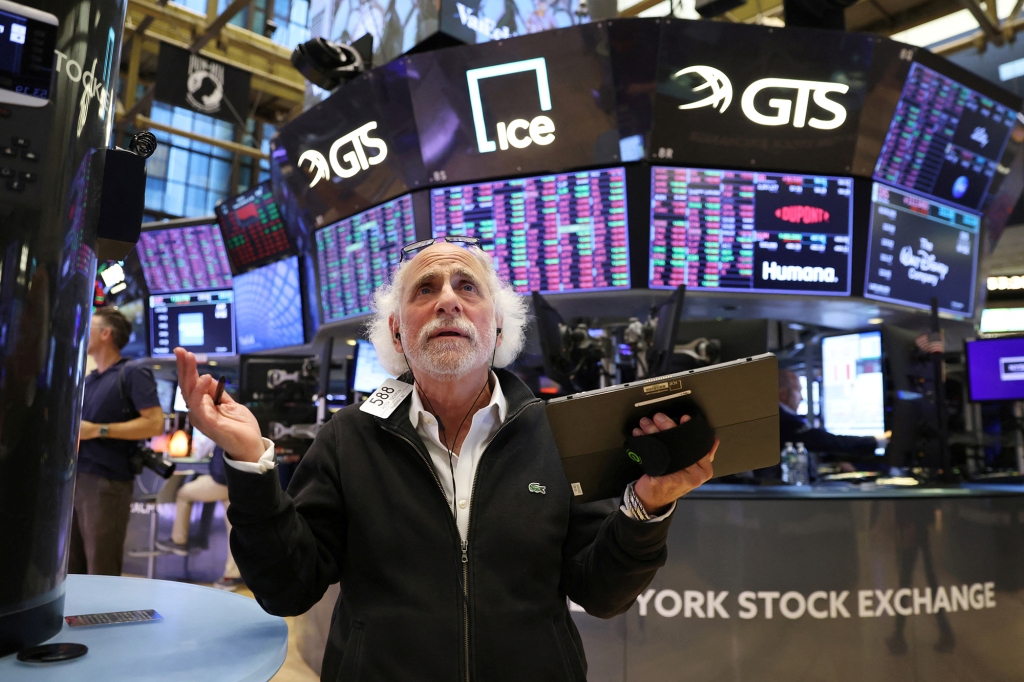
Wall Street’s main indexes hit near-two-month lows on Friday, after a profit warning from global delivery bellwether FedEx spooked investors already worried about aggressive rate hikes from the Federal Reserve tipping the economy into a recession.
In midday trading, the Dow Jones Industrial Average was down 329.09 points, or 1.1%, at 30,632.73, the S&P 500 was down 55.86 points, or 1.4%, at 3,845.49, and the Nasdaq was down 205.11 points, or 1.8%, at 11,347.24.
The benchmark S&P 500 fell below the 3,900 mark, a level traders considered a key support, dragged down by a 23.4% plunge in shares of FedEx, which hit a 52-week low on Friday.
The stock was on pace for its worst day on record after the company said a global demand slowdown accelerated at the end of August and predicted that it would worsen in the November quarter.
Rivals UPS and XPO Logistics slid 5.7% and 7.4%, respectively, while Amazon slipped 3.9%.
All of the 11 S&P sectors declined in early trading, led by a 2.5% fall in the industrial sector. The Dow Jones Transport Average Index slid 5.8%.
“FedEx news may be saying something about the health of the economy and underlying demand. However, this news itself is not a specific factor that will be taken into account in terms of next week’s policy decision,” said Mark Dowding, chief investment officer of BlueBay Asset Management.
“We have seen rising concern about higher yields, and slowing growth and recession risk is something that is weighing on sentiment. So, we would not be surprised to see the equity market retest its lows,” Dowding said.
The S&P 500 is now just 5.8% above its mid-June closing low as a summer rally in Wall Street peters out on fears of steep increases in US interest rates and deterioration in earnings growth.
The Federal Reserve is widely expected to deliver the third straight 75-basis-point rate hike at its meeting next week after recent data failed to alter the expected course of aggressive policy tightening.
Adding to the somber mood, the World Bank projected that the global economy might be inching toward a recession, while the International Monetary Fund said it expected a slowdown in the third quarter.
September, which is a seasonally weak period for markets, will also see the Fed ramp up the unwinding of its balance sheet to $95 billion per month, a move some investors fear may add to volatility in markets and weigh on the economy.

Meanwhile, the week of the monthly options expiration, ending on the third Friday of every month, has been marked by a greater-than-usual volatility this year, as options-hedging activity has amplified market moves.
The CBOE volatility index, also known as Wall Street’s fear gauge, hit a two-month high of 28.39 points.
All three indexes are set for a sharp weekly fall, with the tech-heavy Nasdaq down 6.3%.
[Written in collaboration with other media outlets with information from the following sources]