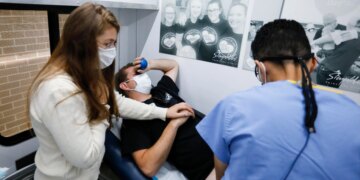
A lecturer who was told by doctors that his short temper and anti-social behaviour was ‘lockdown depression’, was actually battling a brain tumour.
Richard West, 64, became anti-social, short tempered and forgetful when Covid restrictions lifted in 2021.
He visited his GP on several occasions where he was given medication for anxiety.
But after he suffered a ‘psychological breakdown’, he went back to his GP who booked him in for an MRI, which revealed a 7cm tumour on the left frontal lobe of his brain.
Mr West, a former University lecturer, from Aylesbury, Buckinghamshire, underwent surgery in June 2022 to remove the tumour which was diagnosed as a meningioma.
The non-cancerous tumour starts in the meninges — the brain’s protective layers. It is very common, but can be deadly if untreated.
‘It was a difficult time because everything was changing fast,’ Mr West recalled.
‘I’d been a lecturer at the University of Westminster in London for more than two decades, but different methods of teaching and assessment were being introduced.

Richard West, 64, (pictured) became anti-social, short tempered and forgetful when Covid restrictions lifted in 2021

He went back to his GP who booked him in for an MRI, which revealed a 7cm tumour on the left frontal lobe of his brain
At the same time, I was developing a new course in Sports Management which was very demanding.
‘When restrictions were lifted, people went back to work in 2021. However, although I loved my job, I returned with no enthusiasm. I was depressed, short tempered, and most worryingly, forgetful and anti-social. Deep down, I knew something wasn’t right.
‘When I heard the words brain tumour, my thoughts turned morbid. All I could think was, how long have I got?’
Mr West had previously been successfully treated for prostate cancer in 2020 and felt ‘numb’ when scans revealed his brain tumour.
After his surgery in June 2022, his symptoms improved almost immediately.
‘The pain and stiffness in my muscles and joints went away. I could walk, run, go to the gym, read and communicate again. It was like having a new life,’ he said.
But after a stroke in January 2024 Mr West was told his tumour had grown back — and he suffered an ‘episode’ on the way to a check up.
‘The vision in my right eye became blurred and I couldn’t read or make sense of words,’ Mr West said.

Mr West pictured with his partner Tina, had previously been successfully treated for prostate cancer in 2020 and felt ‘numb’ when scans revealed his brain tumour

Mr West underwent six weeks of radiotherapy after his tumour grew back and is now monitored with regular scans
‘We made it to the MRI centre and explained what had happened, but it was recommended the scan should go ahead as planned.
‘It wasn’t until two days later that I went to my GP, and further tests confirmed I’d had a stroke. I was lucky to be alive as it could’ve been fatal.’
However, when the MRI scans came back he had even more bad news, the residual meningioma had grown a couple of millimetres.
Mr West underwent six weeks of radiotherapy after his tumour grew back and is now monitored with regular scans.
To help raise awareness and money to fund research, Mr West is hosting a music event to fundraise for Brain Tumour Research and Berkhamsted-based mental health charity, Hector’s House.
He said: ‘Having survived prostate cancer, to be diagnosed with a brain tumour and to have had a stroke, I feel like I shouldn’t be alive — but here I am, feeling positive and getting fitter by the day.
‘I want to raise awareness of brain tumours to bring it to the attention of more people so that we can drive investment towards research into the disease.’
According to The Brain Tumour Charity, meningiomas are common, accounting for 27 per cent of all brain tumours diagnosed.
While uncommon, they can be life-threatening if they’re untreated and left to invade and damage other parts of the brain.
Meningiomas can start anywhere in the brain and spinal cord and the symptoms depend on where the tumour is.
Symptoms can include headaches, vision changes, hearing loss, seizures and weakness in the your arms and legs — but some meningiomas do not cause any symptoms, Cancer Research explains.
Mr West confessed that for him, one downside of having a brain tumour is that it changes your personality.
‘Friends, family and people you meet don’t always realise, because from the outside you can appear “normal”. But inside there are all kinds of anxieties,’ he said.
He added: ‘What will the next MRI scan will reveal? Is this sudden headache something to worry about? Did I just forget the car keys, or is my memory fading?’
Mr West explained: ‘For many, their journey will involve ongoing radiotherapy, more surgery, and always a nagging fear that the tumour will regrow. Of course, not everyone feels the same and their journey may be different.
‘It is a cruel disease that shatters lives. That’s why I’m focused on promoting a gig to raise funds for causes that are vitally important to me. If we had more knowledge and understanding of the disease, there is a potential to stop it from changing lives so drastically.’
[Notigroup Newsroom in collaboration with other media outlets, with information from the following sources]