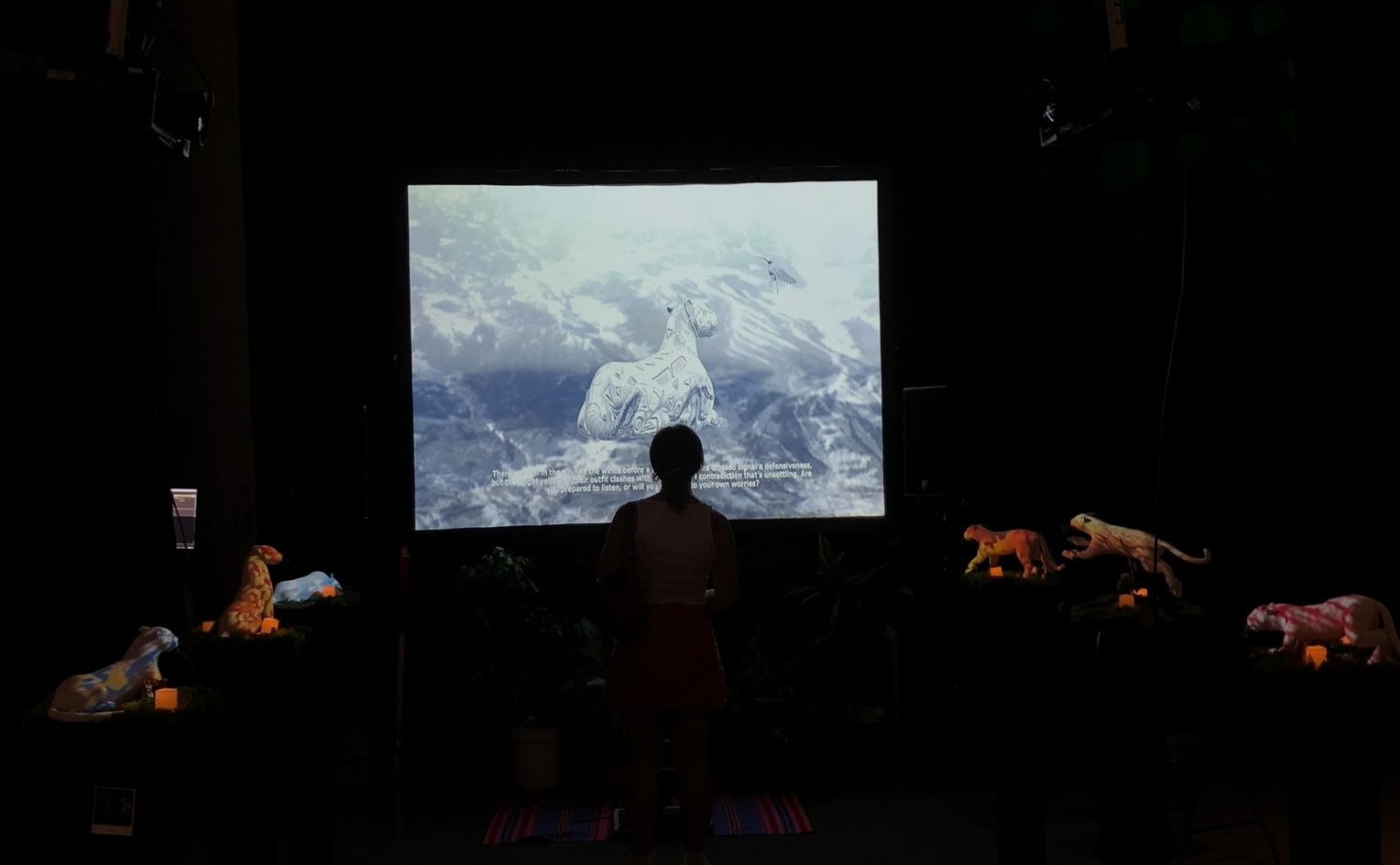
At a recent exhibition in Copenhagen, visitors stepped into a dark room and were met by an unusual host: a jaguar that watched the crowd, selected individuals, and began to share stories about her daughter, her rainforest, and the fires that once threatened her home — the Bolivian Amazon. The live interaction with Huk, an AI-driven creature, is tailored to each visitor based on visual cues. Bolivian Australian artist Violeta Ayala created the piece during an arts residency at Mila, one of the world’s leading AI research centers.
These residencies, usually hosted by tech labs, museums, or academic centers, offer artists access to tools, compute, and collaborators to support creative experimentation with AI. “My goal was to build a robot that could represent something more than human; something incorruptible,” Ayala says. Ayala’s jaguar is a clever use of early AI, but it is also emblematic of a wider movement: a fast-growing crop of artist residencies that put AI tools directly in creators’ hands while shaping how the technology is judged by audiences, lawmakers, and courts.
Residencies like these have expanded rapidly in recent years, with new programs emerging across Europe, North America, and Asia — like the Max Planck Institute and the SETI Institute programs. Many technologists describe them as a form of soft power. Pieces by artists who have participated in AI art residencies have been featured in galleries such as the Museum of Modern Art in New York and Centre Pompidou in Paris.
One of the newest programs was started by Villa Albertine, the French American cultural organization. In early 2025, the organization created a dedicated AI track, adding four new residents per year to the 60 artists, thinkers, and creators it hosts annually. The initiative was announced at an AI summit in Paris with French Minister of Culture Rachida Dati and backed by Fidji Simo, OpenAI’s CEO of applications.
“We’re not choosing sides so much as opening space for inquiry,” says Mohamed Bouabdallah, Villa Albertine’s director. “Some residents may critique AI or explore its risks.” In 2024, Villa Albertine also hosted a summit called Arts in the Age of AI, drawing more than 500 attendees and participants from OpenAI, Mozilla, SAG-AFTRA, and both US and French copyright offices, according to Bouabdallah.
Bouabdallah says these programs are designed to “select the artist, not just their work.” They provide artists with the time and resources needed to explore art projects that use AI. “Even if someone uses AI extensively, they must articulate their intent. It’s not just about output—it’s about authorship.” As he puts it, “The tool must be behind the human.”
This kind of cultural framing is meant to promote artistic production, but it can also influence how AI is viewed by the public, pushing back on the often negative perception around AI art. “An AI developer might want to change minds about what’s legitimate by packaging the use of AI in a form that resembles traditional artistic practice,” says Trystan Goetze, an ethicist and director at Cornell University. “That could make it seem more acceptable.”
“The real value here is giving artists the space to grapple with that themselves.”
Residencies may support specific artists, but they don’t address the broader concerns around AI art. “Changing the context from random users prompting models in Discord to formal residencies doesn’t alter the core issues,” Goetze says. “The labor is still being taken.”
These legal questions around authorship and compensation remain unresolved. In the US, class-action lawsuits by artists against Stability AI, Midjourney, and others are testing whether generative models trained on copyrighted work constitute fair use.
Courts will decide these questions, but public sentiment may shape the boundaries: if AI-generated art is culturally perceived as derivative or exploitative, it becomes harder to defend its legitimacy in policy or law, and vice versa.

A similar dynamic played out over a century ago. In 1908, the US Supreme Court ruled that piano rolls, then a new format for reproducing music, were not subject to copyright, because they weren’t readable by the human eye. Widespread backlash from musicians, publishers, and the public spurred Congress to pass the 1909 Copyright Act, introducing a compulsory licensing system that required payment for mechanical reproductions.
“These models do have a recognizable aesthetic,” Goetze says. “The more we’re exposed to these visuals, the more ‘normal’ they might seem.” That normalization, he speculates, might soften resistance not just to AI art but also to AI in other domains.
“There’s always been debate around inspiration versus plagiarism,” Bouabdallah says. “The real value here is giving artists the space to grapple with that themselves.”
Ayala argues that “the problem is not that AI copies — humans copy constantly — it’s that the benefits are not distributed equally: the big companies benefit most.”
Despite those challenges, Ayala sees residencies as important sites of experimentation. “We can’t just critique that AI was built by privileged men, we have to actively build alternatives,” she says. “It’s not about what I want AI to be: it already is what it is. We’re transitioning as a species in how we relate, remember, and co-create.”
[Notigroup Newsroom in collaboration with other media outlets, with information from the following sources]