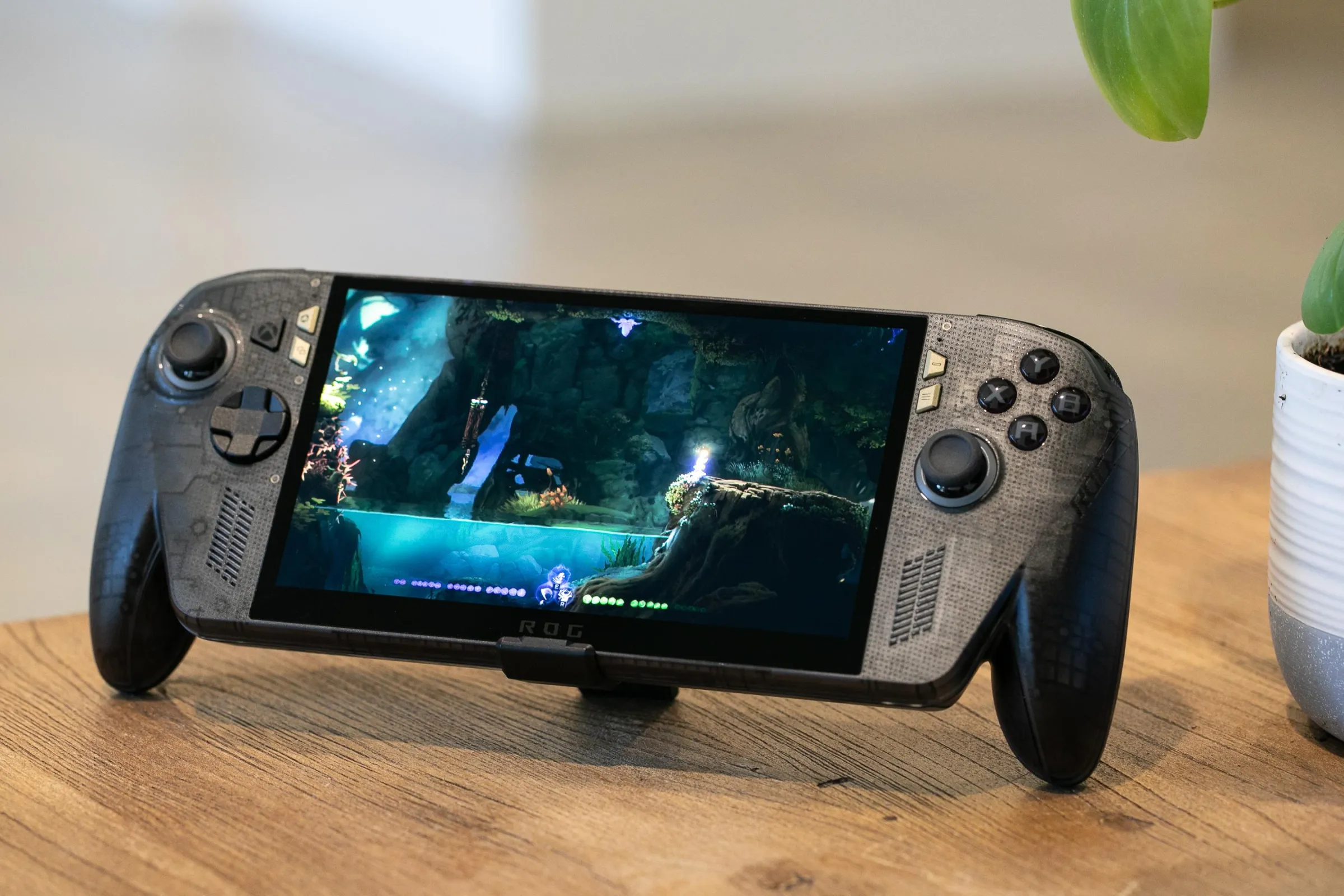
When I first told you about the “OLED Xbox Ally X of my dreams,” I had to curb my enthusiasm a bit. That’s partly because I hadn’t yet tried the handheld myself, and partly because Asus was only planning to sell it bundled with a pair of expensive AR glasses! I’m happy to say both things are no longer true.
Asus will sell a standalone version of the OLED Ally as well, spokesperson Anthony Spence confirms to noti.group. “We are actively discussing the release schedule for a standalone version of the new Ally. Please stay tuned for upcoming announcements.”
And after spending two hours with the OLED Ally at the company’s California offices, I think it might even give the new MSI Claw 8 EX AI Plus a run for its money.

Today, the $1,000 Asus Xbox Ally X is suddenly the best deal in town because of RAMageddon, while the MSI Claw 8 EX offers a generational leap in performance for those who have a staggering $1,800 to spend.
But the OLED Ally might offer a third choice for deep-pocketed gamers: the most comfortable and refined handheld yet.
I already prefer Asus’ 7.4-inch OLED screen over the 8.8-inch one that Lenovo picked for the Legion Go 2 — yes, the one I previously called “the best handheld screen money can buy.” And I definitely prefer it over the MSI Claw 8 EX’s 8-inch IPS panel.
Even though the Ally’s screen is smaller, shorter, and slightly lower resolution — 1080p rather than 1200p — it is so much clearer in person because of its anti-glare cover glass and the brighter panel underneath.

I brought along a Legion Go 2 and a Claw 8 EX to compare directly to the OLED Xbox Ally X20. With harsh overhead indoor lighting, I had to look through the reflection of my own face on rivals’ glassy screens, but the OLED Ally’s was crystal clear. And while it’s only a little brighter than the Legion Go 2, with 1,400-nit peaks instead of 1,000-nit peaks, it’s much brighter than the Claw EX’s 500-nit screen. I recently took a road trip with the Claw EX and had to squint even at max brightness because of all the glare.
A 7.4-inch screen may not sound much bigger than the 7-inch ones on previous Allys, but it makes a difference. Those earlier ones feel a little claustrophobic for me after testing 8-inch handhelds, but I didn’t feel that at all in my couple hours with the Ally X20.

Last year’s Xbox Ally X showed me that handhelds are better with prongs, and I have to hand it to the MSI Claw EX for adding manta ray fins for an even beefier grip. But Asus now has cushy rubberized grips, too, rather than simply a textured plastic shell, for even more comfort.

The new ABXY face buttons are the most satisfying ones I’ve felt on a handheld yet, quieter, and flush with the handheld’s shell when you press them down. The bumpers feel slightly better, and the screen doesn’t get quite as hot in use due to the reworked fans and airflow. I’m not sure about the triggers yet; I don’t like the squeak my Xbox Ally X review unit’s triggers developed, and these ones feel pretty similar.

But I’m so happy to say my old nemesis, the Xbox Ally X “Library” button, is well and truly dead. When I accidentally pressed the new “Action” button that replaces it (it’s the upper-right gold button with a picture of a single horizontal bar), it simply took a screenshot instead of yanking me out of my game. I still think the Start button should be the top button, though.
The trick D-pad really works
A transforming D-pad that spins to go from eight-way to four-way by lowering four of its corners? I was ready to write it off as a gimmick — until I fired up Hollow Knight: Silksong. It was instantly the difference between nailing every single one of Hornet’s diagonal attacks, letting her float and sting again and again, or me sometimes missing the diagonal input and watching my warrior fall to the ground.


You transform it by pulling up on the D-pad’s horizontal edge with your fingernails and rotating it a quarter-turn. Hopefully it doesn’t become an extra point of mechanical failure; it felt tight and premium to me. The clicky dome switches underneath won’t satisfy those who prefer membrane D-pads, but I like it.
Asus wasn’t ready to let me run true benchmarks, but I did fire up two games on the Xbox Ally X20 and the MSI Claw 8 EX for direct comparisons, setting both processors to 25 watts and loading the same exact save.
In Cyberpunk 2077, the Claw EX offered 61 frames per second in the same location that the Ally X20 offered 44fps. In Returnal, the Claw EX offered 62fps where the Ally X20 offered 41. Both handhelds drained their battery at roughly the same rate of 36 watts, meaning their 80-watt-hour batteries should last about two hours on a charge.

That means the Claw may have 40 or 50 percent more performance with no battery penalty — but it’s not the whole story. First, the OLED Ally has a 30–120Hz variable refresh rate (VRR) screen, meaning it should look smoother at even lower frame rates than the 48–120Hz panels in the Claw EX and the original Ally. It definitely seemed smooth in my brief demo.
Second, as I’ll eventually discuss in my full Claw EX review, that Intel chip is having some growing pains with drivers. You may even be able to see it in my Returnal comparison photo in this story: There’s less volumetric fog and less ground cover than you see with the AMD chip in the Ally.
I’m also experiencing stutter or uneven frame pacing in some games with the Intel Claw, like Clair Obscur: Expedition 33 and Star Wars Jedi: Survivor, where I’ll get more than 50fps but they still don’t always feel smooth, and Indiana Jones and the Great Circle keeps freezing on me entirely. Intel tells me it’s working on issues like these, though, and its latest drivers have already fixed most of the Expedition 33 graphical glitches we saw on Intel.
Third, the Ally’s fans were notably quieter than the Claw’s during these two tests.

Because of RAMageddon, every gaming handheld is too expensive today, and the OLED Ally will surely be the same. It’s almost certain to cost more than today’s $1,000 Xbox Ally X, so I wouldn’t wait for this new one if that’s as much as you’re willing to spend. But if you’re looking for the best handheld at any price, the OLED Ally might be worth waiting for.
Photography by Sean Hollister / noti.group
[Notigroup Newsroom in collaboration with other media outlets, with information from the following sources]