Volvo once had ambitions to fully exit the gas car business. Now it’s trying to keep its tenuous foothold in the EV market.
It’s not an understatement to say that Volvo’s EV journey has been a bumpy one. The compact EX40 has been a consistent winner, but the Swedish brand’s other EVs have been plagued with problems. The EX90 was supposed to be a bold statement for the future, but persistent software bugs have forced Volvo into an expensive hardware replacement. The tiny EX30 faired no better, with tariffs upending the rollout of the brand’s first mass-market affordable EV, eventually leading to its discontinuation in the US.
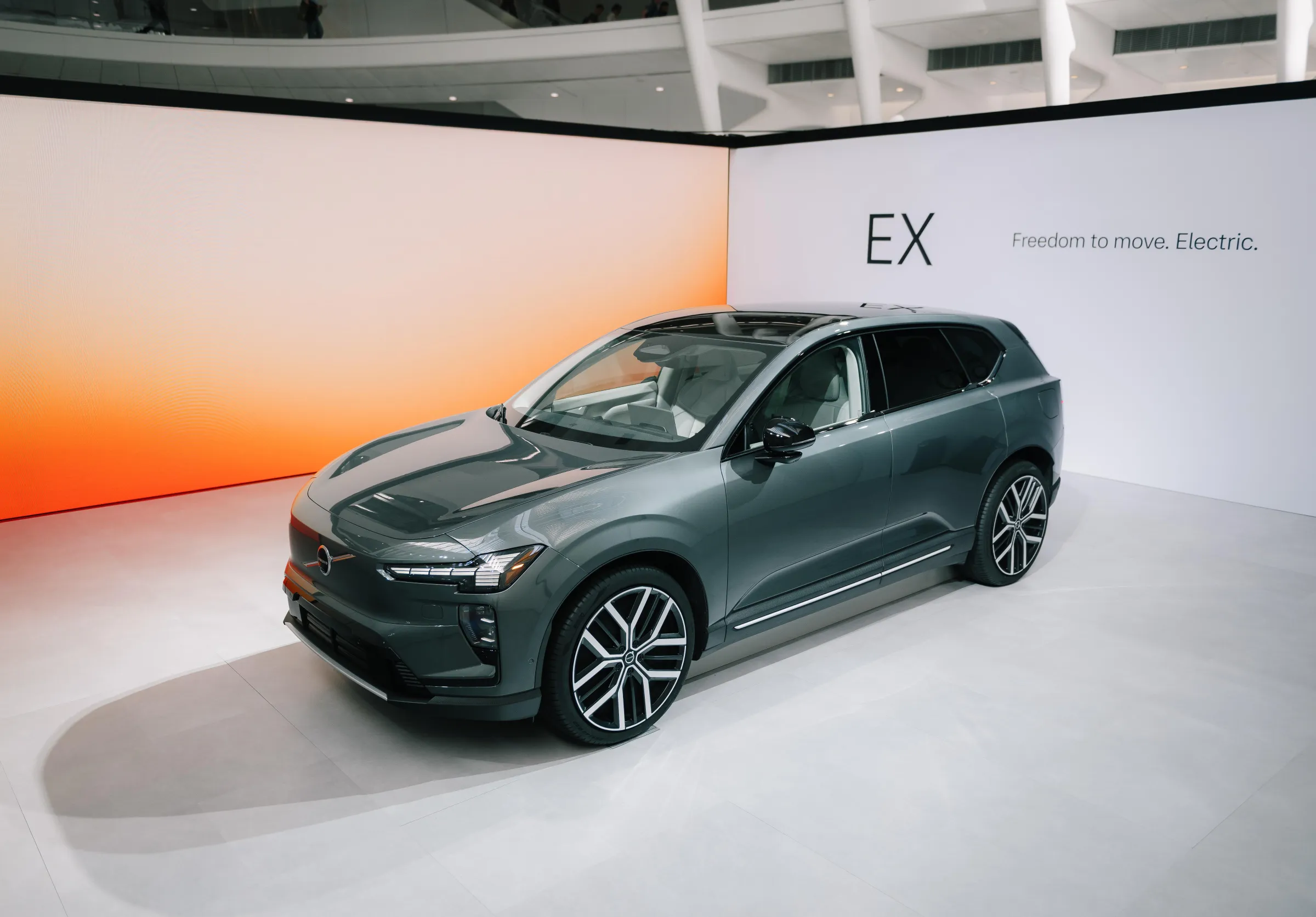
But now with the EX60 compact SUV, Volvo is hoping to get its EV groove back. Volvo’s top executives gathered in New York City this week to mark the new compact SUV’s US debut and to celebrate the opening of orders for customer deliveries later this summer. Starting at $59,795, the next-gen EX60 will be more expensive than the regular, gas-powered XC60 crossover, which has recently become Volvo’s top-selling model of all time. But it will be less expensive than the plug-in hybrid XC60, which says a lot given the popularity of hybrids these days.
But the EX60 will arrive in what is arguably the most hostile environment for EVs since their inception, thanks to the elimination of the $7,500 federal EV tax credit, policy changes, and tariffs making vehicles of all types more expensive. As EV sales grow globally, the American market is in an obvious slump. But Volvo thinks the EX60’s impressive traits — 400 miles of range, 10–80 percent fast-charging in 18 minutes, and a steady stream of OTA software updates — will be enough to beat back the headwinds.
“Is this the right time to introduce an electric car with everything you hear on the market?” Volvo CEO Håkan Samuelsson said. “I would say yes, because we think this car will not be electrified with subsidies or incentives. It will be electrified… because we can offer something better to consumers.”
Still, Volvo’s previous plans to phase out the sale of gas guzzlers is still evolving. Slowing EV demand and concerns about charging infrastructure have caused some manufacturers to reconsider how quickly they can transition away from gas-powered vehicles. Volvo previously said it would stop selling internal combustion-engine vehicles by 2030, but now has no strict date. The automaker also said it will broaden its scope to include plug-in hybrids and extended-range EVs, echoing a position across the industry.
The EX60 represents a new start. Volvo started with a clean sheet , intentionally removing legacy combustion-engine assumptions from the engineering process, Volvo CTO Anders Bell said. To achieve this, the automaker rebuilt its development process around a more modern software-defined architecture.
“So all the lessons, all the polishing, all the infrastructure, all the learning stuff that has been quite painful over the last few years has now gone into the whole machinery and the whole software,” Bell said
Getting to a regular cadence for software updates will be another regular feature for the EX60. Bell said that Volvo will release major updates to customers every three months, arguing that quality improves when multiple vehicles share the same digital architecture. Bell said the EX60 already felt significantly more stable in testing than previous Volvo EVs did at the same stage of development.
When it comes out, the EX60 will find itself in competition with the Tesla Model Y, one of the most popular vehicles on the planet, as well as a host of promising up-and-coming EVs like the Rivian R2, and BMW iX3.
“Is this the right time to introduce an electric car with everything you hear on the market?”
— Volvo CEO Håkan Samuelsson
That said, the EX60 is not intended to be a “global” car, Samuelsson said, noting that it will primarily be sold in the US and Europe. He described the global automotive industry as increasingly splitting into two separate markets: one centered around China and another around Europe and North America. And while Volvo has access to Chinese technology through its relationship with its parent company Geely, the automaker will remain focused on Western consumers.
Samuelsson also hyped up the company’s future hybrid models, which he said would flip the current hybrid formula of producing combustion-engine vehicles supplemented by relatively small batteries for short-distance electric driving. Volvo’s new hybrids will behave primarily like EVs, while retaining a combustion engine as a backup for long trips. These EREVs could appeal strongly to American consumers who are not yet ready to transition fully to battery-electric vehicles, he argued.
Volvo’s use of Android Automotive as its core vehicle operating system will also give the company a leg up over its competitors with regard to the integration of more AI features, Bell argued. This week at Google’s I/O conference, Volvo announced that the EX60 would give Gemini access to the vehicle’s external cameras so the AI chatbot could help drivers interpret lane markings and road signs. Volvo is also preparing to deploy Gemini to approximately 2.5 million vehicles dating back to model year 2020 through over-the-air software updates, he said.
”We had no idea when those cars would roll out six years ago that we’re going to over-the-air update something called conversational AI to those cars in six years,” Bell said. “We had no idea. That’s what we’re doing now.”
Still, Volvo’s gathered executives agreed that the company’s EV launches have been complicated, with Bell acknowledging that it’s been a “bumpy” ride. The EX90 is continuing to receive software updates to help smooth out its bugginess, with the latest addressing more than 20 separate issues while introducing significant improvements to the driving experience. And in addition to the EX60, Volvo is working on a new EV that will replace the affordable EX30 in its lineup. But overall, the company is trying to loudly project the message that it has learned its lessons and stands ready to face its competition.
“The EX60 will be much more solid,” said Erik Severinson, Volvo’s chief commercial officer. “But also with the number of vehicles that we’re going to sell, the EX60 will be so much bigger then. So more experience, more vehicles, more consumers.”
[Notigroup Newsroom in collaboration with other media outlets, with information from the following sources]