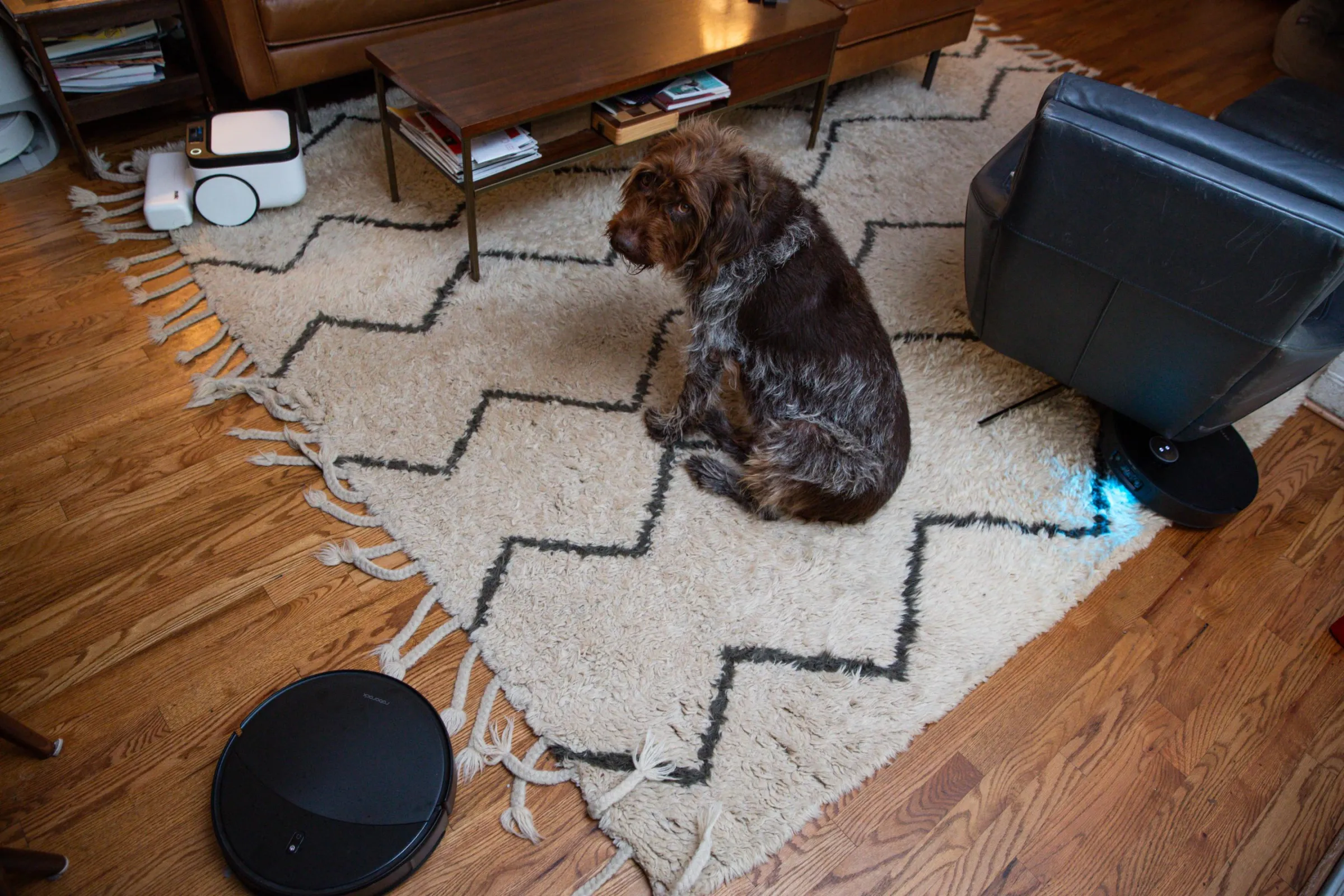
Inviting a robot vacuum-mop into your life is a big decision. An autonomous floor-cleaning machine roaming your home is equal parts glorious and intrusive. But if it does its job well, you may forgive it for eating your rug tassel, running over your Apple Watch, smearing strawberry jam across your carpet, or chattering to you in Chinese at 3AM — all things that have happened to me in my six years of testing these things.
Over that time, I’ve learned that the best robot vacuum-mop is the one most likely to consistently vacuum and mop your floors with the least intervention. And doing that depends far more on your house than on a spec sheet. The first thing I ask someone who wants to buy a robot vacuum is to describe their house. What is your flooring type, how many rugs do you have, what’s the furniture style, are there big room transitions, and how is the home laid out? All these details factor into which robot will work best for you.
Here, I’m going to tell you which robot vacuum-mop I would pick for my home and why, and then go through those I would choose for other common home scenarios — from all-wood floors with the occasional throw rug to a home with wall-to-wall carpet and tile floors. These recommendations aren’t from lab tests or spec sheets; they’re based on actually living with these bots.
First, let’s set expectations. Robot floor cleaners have improved significantly in the last few years, especially for mopping. Many can now “scrub” your floors instead of just dragging a damp cloth around your house. But they still don’t clean as well as picking up a vacuum and a mop yourself, and they are far from hands-off.
Most still struggle with corners, baseboards, tight spaces, and dried-on messes, and all of them need maintenance — mopping robots even more so than vacuum-only models. But if these tradeoffs are worth it to you, these robots will keep dirt, dust, and pet hair under control with far less effort on your part.
The biggest decision when choosing a robot vacuum-mop is the mop design. In my testing, spinning mops work best on textured flooring like tile; roller mops are excellent for hardwood or vinyl; and flat vibrating pads are gentler and use less water, making them better for floors that require a delicate touch. Each design has its tradeoffs, but the best choice comes down to which one is most likely to get the job done in your house.
Other things I look for in a capable robovac that can mop are:
- reliable obstacle detection
- automatic carpet sensing
- the ability to remove, cover, or raise the mop when on carpet
- a mop that can extend into corners and along edges
- a dock with hot water washing and hot air drying
I’m not convinced by the new AI-powered stain detection feature several models offer; in my tests, it’s been inconsistent. And while some have neat pet-specific options, all the robots I recommend do a good job cleaning up after your critters — I have two cats and an 80-pound dog who will agree.
For this article, I tested 16 robot vacuum mops, and these are the ones I recommend.
The robot vacuum mop I would buy for my complicated house
The house: I live in an older three-story house with mostly small rooms, hardwood floors, and several high-pile rugs, including a thick tasseled one in my living room. I remember thinking it was the ideal robot trap when I bought it.
We have four bathrooms, all with different tile floors and some with incredibly high transitions. I have pets and live with my spouse and two teenage children — so clutter and dust devils are a daily battle. I work from home, which is a big consideration when buying a robot vacuum mop — many are noisy and need to be shut off during important meetings.


$1245
The Good
- Excellent on carpet, great mopping
- Superb mapping and navigation
- Maps and processes data locally
- Mops up large wet spills
- The least annoying robot vacuum you can buy
The Bad
- Proprietary, expensive bags
- Can’t get under low furniture
- Edge cleaning is spotty
- Can’t mop and vac simultaneously
The robot: The Matic is the best robot mop for my house because of its superb navigation, impressive vacuuming power, methodical mopping using a long roller mop, and unmatched skill at not being deeply annoying. It gets the job done 9 times out of 10, which is better than any other bot. The only thing that trips it up is when its bag is full, but it will still vacuum if its water tank is empty, something only a couple of other models will do.
As someone who runs a lot of robots around her home, I appreciate the Matic because it’s the lowest-maintenance bot on this list. Instead of a big multifunctional dock that most mopping bots use, it carries its water tank around and dumps dirty water into its onboard dust bag, where it’s absorbed by diaper crystals. This means no dock to clean or dirty water tank to empty. The Matic does require regular refilling, but it will park itself at the sink when it needs water.

- Height: 7.8 inches
- Mop type: roller
- Brush type: single, rubber
- Suction power: 3,200Pa
Matic’s large wheels mean it can traverse nearly all the transitions in my home and get onto my big rug — though it did win a battle with one of my rug tassels once. It also handles multiple floors smoothly, and it’s easy to carry up and down the stairs. Another bonus is that it doesn’t require Wi-Fi to work, and all mapping and processing is done locally.
The downsides are that the Matic doesn’t do edge cleaning well. Its bags are proprietary and expensive, and it won’t run without one. Its mopping is slow, and it can’t mop and vacuum simultaneously. But the Matic is so quiet that you can let it run all day without it being annoying.
Its height means it doesn’t get under my beds, but it does get under my coffee table and can push its head under the edges of my couch. I’ve largely given up on letting bots under there, as they all get tripped up by my high-pile rug and end tables that are a robot vacuum’s worst nightmare. Read my full review for more of my thoughts on Matic.
For the clean, minimalist home
The house: A clean, contemporary space with large, open-plan rooms, minimal clutter, lots of smooth engineered or vinyl floors, and some low-pile throw rugs.


$1300
The Good
- Superb mopping with warm water
- Wide, flat track mop for more coverage
- Effective obstacle detection and navigation
- Good dirt detection feature
The Bad
- Struggles with higher pile rugs / transitions
- Only 10mm mop lift
- Thought my tile floor was a carpet
The robot: The Narwal Flow 2 is my recommendation for a home with lots of hard floors, an uncomplicated layout, and the occasional rug. It’s an excellent mopping bot, something Narwal is known for, and it’s the only model on this list with a wide-track roller mop, so it covers more surface area. It’s also a very good vacuum that did well in all my tests, with impressive lidar- and camera-based navigation and obstacle detection.
It’s a better option than the Matic if you want a bot that will get under low furniture, but it struggled with taller transitions and thick carpets. It navigated my test area — my lower floor, mostly hardwood with one low-pile rug, one tile room, and minimal furniture — without getting stuck or lost.

- Height: 3.5 inches
- Mop type: roller mop
- Brush type: single rubber/bristle
- Suction power: 30,000Pa
As with most of the new roller mops, the Flow 2 is self-cleaning, helping avoid cross-contamination by spraying fresh water on the mop as it works. This also means fewer trips back to the base station than bots with spinning mop pads, which need to go home to clean them. Roller mops cover more area than spinning mop pads, which can sometimes leave faint streaking from the gap between them, and the Flow 2 uses hot water to mop, which did a better job on my sticky jam tests than any other model.
The downside is that roller mops can’t be removed like spinning pads, and the Flow 2’s can only lift 10mm, so it’s not a good option if you have thicker rugs and carpet. Roller mops don’t clean edges as well, and corners and baseboards are largely neglected. Even with the mop extension on the Narwal that gets close to the wall, it’s not as effective as spinning mop pads.
Like all roller mops, the Narwal is heavier and bulkier than other vacuum-mop combos because it has to carry the infrastructure to continuously clean the roller, which is why it does best in less cluttered homes without big transitions to navigate.

But if you have a large area of wood flooring with low-pile rugs, it will keep them spotless. I particularly like Flow 2’s dirt-detection feature, which goes back over areas it “sees” have heavier stains or debris. It’s neat to see it stop, back up, and tackle a spot more thoroughly. I’ve tried a few models that claim to detect stains or dirt, and Narwal is hands down the best, though it’s far from perfect.
The Narwal’s sleek gray base station fits well in a more contemporary living space, and it features hot-water washing and hot-air drying. This is an important feature for bots with multifunctional docks — without it, base stations get gross fast.
One quirk to be aware of: the Narwal kept thinking my hexagonal-tiled bathroom floor was carpet, so it wouldn’t mop there. No matter how many times I told the app to ignore the “carpet,” it kept seeing it again in every run.


$850
The Good
- Long, self-cleaning roller mop
- Impressive pressure gets up dried stains
- Compact, sleek dock
The Bad
- Robot is bulky
- Can get stuck in tight spaces
- Middling obstacle detection
If a roller mop appeals but you have tiled floors that Narwal might mistake for carpet and higher-pile rugs, the Roborock Qrevo Curv 2 Flow is a better option. While it’s bulkier and has weaker navigation and obstacle detection, it is less expensive, has a nice dock design, and has a retractable mop cover, which will keep higher-pile rugs dry when vacuuming, where the Narwal might struggle. You can read more of my thoughts on the Curv 2 Flow here.
For the house with lots of robot traps
The house: A traditional ranch house with multiple floor surfaces, hard flooring, rugs, and tile that result in high transitions between rooms and over floor coverings. Low-profile furniture, such as couches and beds with under 4 inches of clearance, can also work here.


$1600
The Good
- Can climb high transitions
- Best in class obstacle detection
- Low profile gets under most furniture
- Good edge cleaning
The Bad
- Expensive
- Roller brush not as effective on carpet
- Mops don’t get very wet on standard clean
The robot: Roborock’s latest flagship, the Saros 20, is the first robot vacuum I’ve tested that can both make it over the two-level, 2-inch transition between one of my bedrooms and the bathroom and handle my big living room rug. It uses two small leg-like appendages to heave itself over obstacles, and at just 3.13 inches tall with no lidar tower on top, its low profile means it can go more places.
This maneuverability, combined with Roborock’s best-in-class obstacle avoidance, is what you’re paying for in this flagship bot, and it’s worth it for a robot that can clean every room and not get stuck. It would be the bot I would buy for my house if I couldn’t get the Matic or if I really wanted a robot to clean under my couch.
- Height: 3.13 inches
- Mop type: dual spinning mop pads
- Brush type: DuoDivide rubber/bristle brush
- Suction power: 36,000Pa
The Saros 20 uses two spinning mop pads rather than a roller mop, and features warm-water mopping (although I couldn’t really tell much difference from cold-water mopping). It can remove and reattach them automatically, and its lack of a heavy roller mop mechanism is in part why it can maneuver so well.
It doesn’t put down as much water as a roller mop on a standard clean, which is better for hard floors, and its dual-spinning mop pads do an excellent job on tile floors (you can set it to use more water in these rooms). In my testing, I find that the texture of spinning pads makes them better able to clean along grout lines than roller mops, and they can extend outward at a greater angle, resulting in a better (but not perfect) clean along edges.

The Saros 20 is a superb vacuum on hard floors; only the Matic does a better job getting up pet hair and everyday debris. It excelled in all my tests, and its duo-divide brush never got tangled. This is a newer type of brush I’m seeing on a lot of bots that is two smaller brushes positioned together with a gap between them to allow hair and fibers through. I find this brush system less effective on thicker-pile carpet, but still good. If you have lots of carpet, however, check out my next rec.
The house: A home with lots of rooms where most bedrooms and smaller rooms feature wall-to-wall carpet. Larger communal areas — such as the living room and kitchen — have hard floors and large area rugs, and bathrooms and utility rooms have tile or vinyl.


$1350
The Good
- Climbs over high transitions
- Really good vacuuming on carpet
- Good mopping with warm water
- Almost silent mop washing and drying
The Bad
- Expensive
- Obstacle detection can be spotty
- Mops don’t get very wet on standard clean
The robot: The Dreame X60 Ultra does an excellent job vacuuming carpet thanks to its two rubber brushes that move in opposite directions to better dislodge pet hair and dirt. The industry pushed suction power as a metric for years, but what actually makes a robot vacuum good, especially on carpet, is a combination of suction, brush type, and agitation. In my testing, I’ve found that two rubber roller brushes, pioneered by Roomba, are the best for cleaning carpet.
- Height: 3.13 inches
- Mop type: dual spinning mop pads
- Brush type: dual rubber/bristle roller
- Suction power: 35,000Pa
The Dreame X60 is also very mobile, able to climb over high transitions, such as a thick carpet or from room to room. It has a similar leg-like mechanism to the Saros 20. It’s also an excellent mop, with spinning mop pads that can extend outward to clean along edges, and the entire robot can swing slightly to reach farther under cabinets and consoles.
Like the Saros 20, it claims warm-water mopping — but it’s more like lukewarm. Still, it did slightly better on sticky messes. Its mops auto-detach for carpet cleaning and, like the Saros 20, you can program exactly how you want it to do this to avoid cross-contamination — for example, have it vacuum carpets first, then go back and mop.

The X60’s 3.13-inch profile allows it to maneuver under low furniture, and while its navigation and obstacle avoidance aren’t as good as the Saros 20, it does very well, and its carpet vacuuming was superior in my tests. Another bonus is that its mop washing and drying process is almost silent, a rare feature.
If you don’t have very high transitions, the less expensive Dreame X50 Ultra will suit you fine, although its edge cleaning isn’t as good as the X60 Ultra. Read more of my thoughts on the X50 here.
For apartments, townhomes, and tight corners
The house: An apartment, townhome, or condo with multiple rooms, small spaces, and a mix of hard floors and rugs.


$500
The Good
- Great mopping
- Compact dock
- Maneuvers well for a roller-mop bot
The Bad
- Poor obstacle detection
- Very loud
- No mop extension or mop lift
The robot: The Eufy Omni C28 is a more affordable, more compact robot vacuum-mop that still offers several flagship features, making it perfect for smaller spaces.
Its navigation is very good, and it cleans well, but the biggest downside is its obstacle detection, which is not great. It got tripped by cables, socks, and more in my testing because it doesn’t use a camera, unlike all the other models here. This is also why it’s cheaper, and it will appeal to those who don’t want a camera in their robot.

- Height: 4.3 inches
- Mop type: roller mop
- Brush type: duo spiral rubber/bristle
- Suction power: 15,000Pa
For a roller-mop bot, it is very nimble and climbs over the spindly legs of my lounger, which routinely trip up bigger, fancier robots. It did a good job on my dried oatmeal and carpet tests, and its duo spiral roller brush was tangle-free after a week of running on hard floors and rugs.
The robot and the dock have a more utilitarian design and a chunkier profile, and it’s noisier overall — my cat leaves the room in disgust when it starts washing its mops. But it’s one of the least expensive self-cleaning roller mops you can buy, and while it can’t handle high-pile rugs — it only lifts its mop 10.8 mm — it does a really nice job on hardwood floors. There’s no mop extension, but its more squared off shape does get into corners and along edges well, plus it’s narrower than a lot of the flagships here, so it can get into tighter spots.
The multifunction dock does everything the fancier ones do, including hot-water washing and hot-air drying, but it’s much more compact, making it a better fit for smaller spaces.
For those who don’t want to spend a fortune
All of these robot mops will do a great job for the homes I outlined, but most are eye-wateringly expensive. While I do think they are worth the money for the convenience and cleaning they bring, I would definitely wait for one of the frequent sales on robovacs to knock a few hundred dollars off.
If you can’t wait or need to knock off more than a few hundred dollars, here are my recommendations for a less expensive robot vacuum and mop that sacrifice some features, but will work well for most of the scenarios described. (Except for rooms with high transitions — you’ll just have to pick it up).


The Dreame L40 Ultra is a great option for a home with a mix of carpets and hard floors. Like the X60, it can auto-detach its spinning mop pads as well as extend them to reach along edges and under low furniture. It can’t climb over high transitions, but it has great obstacle detection and navigation for this price range. Its vacuuming prowess was similarly impressive, doing well on both carpet and hard floors.
- Height: 4.10 inches
- Mop type: dual spinning mop pads
- Brush Type: single rubber/bristle
- Suction power: 11,000pa
The L40 Ultra’s multifunction dock also has hot-water washing and hot-air drying to help keep the dock cleaner and fresher. It’s a great all-rounder at a good price, and as is often the case, buying an older model from an established brand gets you many of the same features as a flagship model for less money.
The L40 launched in 2024, so it can be hard to find. Dreame has since released the L40s and the L40 Gen 2, which are worth considering if you can find them on sale, which they nearly always are. They have most of the same features and increased suction power.


$280
The Good
- Inexpensive
- Good mopping
- AI obstacle detection
- Auto mop lift and auto carpet detection
The Bad
- Very wide bot
- Manual water filling
- Docking can be spotty
The Roborock Q10 S5 Plus has many high-end features, including good obstacle detection and navigation, as well as automatic carpet detection. It also lifts its mop pad 8mm to go over rugs, none of which are features you’ll find in other bots at this price. My main caution with this robot is that it is very wide, so it is not great for more cluttered homes, but it will do well in open-plan spaces.
- Height: 3.9 inches
- Mop type: flat, vibrating pad
- Brush type: single, rubber/bristle
- Suction power: 10,000Pa
The Q10 S5 uses a different mopping system from the other picks: a flat vibrating pad. This is one Roborock has used for a while, and I’ve always found it to be very effective, especially for more delicate floor surfaces that you don’t want to get too wet, as the vibration lets it clean effectively with less water. (For a more advanced, more expensive robot with this flat-pad mop system, check out the Roborock Saros 10.)
The Q10’s dock will recharge the bot and automatically empty its bin, but that’s it. It won’t refill the bot’s water tank or clean its mop pad, so you’ll have to do those chores yourself. If you don’t mind emptying the bot yourself, too, you can save $60 to $100 by opting for the model without the dock. Read my full review for more.
Photos and video by Jennifer Pattison Tuohy / noti.group
[Notigroup Newsroom in collaboration with other media outlets, with information from the following sources]