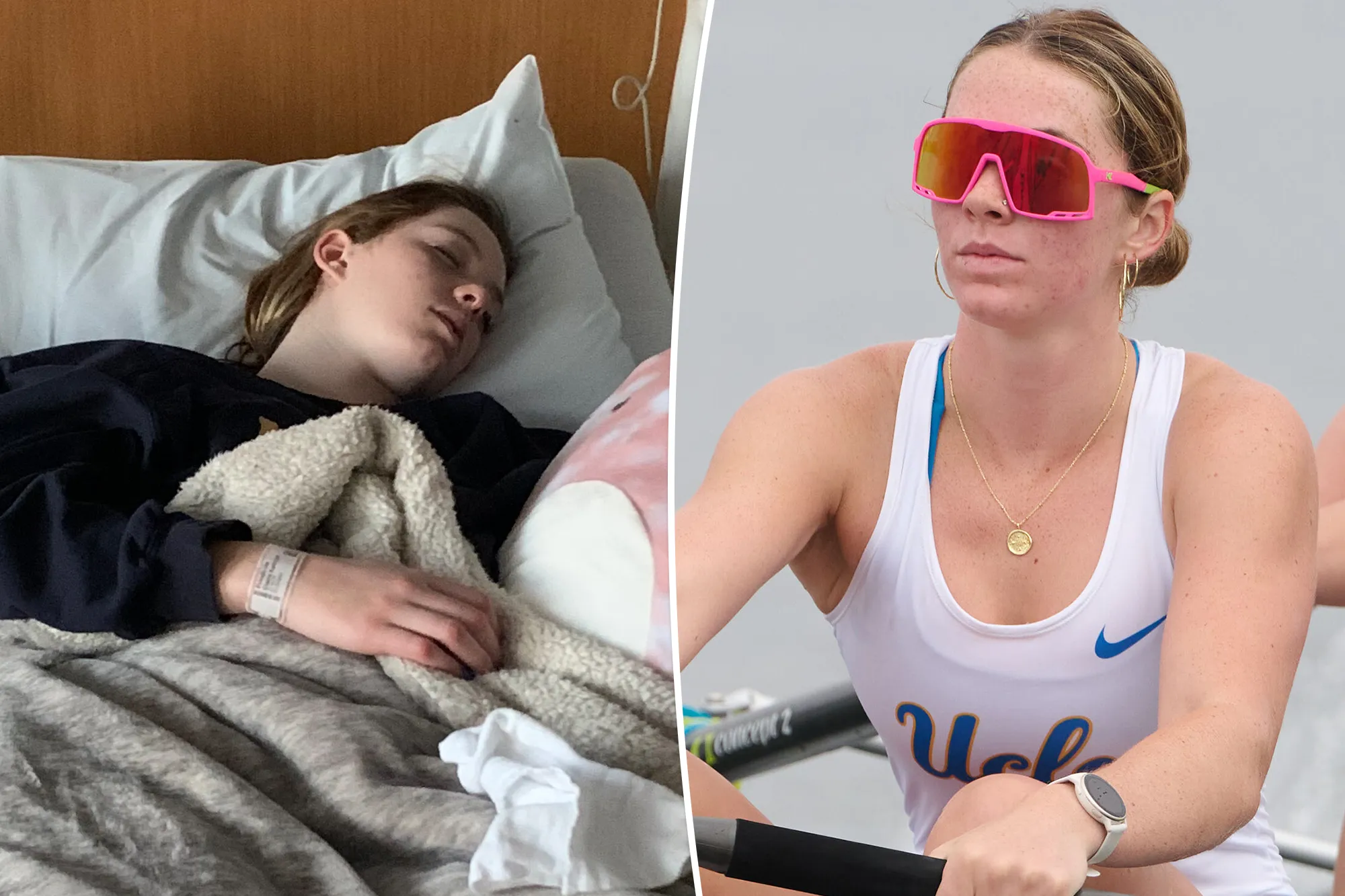
Claire Prindiville wakes up not knowing if this will be the day.
The day that her symptoms come back. The day that her legs betray her again. The day that her vision falters, or her ability to use the bathroom is out of her control.
Doctors have told her there’s a 60% chance that she’ll have to battle these same despicable conditions again, and if they return they might be worse than the first bout.
Somehow, none of those possibilities crosses the UCLA rower’s mind as she rises at 5:28 every morning except Sunday thanks to an alarm that beats the roosters.
Grateful for every moment free of discomfort, and believing that a positive outlook will set the tone for her day, she makes one celebratory jump next to her bed.
“It sounds kind of silly,” Prindiville told The California Post in a lengthy interview, “but I find it fun, and it also helps me start the day feeling grateful that I’m able to move.”
She’s done plenty of that since starting this journey fraught with unease four years ago. Among other things, she’s run the LA Marathon, went skydiving and rose from a walk-on to a scholarship rower in the top varsity boat after joining the team on a whim.
Along the way, she’s adopted a mantra of perseverance, convinced she can do anything she wants.
She likes to say that she’s the 40%, refusing to be paralyzed by her chances of recurrence.
“I know who I am,” she said, “and I’m not going to let this dictate my life.”
It’s not always easy.
Every time Prindiville experiences headaches, fatigue or blurry vision — even for a few moments — it can spark reminders of what she’s endured and what the odds say she’ll have to revisit.
“Headaches are definitely the scariest for me,” she said, “because my disease originally started with migraines.”
Early Days
When Prindiville was a junior in high school, persistent headaches landed her in the emergency room.
Doctors just sent her home with medication. Her pediatrician diagnosed her with a stiff neck, and she started acupuncture, thinking nothing of it.
A promising swimmer at the time, Prindiville rose from the pool after one unusually sluggish race and sat next to her parents. She couldn’t stop her legs from shaking.
Back at their hotel, she took an unusually long nap. Later, when she tried to climb the three flights of stairs back to her room, she had frightening difficulty.
“It wasn’t like I was winded,” she said, “it was like my legs weren’t cooperating and moving like I wanted them to.”
Prindiville felt the sensation that she needed to urinate, but her body wouldn’t let her. Trying to push through the bizarre symptoms, she convinced her parents to take her back to the swim meet.
On the way, she vomited in the car.
That was enough.
Her parents called a doctor who advised them to immediately make the 5 ½-hour drive to the children’s hospital near their home in Minneapolis.
“The following morning, I woke up to a room full of doctors,” Prindiville wrote in her college application essay. “After rubbing my eyes a few times, I realized that nothing appeared on the left side of the room. Complete black. Not the black when you breathe in the crisp night air, but the black when you’re alone walking down into your cold dark basement.”
She was blind in her left eye.
Perseverance Personified
Tests showed that Prindiville had severe swelling in her brain, spinal cord and optic nerve.
While the family waited for a diagnosis, there was an initial fear that she might have multiple sclerosis. Staying overnight with her daughter, Megan Prindiville walked her husband to the elevator to say goodbye until the morning.
“We just crumbled,” Megan said. “You know, I don’t know if I’ve ever cried so hard in my life.”
Eventually, they learned that Claire was suffering from a rare neurological autoimmune disorder called myelin oligodendrocyte glycoprotein antibody-associated disease, or MOGAD. There is no known cause or cure for the disease in which the immune system attacks the protective coating of nerves in the central nervous system, impairing their ability to send signals from the brain to the rest of the body.
As awful as that might sound, relief washed over Prindiville now that she knew what she was battling.
“I feel like this was the best-case scenario out of all of them,” she said of the possibilities, “and then I was just like, well, I guess I’ll just live with it now.”
Prescribed a heavy dose of steroids, Prindiville kept busy as she began to regain her eyesight and push the disease into remission. She walked countless loops in her hospital hallway and tried to rally other patients to play their own version of the Winter Olympics before protective nurses intervened.
Positivity was the best remedy.
During doctor’s visits, she would often laugh over something frivolous with her parents, only to be chided by caregivers about not taking this ordeal seriously enough.
“We’re like, it kind of helps,” Prindiville said. “Obviously, I understood the entire time the severity of the situation, but I think that just keeping it lighthearted has helped.”
The day after being released from the hospital, Prindiville returned to swimming, weakened but undeterred. Her face was so swollen from the steroids that she was almost unrecognizable.
Without the times she wanted, her college swimming options were limited. But none of that mattered once she was accepted to UCLA, her dream school.
“She’s like, ‘I just want to go there,’ ” Megan recalled. “ ‘I don’t care if I don’t compete in anything.’ ”
Path to the Bruins
Having rowed for Gonzaga, Matt Prindiville told his daughter that his old sport might be an option at her new school if she missed competing.
She had no choice after losing a bet to a friend who wanted her to try out for the team.
Even though she clocked an exceptional time on a rowing machine, coaches felt her form was too raw and she was too prone to injury. They cut her.
Devastated, she wrote an email asking for another chance to prove herself. Her coach called two hours later, accepting the offer.
“With Claire,” her father said, “there’s a strong component of just advocating for herself.”
Showing continual improvement, she not only made the team but eventually landed a scholarship. Combining superb strength, endurance and a relentless pursuit of mastering proper technique, she’s now one of the top rowers on a team that will compete in the Big Ten Championships on Saturday in Indianapolis.
“Her ability to pick up the sport and really dive into the technical work,” said Bruins coach Vanessa Tavalero, who was hired last fall and only recently learned about Prindiville’s journey, “has been pretty impressive.”
What’s amazed those around her most is her fighting spirit.
Complicating her daily life is that many of the symptoms of her disease — headaches, fatigue, unsteady legs — can mirror those of an athlete in training. Whenever she feels any discomfort, she starts ruling things out.
For instance, if she has a headache, she’ll chug water to make sure she’s properly hydrated. If it persists, she’ll take a pain reliever and then a nap. If there’s still no improvement or other symptoms arise, she’ll contact her neurologist.
That routine has shifted potential moments of fear to reminders of resilience and gratitude.
She is the 40%, recurrence be damned.
“If that happens in a year,” she said of her symptoms returning, “I want to know that I have moved my body to the maximum before that happens. If something bad flares up again and I do become fully paralyzed forever, I want to know that while I still had the ability to move and to walk, I never took that for granted.
“I think that’s the coolest part for me to come out of this.”
[Notigroup Newsroom in collaboration with other media outlets, with information from the following sources]