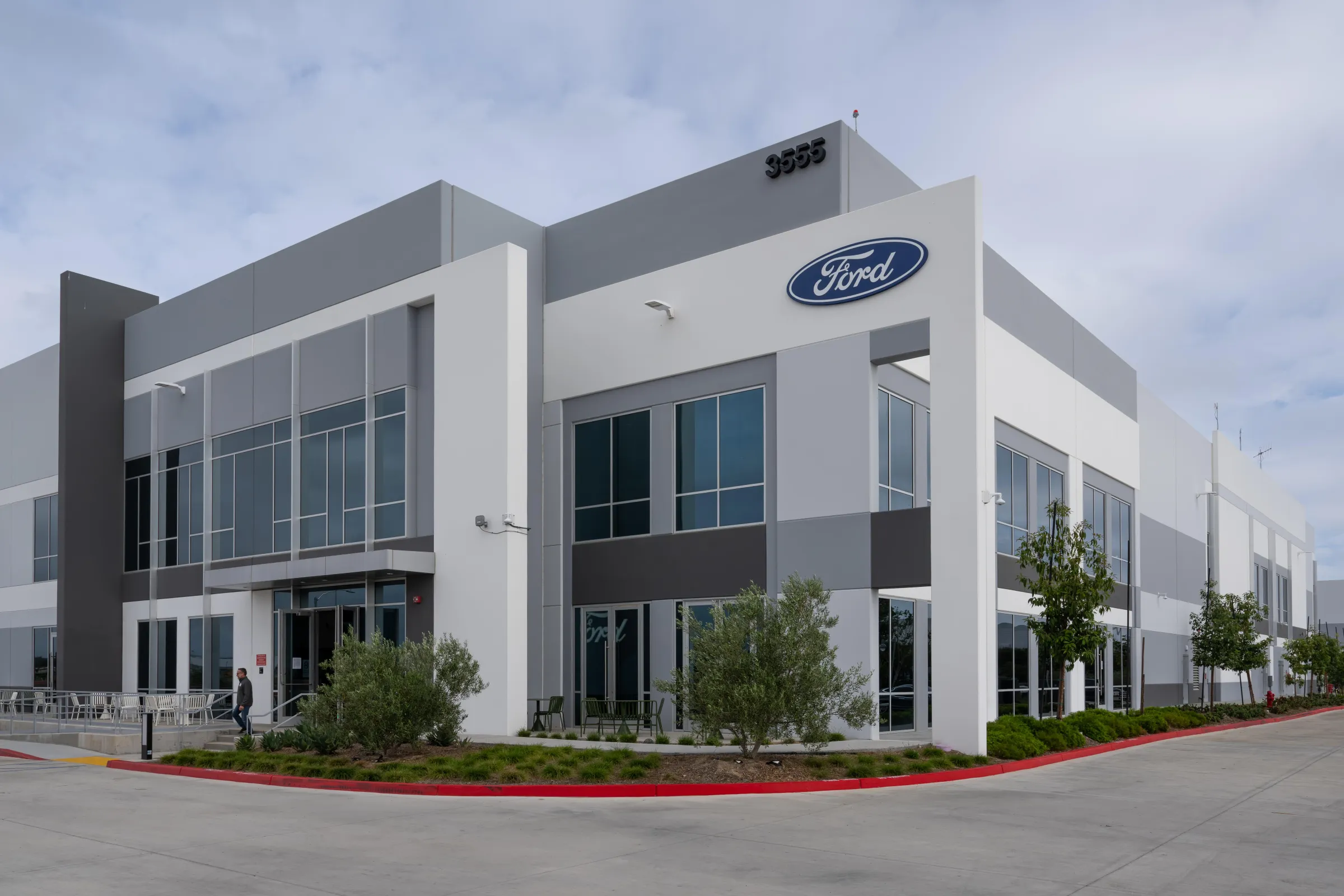
Ford isn’t sending the clearest signals regarding its EV future. We got a glimpse of its Universal EV (UEV) Project last February, but then it pulled the plug on the F-150 Lightning, which is regarded as one of the more successful electric pickup trucks to date. The climate surrounding electric vehicles hasn’t helped, either, between loosening emissions rules, tariffs, and the elimination of the federal EV tax credit.
But recently, after touring Ford’s less-than-two-year-old Electric Vehicle Development Center (EVDC) located in Long Beach, California, I have a better sense of the company’s current position. Ford says it will continue to build EVs, doing everything possible to make its next model hit a $30,000 price point.
Sitting in a nondescript facility just north of the city’s airport, employees working in this skunkworks facility are harnessing the brand’s tremendously deep experience in vehicle manufacturing by putting almost all of its UEV platform development under one roof. From every square millimeter of interior material to the way the vehicle is assembled, efficiency is the first priority, eventually — hopefully — leading to a lower cost to consumers.
The basic theme of this project is that everything counts, but especially time. In the past, Ford’s development has been split across multiple facilities around the US, but here, having several teams of engineers, designers, and more within a short distance of each other means the most minute changes can be made with little impedance.
Along with several other journalists, I first got a glimpse of this when it came to chassis/body assembly. Ford is asking the question: How can we make assembly as seamless and short as possible? This is done via input from its assembly line workers (or, operators in the company’s terms) as well as its engineers. Instead of starting off with an empty unibody — floor, door frames, and all — why not assemble it in sections. I saw a completed midsection containing the seats, battery unit, and other equipment that can be fitted all as one into the body. This saves time over the traditional method of bolting in interior equipment through the body’s door frames. And when I say the battery unit is part of the center section, it truly is — the example shown comprises the entire floor and midsection of the chassis.
Whether this will make it to final production wasn’t fully clarified. The next stop was the design process, covering the facility’s ability to run a life-size clay model through a five-axis CNC machine, and having the ability to make easy changes depending on various factors. Because designers are down the hall from different engineering teams, the process is a lot more fluid and immediate.
“We solve problems in a very beautiful and creative way, and that’s something that’s really hard to do if you’re disconnected or in a silo away from the problem and teams that are actively, every day, trying to progress on those concepts,” said Eva Ross, automotive designer at Ford. “Whether that’s the marketing team… or with the ergo[nomics] team and trying to understand how we’re using this space differently, since it’s not a carryover from an ICE vehicle.” Additionally, the designers work with the aerodynamics and battery teams to reach their targets.
Nothing goes to waste, either. When discussing interior materials, dimensions, where to place certain controls, and even determining what amount of stitching should go where, there was a heavy emphasis on not discarding too much.
For example, lab workers have the ability to put interior cloth material through a software program that ensures that every square millimeter is used when it’s cut. They then create seats that are as close to production as possible, and get their own bodies in them for evaluation.
“As we collaborate together, what we’re trying to do is develop the best possible product in the most cost-efficient fashion,” said Scott Anderson, senior manager of seating.
Getting a seat made could take as long as three months, thanks to different teams making design and engineering decisions, coupled with outside suppliers needing input. It now takes as little as two weeks with everything in-house. Saving time here means comfort is ensured, changes can be made quickly, and the minimizing of materials is passed on to consumers to help make that $30,000 price tag possible.
Efficiency and simplicity
Then there’s the brand’s idea of bounties, or, decision-making based on whether the net end result is more efficiency, and therefore more range. Ford is applying these bounties to everything from battery size to aerodynamics and weight. This permeates throughout the facility, but especially when shown a side-by-side comparison in wiring between the F-150 Lightning and UEV. Utilizing zonal architecture in the latter, less wiring is used, which translates to a lower cost and more efficient assembly.
In fact, the part of the tour that I found particularly interesting was its wiring department. A handful of skilled craftsmen assemble all of it in-house, not only cutting out any potential supplier issues, but also having a quick turnaround on any design changes. This saves both time and money. They build certain circuits, wiring harnesses, control boxes, and more to accommodate various teams’ needs. Additionally, the team here supplies wiring for the whole facility in general — the building is still a work in progress, so any additions and changes, particularly as engineers test batteries, charging systems, ECUs (electronic control units), and more, is once again a short walk away.
“Anything that has a wire or board, we were involved with it,” said Oscar Lomeli, EE lead technician. The shop keeps a massive array of wire gauges, connectors, sleeves, dressings, and more on-hand, ready to take on any project.
The battery and equipment testing aspect was equally fascinating. While personnel couldn’t share the finer details about battery size, charging, and more, efficiency was a top priority, with DC-to-DC and AC converters sharing the same board. Despite 800V architectures becoming increasingly common, Ford believes that 400V will still result in comparably fast charging and efficient energy consumption.
Once a working prototype is assembled — there’s a full in-house fabrication shop ready to do so — it can be put to the test by engineers in a controlled chamber where a myriad of climates (temperatures range from -40 to 65 Celsius, humidity can reach 95 percent), changes in elevation, UV levels, and more, are turned out to test equipment to the max. The lab utilizes a road load simulation chassis dynamometer, which is essentially a rolling road that can simulate any driving scenario. How will the UEV deal with a maxed-out towing capacity, steep inclines, and freezing temperatures? And what about charging conditions when hooked up to a DC fast charger? Additionally, individual control units can be placed in what’s basically a massive Faraday tent where staff determine if outside signals mess with it, or vice versa.
These labs put Ford’s bounty system to the test. “This lab really enables us to test all of those decisions, test those ideas, and see what the impact is going to be, both from the customer [perspective], as well as [determine] what our fuel economy range will be,” Eric Kooinga, range and performance testing manager, said.
Summoning its legacy in a key location
Interestingly, Ford had a facility in Long Beach’s port nearly 100 years ago where vehicles like the Model A were assembled. It’s now returned to the region, utilizing all of the experience it’s gained in perfecting the assembly line and taking advantage of the local workforce; Southern California is renowned for its aerospace industry. There’s a massive pool of engineers with the necessary skills to take on this kind of project, and Ford says its choice of location has really paid off.
As we departed our tour, a conveniently timed midsize pickup truck prototype wrapped in camouflage rolled past us, possessing a shape that was reminiscent of the Ford Explorer Sport Trac of the early 2000s. Replicating and refining the formula for different classes of vehicle should take far less time than in the past due to all of the development invested in the UEV platform.
Considering the fact that a beautiful Mark 1 Ford Escort racecar was chilling in the corner of the design area earlier in the day, there’s a chance that some really cool stuff could be coming soon.
[Notigroup Newsroom in collaboration with other media outlets, with information from the following sources]