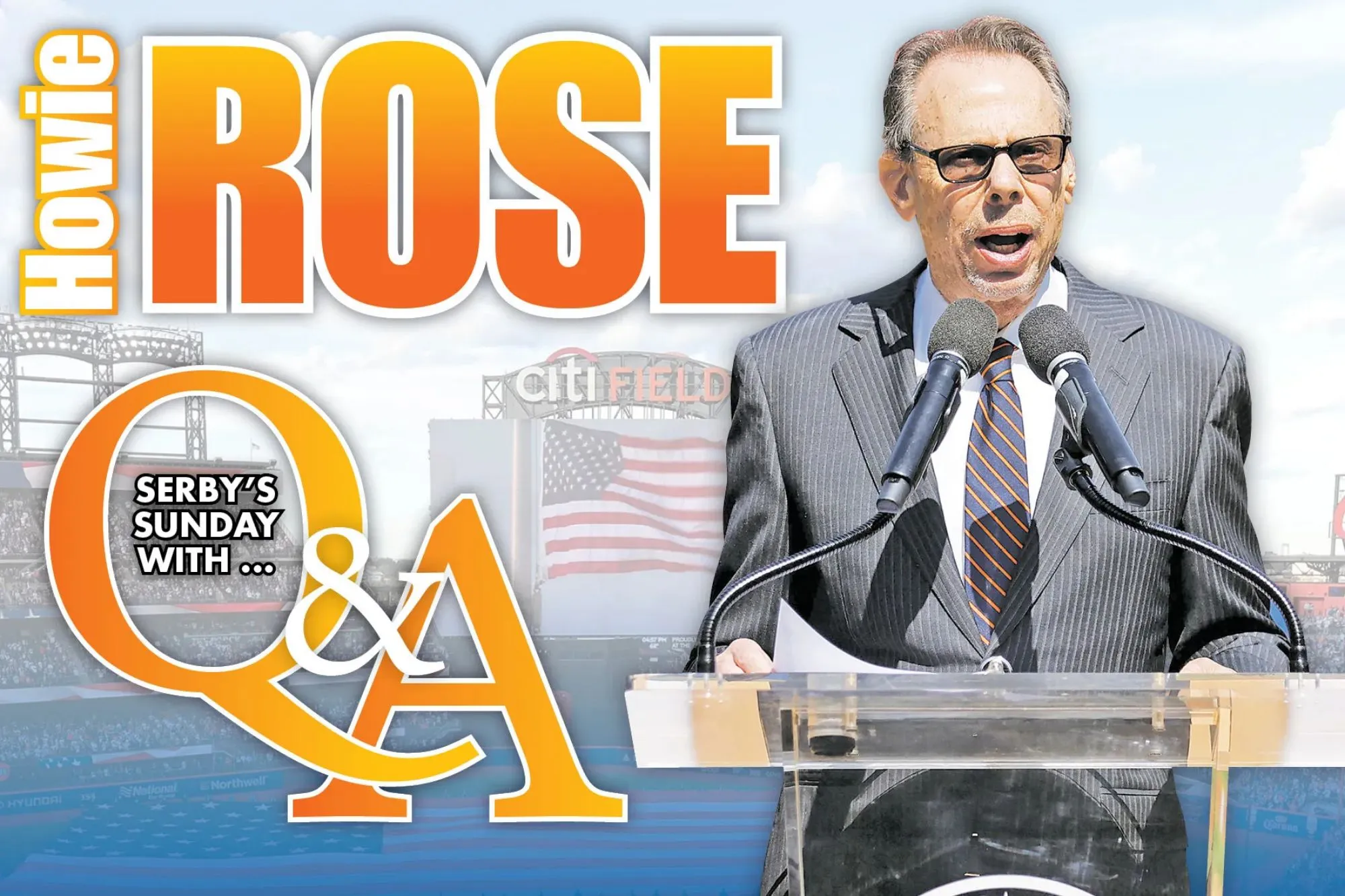
After three decades as the voice of the Mets across radio and television, currently with WHSQ 880-AM, broadcaster Howie Rose is retiring at the end of the season. He makes the call for some Q&A with Post columnist Steve Serby before he says to his career, “Put it in the books.”
Q: What has the last week been like since you made your retirement announcement?
A: It’s been crazy. So many people reaching out and so many wonderful things written, and various comments to things that have been posted on social media have really made me take a step back and appreciate that over the course of a long career, I must have made a connection somewhere with somebody (laugh). It’s very flattering.
Q: Who are some of the people you’ve heard from?
A: A lot of the people in the business, and former players like David Wright. … Marv Albert reached out to me, which is wonderful, because he’s the single biggest reason I’m in this business … and just a whole lot of other friends and contemporaries. … When I was scrolling through messages and calls I saw some from Lee Mazzilli and Howard Johnson. Those guys are good buddies and we socialize in Florida. It creates a little melancholy, which I kind of expected, but it doesn’t give me misgivings about the decision I made, it’s just very humbling … really, really humbling.
Q: What did Marv text?
A: “Just wanted to wish you the best in your eventual retirement following this season. You’ve had a fantastic career, enjoyed listening to your broadcasts and your exceptional knowledge. I still do remember that nice young kid who would visit me at WHN radio and always ask great questions.” I got back to him and said, “It’s hard to believe it’s nearly 60 years since we met and I just recently stopped answering the phone like you.” … I met Marv when I was 13 years old in 1967, when I became the president of his fan club. I got the number for WHN, which is where Marv worked, and I called the station, and remember, I’ve got this very adolescent kind of high-pitched voice at the time, and the switchboard operator answers the phone, and I go, “Is there maybe some way I could speak to Marv Albert?” And next thing I know, a couple of beeps later, Marv picks up the phone, he goes, “Hello.” It’s just unique to his speech the way he said hello. … Along the way, he would take an interest in me when I told him that I was now an aspiring broadcaster, and at age 16, I was able to get my first season ticket to the Rangers, and a few times that season, I brought me tape recorder to the games, and so play-by-play from my seat into the tape recorder. Amazing I wasn’t led out of there in handcuffs — or a straitjacket. … I would send him, with his approval of course, the cassettes of those games that I did and see what he thought. He gave me some really detailed constructive criticism, little things that stayed with me the rest of my career.
Q: What did Carlos Mendoza text?
A: “You are going to go out on a big way, we are going to win the whole thing.” With a couple of prayer emojis. I got back and said, “Nothing would make me happier. Appreciate your friendship and support.”
Q: Why is it time for you to retire after the season?
A: Because I didn’t want it to go to where it became past time. I’ve seen, and heard, too many people on my side of this industry, work years beyond what they should have for various reasons. I’m a little surprised at myself from the standpoint of, we all have egos, right? And our egos very often are satisfied in this business by positive feedback and such. It’s a hard thing to let go of when people recognize you and smile and thank you for all the great years or however they want to say something complimentary. That can be kind of intoxicating. We all like to be modest, and I try to be as much as anyone, but I have an ego too. And I just wrestled with, “Can I walk away from that?” I mean, it’s a wonderful feeling to go from literal obscurity as a kid. When I was in high school, nobody other than my circle of friends, gave a second thought or look to me, nor should they have. I was the most unremarkable kid you could imagine. But there was a part of me I guess that never wanted to be anonymous. It can be not only an intoxicating thing, but it can be fearful to consider walking away from it. … But I think the overriding reason is that I didn’t want to overstay my welcome. I’m 72 now, right?, so the synapses don’t fire quite as quickly as they once did. I recognize that. I know how to compensate for it, just as a pitcher who loses a mile or two off his fastball learns to make adjustments. And I’m confident that given my ability to make those little adjustments, I can do this for several more years, but it’s all of the ancillary issues and ancillary factors that make up the average work day are the things that I just can’t abide anymore. I remember Vin Scully saying this too, that as he got on in the latter years of his career, was the preparation, and I get it. … And the thing more than any that tipped the scales in favor of calling it a career at the end of this year, I would get home from games last year, and I’d walk in the door and there’s my wife [Barbara] sitting at the kitchen table or on the couch, she’s on her computer, she’s watching TV, I’d say, “So what did you do tonight.” She said, “Ah, not much.” “What’s you have for dinner?” “Ah, just a bowl of cereal.” I can’t do that to her anymore. She sacrificed so much for me for so long, as did my daughters, when I was doing the baseball and the hockey full schedule concurrently, that it doesn’t only take a toll on me, think about what that does to your spouse or significant other. My wife wants to travel. I hate travel. But I owe her. She’s been way more of a homebody than she’s wired to be, and I owe her a husband, whether she likes it or not.
Q: What is your most exhilarating Mets moments in the booth?
A: Johan’s [Santana] no-hitter, because I was in sheer disbelief. … The night they won the pennant in Chicago was a bit anticlimactic only because it was a four-game sweep, and there was not much mystery to the fourth game. Much different than say the seventh game of the Stanley Cup Final when that third period seemed to take an hour-and-a-half. When Dexter Fowler took a called third strike from Jeurys Familia, and those words, “The Mets win the pennant,” came out of my mouth,” I still, even as I say them now, got goosebumps all up and down my body, because as a kid that not only dreamed of being a broadcaster but was incredibly fortunate to have broadcast for the two teams that controlled my moods as a kid, the Rangers and the Mets … I’d play in the schoolyard and imagine being the Mets in a one-on-one stickball game, and yelling, “The Mets won the pennant!” if I won the game and here I was doing that in real life, in real time, into a live microphone. It was a lot to digest, even as the words were coming out of my life … and obviously the big moments in the ’24 postseason.
Certainly the [Pete] Alonso home run. The call that I liked the best personally though, the moment, was the [Francisco] Lindor grand slam in the clinching fourth game against the Phillies in the Division Series. … I just felt when I listened back to it, I had a little bit of a Vin Scully moment there, they’d been so frustrated all night that I said “They were famished for the big hit all night, and Francisco Lindor just provided a feast.” And I thought, “That’s pretty lyrical (laugh), I like that.” For Vin it was, after the Kirk Gibson home run when he goes (in Scully imitation]), “In a season that’s been so improbable, the impossible has happened!” We all take pride in finding the right words at the right time in the right setting. And, at least for that one brief shining moment, I felt like I’d experienced a little broadcasting Camelot.
Q: Most heartbreaking Mets moments in the booth?
A: Well no question Game 7 against St. Louis in the 2006 National League Championship Series. … Certainty the last game of the ’07 season when they completed that epic collapse, with a seven-game lead and 17 to go. That whole last week was a nightmare … when they needed to win on the last day of ’08, which would prove to be the final game at Shea Stadium, Ryan Church got a fly ball that looked like it was going to go out and tie the game, but whatever forces held that ball down; the same forces that held down the ball [Mike] Piazza got off of Mariano [Rivera] for the final play of the 2000 World Series against the Yankees; the same forces that held Davey Johnson’s ball in the yard off of Jerry Koosman for the final out of the 1969 World Series. Well, those forces giveth in ’69 and they taketh away in 2000 and 2008. That was really frustrating, too.
Q: How many times over the years have you run into Rangers hockey icon Stephane Matteau?
A:. We’ve become friends, and people get a kick out of that. … I was like a mascot in this foursome last year. I’m terrible. Matteau was my teammate. Literally sank about a 30-foot putt. And when the ball rolled into the hole, I just had to do it (laugh). I started screaming, Matteau! Matteau! Matteau!”
Q: Describe Bartolo Colon’s home run in 2016.
A: One of the most incredulous moments I’ve had as a fan too and a broadcaster, because I’ve always felt one and the same really. When that ball left the yard, I thought, I can’t even attempt to find the right words here. So I just blurted out as though it were a bulletin: “Home run Barloto Colon. Repeating, home run Bartolo Colon.”
Q: Tom Seaver
A: Whatever Tom Seaver was to millions of Mets fans, he was to me. Then when I got into the business, I was like a teenage girl. I remember he was at Shea Stadium with NBC doing a Game of the Week with Vin Scully. And Kenny Albert, who was my associate producer on “Mets Extra,” was sitting at a big round table in the press room with me having lunch, and Tom wanted to know something about the Mets, and he calls out from probably 50 or 75 feet away, he goes: “Hey Howie, you got a minute?” And I looked at Kenny (laugh) the way a teenage girl would look at her friend when the most popular guy in school asked her out or even recognized her. I said to Kenny, “Wow! He knows my name (laugh).”
Q: Steve Cohen.
A: Incredibly kind to me, and an absolute gift to Mets fans.
Q: Mark Messier.
A: An unparalleled leader.
Q: What do you recall about Keith Hernandez and Ron Darling in the clubhouse when they played?
A: Keith was incredibly insightful, and as intelligent a player as he was on the field, that came across in every interview. And Ronnie, very much the same way without the beer and cigarette. When Ronnie spoke, there was always something compelling that came out of his mouth.
Q: Davey Johnson.
A: My baseball mentor. Davey was one of the biggest influences, unknowingly to him, in my career. He just let me pick his brain about everything. He would just explain to me how the managerial mind worked, and what he knew that no one else did about his players, and how he’d have to utilize them that night.
Q: Dallas Green.
A: He could be intimidating because of his size and John Wayne-esque demeanor, but he was just one of these old-time guys that loved to talk baseball, and to pick those guys’ brains is one of the greatest privileges I’ve had in my career.
Q: Willie Randolph.
A: A friend. I hit it off with Willie right away, were the same age, a couple of New York kids. I love Willie.
Q: Jerry Manuel.
A: Jerry was intentionally distant and kept all of us at arm’s length.
Q: Art Howe.
A: One of my favorite human beings in the game. Just one of the nicest people you’ll ever come across, one of the most down-to-earth souls that ever wore a baseball uniform. And it angers me how he was so badly misrepresented in the movie “Moneyball.”
Q: Terry Collins.
A: The greatest. To be in Terry’s company is to smile, laugh and just absorb baseball story after baseball story. Terry wanted the game broadcasters who traveled with the team to know what was going on, so when everybody else left his office, he’d shut the door and we’d schmooze back and forth sometimes for about a half hour.
Q: Jeff Torborg.
A: I was, I wouldn’t say estranged, but I was separated a bit from the club because I had a little thing with management then, Frank Cashen and Al Harazin didn’t appreciate that I told the truth as I saw it. So they pushed me a little further back from the game broadcast, and I didn’t have the same kind of access or relationship with Jeff. … We did that show with Davey, and I know it rankled Frank that Davey and I developed the solid relationship that we did. Davey was smart enough to understand that he could use that show as a forum to air his grievances against Frank. … When Al Harazin was fired, Fred Wilpon actually came to me and said, “We made a mistake here, I never should have let it get as out of hand between you and Frank and Al as I did. We’re going to make good, just trust me on this, and he did. By ’94, I was back in the Mets’ good graces, and it’s been smooth sailing ever since.
Q: Bobby Valentine.
A: Complex. Brilliant. A joy to get to know, and a brain that I wish I would have picked even harder while he was manager. But an unparalleled in my opinion judge of baseball talent.
Q: Bud Harrelson.
A:. He was Everyman, he was just a great guy. He was so accessible, he was always out meeting the public.
Q: Mickey Callaway.
A: Weird. Just a weird guy.
Q: Buck Showalter.
A: One of my favorites. Again, a brain I loved to pick, a guy who has opinions about everything, and they were always very compelling. He encouraged me to pop into his office and just talk baseball and ask questions privately because that’s what managers used to be able to do with certain media that they connected with.
Q: Mendy, Carlos Mendoza.
A: What a breath of fresh air, and an absolute delight to get to know. You ask him a question, he looks you in the eye, he gives, you an answer, and he’s a guy that you immediately feel a kinship with shortly after you get to know him.
Q: David Stearns.
A: Met fan made good. And trustworthy. He knows what he’s doing, and I love the fact that he’s the first guy ever to grow up a Mets fan who took charge of the team.
Q: Sandy Alderson.
A:. A mensch. He’s very warm and very caring about people. He wanted to come up after I had my surgery September of ’21, remember we were still coming out of COVID.
Q: Jay Horwitz.
A: I love him. Biggest heart of anyone that I’ve ever known. Jay will always die on the hill of wanting to do the right thing. He is the most wonderfully humane human being you will ever meet.
Q: Three dinner guests?
A: John Lennon, Richard Nixon and Curly Howard. … We didn’t know anything about him and who he was. Nixon was not known for his humor, so I have to think that Curly could have gotten a rise out of Nixon.
Q:. Six years ago you gave me Lennon, Nixon and [Winston] Churchill.
A: I replaced one bald guy with another.
Q: What will you miss most?
A: Certainly the people, and that would be the same in any profession, right? … the guys in the booth, my fellow announcers, not only Keith [Raad] and Pat [McCarthy], but obviously Gary [Cohen], Keith, Ron, Steve Gelbs — I don’t want to leave people out — no one more so than Chris Majkowski our beloved engineer/producer. But I will miss the incredible adrenaline rush that I’m happy to say, that after all these years I still get when that figurative red light goes on as we take air, and I get to say: “From Citi Field in Flushing, Queens, welcome to New York Mets baseball.” Because no matter where the team is in the standings, no matter what the weather is, or what the significance or otherwise what the game is, there’s still a singular thrill that I get when I open a broadcast. I’m going to miss that more than anything.
Q: On your very last broadcast, how are you going to handle, “Put it in the books?”
A: I don’t want to go there yet.
Q: Your message to Mets fans?
A: I feel as though any one of you can be where I am in the booth, because I started where you are, in the stands, loving the New York Mets. We are, and always will be, kindred spirits. And I would encourage everyone of you to follow your dream. And if that entails becoming a broadcaster in the major leagues, and ideally for the New York Mets, that I hope with all of my heart, that you occupy my seat one day.
[Notigroup Newsroom in collaboration with other media outlets, with information from the following sources]