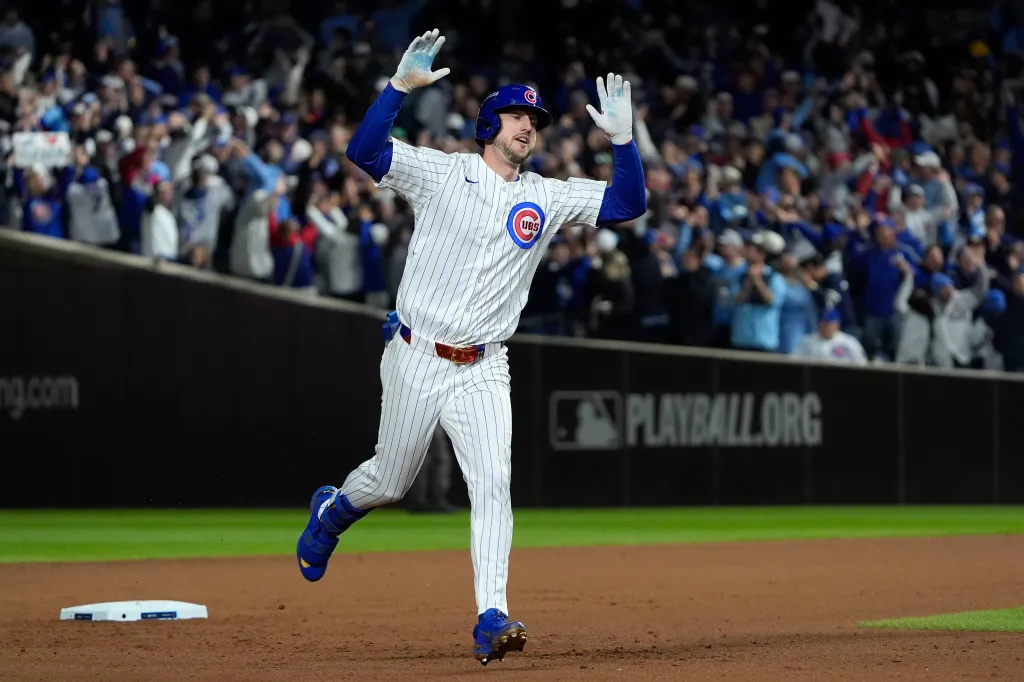
In the hours before the decision was made, Steve Cohen asked his X followers to let him know when they saw smoke — when Kyle Tucker was set to announce his new team.
When that smoke billowed out, the Mets were reminded one more time of what they are and what they are not.
They are a talented but still-building organization that is coming off a regrettable, playoff-less season. They certainly are not the “East Coast Dodgers” that Cohen once said he strove to become.
The West Coast Dodgers — the real thing — are the gold standard, with both wide-open title windows and bottomless pockets able to lure just about any free agent they want. And as became clear, they wanted Tucker.
So Tucker will not be a Met, on Thursday choosing a relatively short-term but lucrative contract with the two-time defending champions, a source confirmed, rather than Cohen’s gobs of money or the long-term stability with the Blue Jays.
Pending a physical, the Dodgers will make Tucker the second-highest paid player per season in MLB history at four years and $240 million, according to noti.group’s Jon Heyman.
The pact reportedly includes an opt-out after the second season, perhaps allowing Tucker to find a long-term home then if he wants. Only Shohei Ohtani ($70 million, albeit heavily deferred) makes more per year, Tucker’s $60 million blowing away even Juan Soto’s $51 million.
The Mets, who had already lost Edwin Díaz to the Dodgers and of course lost in the NLCS two years ago to this new Evil Empire, certainly tried. They lurked in the sweepstakes for Tucker, eyeing the same kind of brief but expensive contract that he chose from the Dodgers, and met over Zoom with him recently. According to Heyman, the Mets — who had offered $50 million per season — bumped their final offer to $220 million over four years, but $55 million per was not enough.
What now?
How else can the Mets meaningfully improve after whiffing on the best free agent on the market? Where else can Cohen throw his money to ensure next season is not like last season?
The Mets are left needing at least one and maybe two outfielders and a starting pitcher, at minimum, during a winter that has been far more about subtractions (Díaz, Pete Alonso, Brandon Nimmo, Jeff McNeil) than additions.
With Tucker — entering his age-29 season, an All-Star in each of the past four years and the owner of a career .865 OPS — the Mets could have envisioned the best lineup (and best top of the lineup) in the sport.
Without Tucker, David Stearns & Co. will have to pivot during an offseason in which they have tried to improve defensively, which has come at an offensive cost that Tucker might have solved.
Cody Bellinger is now the best outfielder available, though he is seeking the kind of long-term deal the Mets are hoping to avoid. There are several center fielders who theoretically could be pried through trade, including the Astros’ Jake Meyers, White Sox’s Luis Robert Jr., Rockies’ Brenton Doyle and Cardinals’ Lars Nootbaar.
The best starter available in free agency is Framber Valdez, and perhaps the Mets would swoop in if his market falls short of expectations. There are plenty of other starters who could be moved through trade, such as the Royals’ Kris Bubic, Nationals’ MacKenzie Gore, Brewers’ Freddy Peralta, Padres’ Nick Pivetta and Twins’ Joe Ryan.
The Mets, who have replaced their core by bringing in Marcus Semien, Jorge Polanco, Devin Williams and Luke Weaver thus far, remain a good team, Stearns insisted this week.
“We have elite talent at the top of our major league roster,” Stearns said. “We’ve got a very good farm system, and we’ve got a very good present-day major league team as we sit here today that’s going to get better before we get to Opening Day.”
A problem that could pop up, though: There is at least one National League team with a roster that looks far better.
[Notigroup Newsroom in collaboration with other media outlets, with information from the following sources]