
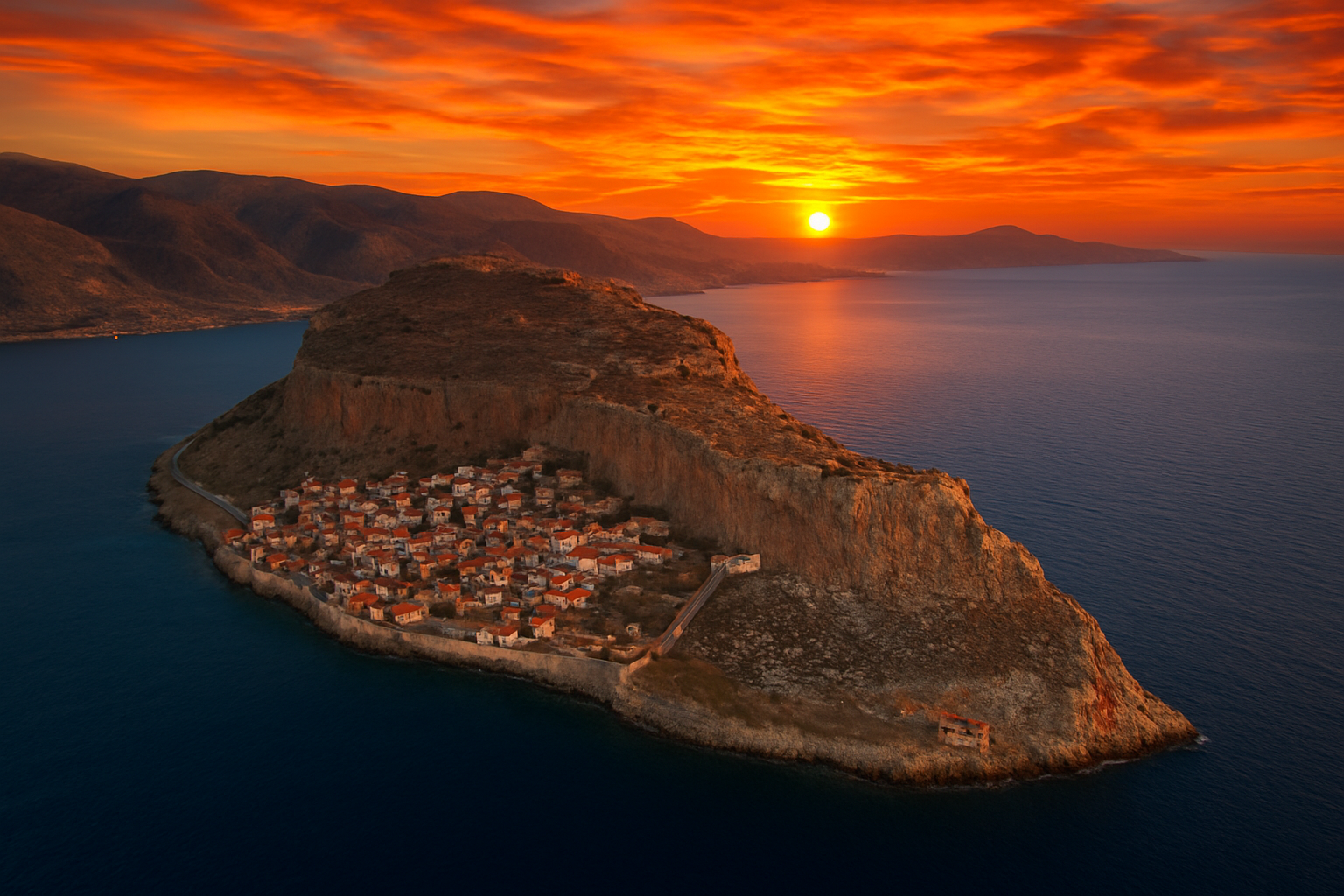
MONEMVASIA, Greece — Suspended in time and perched dramatically on a massive rock off the southeastern coast of the Peloponnese, Monemvasia is truly unlike any other place on Earth. This fortified medieval town, carved directly into the face of a cliff and entirely isolated from the modern world, offers an experience that is not merely rare, it is singular. To step through its ancient stone gateway is to be transported centuries into the past.
There are no cars, no visible signs of modern infrastructure, no concrete scars from contemporary development. Transport of goods and materials is still carried out manually or with donkeys, just as it was in centuries past. There is no urban sprawl, no visible contemporary buildings, no LED or neon lighting or signage. Enclosed by walls that once repelled empires, Monemvasia shows you only herself and the sea she’s leaned on for a thousand years.
It is an unbroken immersion into the Middle Ages, a living museum, not curated, but inhabited. The only remaining european town with a night sky, without the interference of modern city lights, the milky-way opens above the Myrtoan sea in a breathtaking celestial panorama. The stars here are as they were a thousand years ago — clear, brilliant, and uninterrupted.
And yet, this last living relic of untouched history is being eroded, not by time, nor by war, but by the very entitites entrusted with its preservation.
A World Apart — And Now Under Threat.
Unlike most historic towns in Europe, swallowed whole by the tide of modern development, Monemvasia’s uniqueness springs from its rugged geology—steep cliffs and surrounding sea—that have shielded it through the centuries. It remains not just a monument, but a living, breathing medieval town.
Originally designed for concealment, the city was strategically built to be invisible from the mainland, shielded behind the towering cliff to protect it from invaders. Even today, this geography protects it — or rather, it should. From within the walled settlement, there are still no modern structures in sight — no antennas, high-rises, cars, traffic lights, motorcycles, no external noise, nothing…
But even this last rare sanctuary is beginning to slip away. Ill-conceived interventions, cultural ignorance, neglect, and the prioritization of tourist profits over cultural preservation are putting this irreplaceable town at risk. The authenticity that has made Monemvasia a global treasure is now endangered.
If Monemvasia loses its isolation, it loses its soul — and the world loses its last chance to walk, unspoiled, through the Byzantine Middle Ages.
A Town Neglected, Not Preserved
From broken, faded plastic signage to centuries-old trails left to erode, Monemvasia is not being preserved — it is being abandoned by the very institutions responsible for its protection. Tourists wander aimlessly through its narrow, winding passages, often confused and disoriented, with no visible wayfinding, no historical context, and with non-existent official information panels to guide them. Where official efforts have been limited, the quiet dedication of residents and business owners, crafting their own maps and guides for its visitors, small acts of care and dedication that keep Monemvasia’s story alive.
Meanwhile, modern infrastructure continues to intrude on this ancient landscape. Plastic piping and cables are visibly strung along medieval stone facades, and inappropriate modern trash bins — the kind you might expect in a suburban shopping center — have been placed throughout courtyards and alleyways that once echoed with Byzantine footsteps. These thoughtless additions shatter the immersive historical experience that Monemvasia uniquely offers.
But the most alarming neglect lies beneath the surface and along the heavily plastic-infested sea.
A recent inspection revealed that the town’s ancient seawall is suffering from severe structural damage, the sea moss and salt have corroded and weakened the early hydraulic binder, leading to the severe erosion and structural issues now observed in the seawall’s original amoloi or concrete core. This centuries-old material, once celebrated for its durability, is now at its sea-side heavily degraded, cracking, crumbling, and flaking away. Left unrepaired, this erosion threatens the stability of the lower town itself, especially in the face of increasingly volatile weather of the area and rising sea levels.
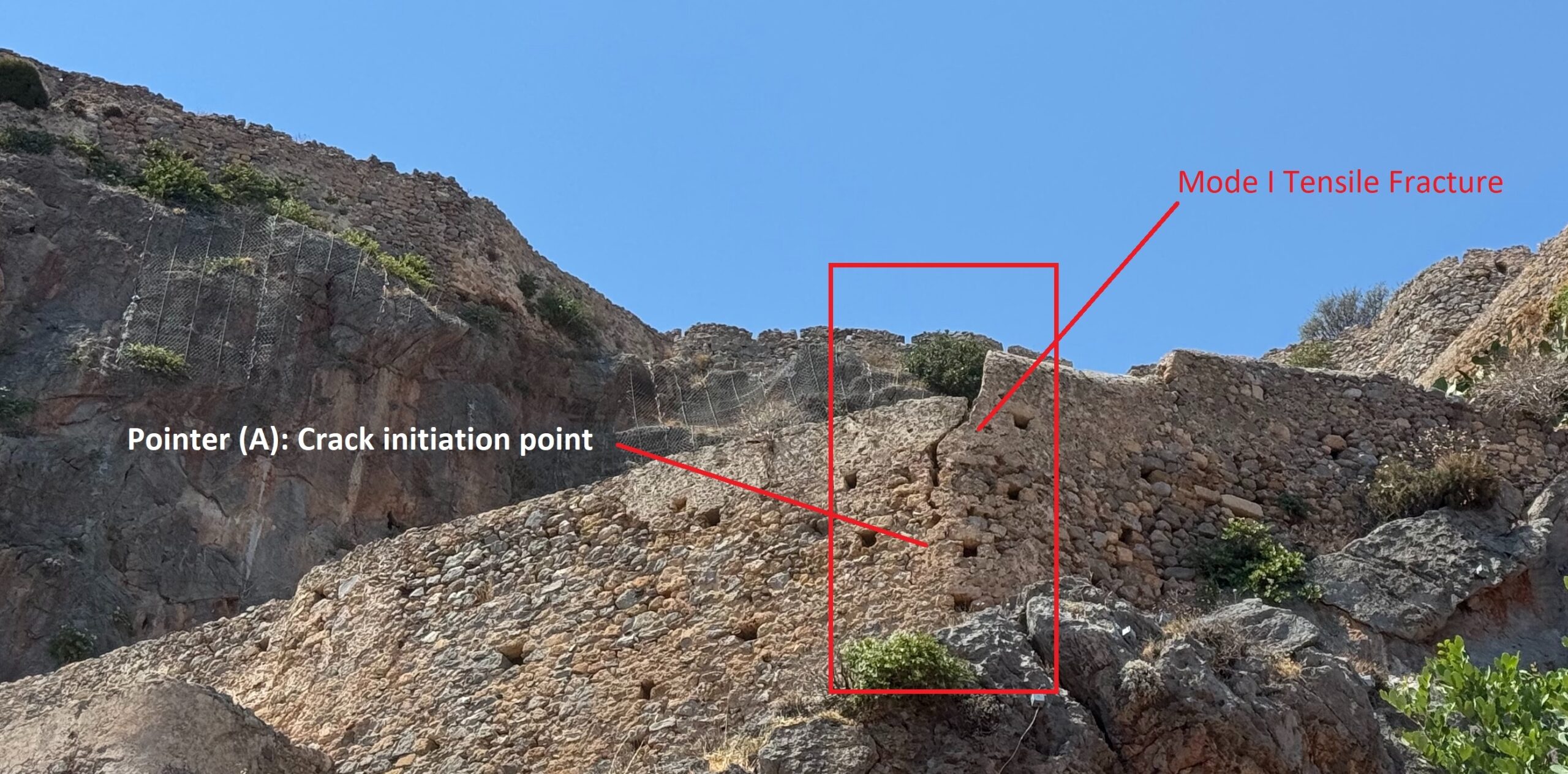
Likewise, the stairs leading to the Acropolis, once the beating heart of Monemvasia’s fortress, exhibit a large structural crack and have become dangerous for tourists, uneven, and in some areas with partially collapsed walls. With no clear maintenance, signage, or lighting, these ancient routes — vital both to tourism and to the city’s identity — are literally falling apart.
And yet, residents criticise the fact that public funds are not being directed toward these urgent problems. Instead, resources are diverted to what they qualify as “ill-advised projects”, such as a 21st-century cable car to be built directly on the historic site, over the archaeological area and next to the centuries-old protective wall, which, they argue, undermines the town’s authenticity. The proposed funicular, a modern cable car intrusion cloaked in the language of accessibility, is a prime example.
Water That Shouldn’t Be Drunk
Despite receiving thousands of visitors each year, Monemvasia has no access to potable water — a shocking and unacceptable reality in a European Union member state in 2025. The water supplied throughout the town is not only unfiltered and untreated but, according to independent tests conducted by Noti.Group, it is dangerously unsafe.
Laboratory analysis revealed electrical conductivity levels exceeding 10,000 µS/cm, which is more than four times the accepted threshold for safe human consumption. Chloride levels were measured at ten times above safety limits, and sulfate concentrations were found to be more than double the maximum allowed under EU drinking water standards. These values are consistent with significant seawater infiltration, making the water toxic, corrosive, and unfit for any form of human use.
And yet, this same water must be used daily by residents, restaurants, hotels, and guesthouses — all of whom have no choice but to haul plastic bottled water of every shape and size through Monemvasia’s narrow, stepped streets. In what is not just a breach of public health regulations but a violation of a basic human right.
Imposing significant financial and logistical burdens on the town’s hospitality sector. Hotels and restaurants face ongoing damage to plumbing systems and appliances. Showers often sputter a harsh, briny mist, leaving behind rust stains, a pungent seawater odor, and, as some visitors report, a burning sensation on the skin. At times, water fails to flow at all — turning something as simple as a shower into a gamble, “if and when the water it’s even available”.
In a town so dependent on tourism, serving visitors unsafe water is not only a public health risk, it reveals the unsettling reality that Monemvasia is being neglected at the most essential level. Over a thousand years ago, the town’s inhabitants engineered sophisticated cisterns and rainwater storage systems to ensure potable supply of water all year round. Today, in the first quarter of the 21st century and in the European Union, the municipality can’t even provide water that is safe to drink to its residents and visitors.
“How can millions be spent on a tourist funicular, while the people who live and work here — and the guests they welcome — are left without access to one of life’s most basic necessities, water.”
Resident of Monemvasia
Light That Dims History
Lighting in Monemvasia has been applied sparingly and without harmony, its inconsistent hues—from harsh cold whites to softer warm glows—revealing a gap in the cultural understanding of its local authorities.
This discord fractures the town’s historic atmosphere, creating a visual jolt where there should be quiet reverence. In most well-preserved and culturally cherished cities like Prague and Florence, warm amber light is the sole standard—carefully chosen to cradle ancient stone and preserve the integrity of time. Yet in Monemvasia, the cold absence of a strong preservation ethos and cohesive aesthetic vision has allowed careless inconsistency to creep in, unsettling the fragile balance that makes this town so uniquely timeless.
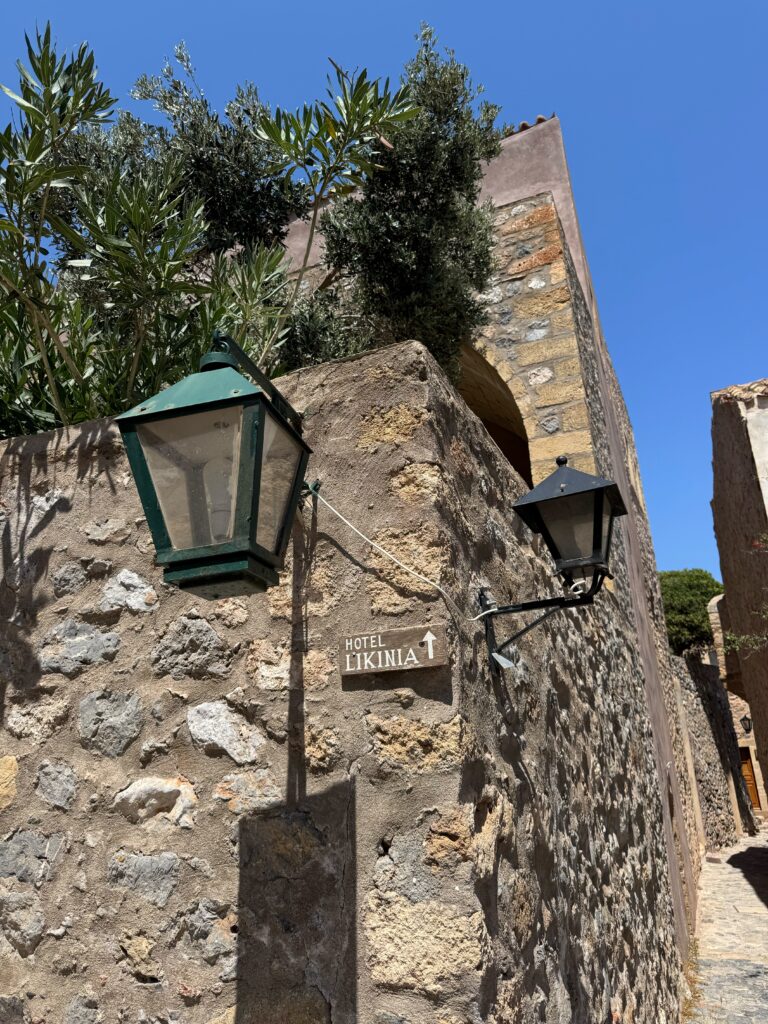
Compounding this issue, plastic tubing and modern energy infrastructure are left fully exposed, snaking across ancient stone walls and winding visibly through alleyways. Maintenance drain covers bear crude, finger-inscribed markings — “DEH,” the initials of Greece’s public power company — etched directly onto the cement covers, a glaring modern intrusion into a medieval environment. Contemporary color paint in metal elements, incompatible materials, and a lack of understanding of their cultural significance further degrade the town’s authenticity.
The bright green-painted public lighting fixtures, many of them damaged or corroded, installed at the beginning of the last century are entirely incompatible with the aesthetics and historical period of Monemvasia. Their appearance evokes a suburban park more than a Byzantine stronghold. And while these unsightly fixtures exist, many areas of the town — including walkways, alleys, and the path leading to the Acropolis — remain completely unlit. After sunset, tourists must use their own lamps or mobile phones to navigate safely.
Cradled by its unique and isolated geography, Monemvasia stands as one of the last medieval towns in Europe untouched by the creeping veil of light pollution—a rare sanctuary where the night sky still unfurls in all its ancient, celestial glory. Beneath the watchful gaze of its acropolis, stars shimmer unbound, gifting both residents and visitors a precious communion with the heavens once known by the older inhabitants of one of the continent’s oldest continuously inhabited fortified towns. Yet even this fragile jewel is under silent threat.
A lingering ignorance of light pollution has allowed harsh, unshielded fixtures to scar the night, dimming a treasure that is among Europe’s rarest—the dark, star-studded skies that Monemvasia alone still claims. Meanwhile, the town’s lighting infrastructure suffers neglect; corroded and loosened by salt and time, its lamps cast uneven, flickering pools of cold LED white light or fail entirely. These silent signs whisper of a deeper disregard—or ignorance—about indirect lighting and the cultural and environmental heritage that makes this place extraordinary. Here, where darkness weaves its own kind of magic, the wrong light—or the absence of light—speaks louder than words.
One cannot help but wonder: If UNESCO officials were to walk Monemvasia’s darkened alleys and gaze upon the modern debris clinging to its medieval bones — what would they say?
In our next article.
This Ancient Greek Town Is Scheduled for Destruction, Here’s What You Need to Know
Sources:

The proposed €6.8 million cable car project in Monemvasia, intended to improve access for tourists and people with mobility challenges, has sparked widespread controversy. Critics—including preservationists, local residents, and archaeologists—warn that it threatens the town’s medieval authenticity, structural integrity, and fragile environment. Despite opposition, the plan has received approval and EU funding, raising concerns about prioritizing tourism over heritage protection. New York Times, May 27, 2025

Monemvasia was named one of Europe’s seven most endangered heritage sites in 2025 due to the planned cable car. Experts argue that the project endangers the site’s visual and cultural integrity, noting a lack of comprehensive environmental assessment and alternatives like a lift being ignored. Conservation bodies demand its immediate reconsideration. To Vima, March 2025

Europa Nostra and the European Investment Bank Institute listed Monemvasia among Europe’s most endangered cultural landmarks, citing the cable car project as a major threat. Opponents stress that it will disrupt the unique topography and propose using a discreet elevator system as a more appropriate solution. Greek City Times, February 19, 2025

The historic community of Monemvasia is deeply divided over the cable car project. Proponents see it as a modernization step, while opponents see it as a destructive vanity project that risks transforming the site into a tourist theme park. Critics emphasize the absence of public consultation and call for restoration of basic infrastructure instead. Vema News, 2025

The €5.6 million cable car initiative in Monemvasia has triggered backlash across Europe, with accusations of cultural vandalism. Local residents and environmental groups fear it will permanently damage the cliffside and medieval structures, while tourism officials defend it as an accessibility improvement. The project is being legally challenged. The Mirror, 2025

Monemvasia’s cable car plan has generated controversy in Greece and abroad, with heritage advocates criticizing the lack of preservation ethics and transparency. The project is viewed as inconsistent with the town’s medieval character and risks undermining its authenticity. Residents demand restoration and humane infrastructure instead. Greek Herald, 2025

Europa Nostra experts, after a site visit, expressed alarm over the project's excessive scale, environmental risk, and lack of transparency. They argue it could damage the cliff, archaeological remnants, and the town’s potential UNESCO World Heritage candidacy. The group urged postponement until full impact studies and public consultation are completed. Ekathimerini, July 25, 2025

Monemvasia’s listing as one of Europe’s most endangered sites is linked to the threat posed by the cable car, with multiple heritage organizations voicing strong objections. Concerns focus on irreversible visual damage, disruption to the medieval setting, and prioritization of profit over preservation. A growing movement urges withdrawal of the plan. Greek Herald, March 2025

International media report that French and Greek heritage organizations strongly oppose the proposed Monemvasia cable car. The concerns include degradation of the landscape, visual pollution, and insufficient environmental review. The project is seen as incompatible with the preservation of one of Greece’s most unique and ancient towns. Libération, Le Journal des Arts, Headtopics

The cable car debate in Monemvasia continues to intensify, with legal, environmental, and cultural objections mounting. Critics argue the initiative risks turning the last living Byzantine town into a commercialized tourist attraction, urging the government and EU to redirect funding to preservation rather than disruption. Ekathimerini, February 15, 2025

The Central Archaeological Council has approved final technical studies for a cable‑car‑style passenger lift system connecting the Upper and Lower Towns. The plan features low‑visibility stations, two cabins, and aims for completion by end of 2025. However, critics—including the Friends of Monemvasia Association and the Association of Greek Archaeologists—warn it may compromise the town’s cultural and environmental value. eRed


What a shame !!!
Deeply troubling to see the last Byzantine medieval town being destroyed, and the fact that it’s deemed ‘too late’ to save it is a stark reminder of our collective failure to preserve our heritage. This isn’t just about losing a town; it’s about erasing a tangible link to our shared history and identity. The apathy towards such irreplaceable sites is not only a cultural tragedy but also a moral one. We must demand accountability and proactive measures to protect our historical treasures before more are lost forever.
Its very sad that this is happening in Europe..
We used to love the unadulterated simplicity, the evocative byzantine archeology, now its just about destruction, and over-tourism.
It’s heartbreaking to see a place as rare and untouched as Monemvasia threatened by modern ill ideas. The beauty of this medieval town lies precisely in its isolation, its silence, and its defiance of time. A cable car may offer convenience, but at what cost? Once the landscape is altered and the integrity of the walls compromised, there’s no going back. We risk trading centuries of history and authenticity for a few minutes of ease. Some places should remain difficult to reach, because that’s part of what makes them sacred.